YayPay Vs CollectDebt.Ai: Comprehensive Comparison Of AI-Powered AR Automation Solutions For 2026

Introduction: YayPay and the Evolution of Accounts Receivable Automation
As businesses navigate the complexities of accounts receivable management in 2026, choosing the right automation platform has become a strategic imperative. YayPay, a well-established accounts receivable automation solution, has long been recognized for its invoice-to-cash capabilities, offering features like automated invoice delivery, payment tracking, and customer self-service portals. However, the AR landscape is rapidly evolving, with artificial intelligence transforming not just operational efficiency but the entire collections paradigm.
This comprehensive comparison examines YayPay alongside CollectDebt.ai, an advanced AI-powered debt collection platform that leverages conversational AI and intelligent automation to deliver superior recovery outcomes. While YayPay focuses primarily on traditional AR automation and workflow optimization, CollectDebt.ai integrates cutting-edge voice AI, omnichannel engagement, and behavioral analytics to address the full spectrum of collections challenges. Understanding the differences between these platforms is critical for organizations seeking to reduce days sales outstanding (DSO), improve cash flow, and minimize bad debt write-offs in an increasingly competitive marketplace.
Understanding YayPay: Core Features and Market Position
YayPay positions itself as an accounts receivable automation platform designed to streamline invoice-to-cash processes for mid-market and enterprise businesses. The solution integrates with popular ERP systems and accounting software to centralize receivables data, automate dunning communications, and provide analytics dashboards for AR teams. Key capabilities include automated invoice delivery via email, customizable payment reminder workflows, online payment portals, and cash application automation.
The platform's strength lies in its ability to digitize manual AR processes, reducing the administrative burden on finance teams. YayPay's customer communication engine enables scheduled reminders based on invoice aging, with templated messages delivered through email channels. The solution also provides basic reporting on collection effectiveness, aging analysis, and customer payment behaviors. For organizations transitioning from spreadsheet-based AR management, YayPay represents a meaningful step toward operational efficiency.
However, YayPay's architecture reflects a traditional approach to receivables management that predates the conversational AI revolution. The platform relies heavily on email-based outreach and lacks the sophisticated voice engagement, right party verification, and real-time behavioral adaptation that define next-generation collection technologies. According to industry research, only 33% of debt collection calls result in a conversation, highlighting the limitations of conventional manual approaches that YayPay's architecture still partially depends upon.
CollectDebt.ai: The Next-Generation AI Collections Platform
CollectDebt.ai represents a fundamentally different approach to accounts receivable and debt collection, built from the ground up on conversational AI and intelligent automation principles. Unlike traditional AR platforms that automate administrative tasks, CollectDebt.ai deploys AI-powered voice agents capable of conducting natural, empathetic collection conversations at scale across multiple channels including voice, SMS, email, and chat.
The platform's core technology stack includes advanced natural language processing (NLP), speech recognition, sentiment analysis, and machine learning models trained specifically for collections scenarios. This enables CollectDebt.ai to handle complex debtor interactions, adapt messaging based on real-time responses, verify party identity through conversational cues, negotiate payment arrangements, and even process payments within the same interaction all while maintaining strict regulatory compliance with FDCPA, TCPA, and other consumer protection laws.
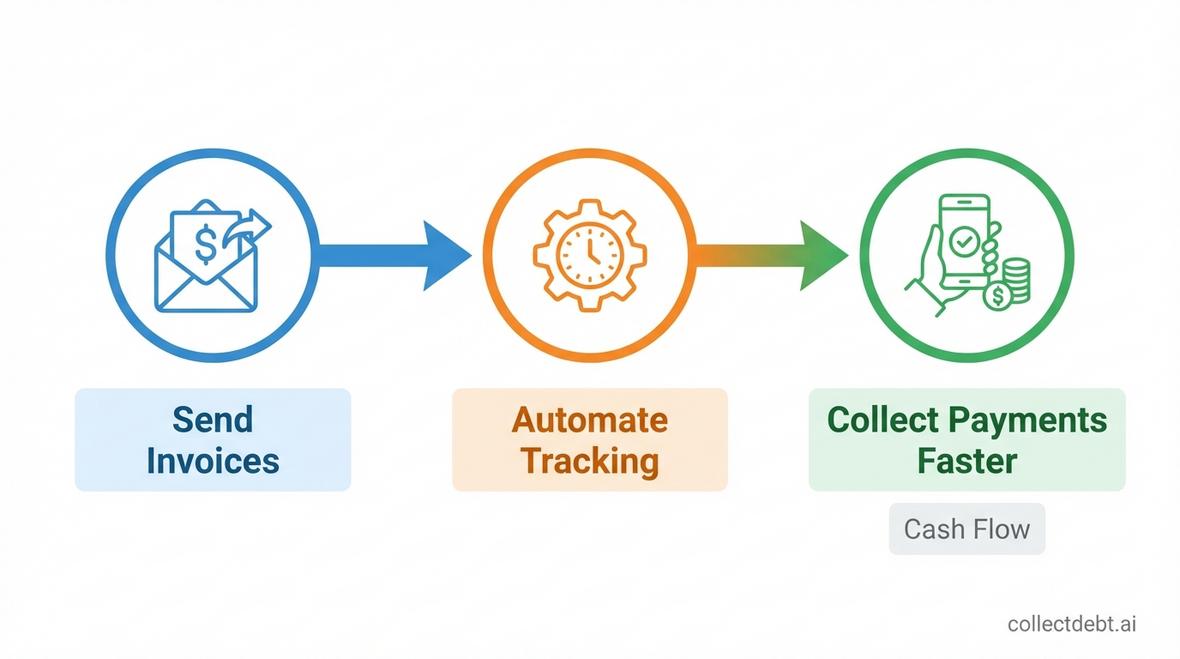
The process illustrated above demonstrates how CollectDebt.ai transforms the traditional collections workflow: invoices are sent through integrated systems, tracking is fully automated with AI monitoring debtor behaviors and engagement patterns, and payments are collected faster through intelligent, multi-touch campaigns that optimize contact timing, channel preference, and message personalization. This results in measurably improved cash flow compared to legacy AR automation approaches.
Head-to-Head Feature Comparison: YayPay vs CollectDebt.ai
Communication Channels and Engagement Methods
YayPay primarily leverages email-based communication with some SMS capabilities for payment reminders. The platform sends scheduled dunning messages according to predefined workflows, with limited personalization based on customer segments or payment history. While effective for early-stage reminders to cooperative customers, this approach lacks the multi-channel sophistication needed to reach diverse debtor populations with varying communication preferences.
CollectDebt.ai delivers true omnichannel engagement, seamlessly orchestrating outreach across voice calls, SMS, email, web chat, and customer portals. The platform's AI determines optimal contact channels and timing for each individual debtor based on historical response patterns, demographic data, and real-time availability signals. This adaptive approach significantly increases contact rates and conversation quality compared to static email sequences.
Automation Capabilities and Intelligence
YayPay automates workflow tasks such as invoice distribution, reminder scheduling, and payment matching. The platform follows rule-based logic configured by AR administrators, executing predefined actions when specific conditions are met (e.g., sending a second reminder seven days after the first). This deterministic automation reduces manual effort but cannot adapt to individual debtor circumstances or optimize strategies based on engagement outcomes.
CollectDebt.ai employs machine learning and behavioral analytics to continuously optimize collection strategies. The platform's AI analyzes millions of interaction data points to identify patterns predicting payment likelihood, preferred contact times, and effective messaging approaches for different debtor segments. This intelligence enables dynamic strategy adjustment, automated escalation pathways, and predictive prioritization that maximizes collector productivity and recovery rates.
Voice AI and Conversational Technology
YayPay does not offer native voice AI or automated calling capabilities. Organizations using YayPay for AR automation must rely on separate contact center solutions or manual calling processes for phone-based collections, creating operational silos and limiting the platform's effectiveness for accounts requiring direct conversation.
CollectDebt.ai's voice AI technology represents a core differentiator, enabling automated outbound and inbound collection calls that sound natural and empathetic. The platform's AI agents can handle complex conversations including objection handling, financial hardship discussions, payment plan negotiations, and dispute resolution all while maintaining compliance with regulatory requirements. This capability is particularly valuable given that research shows invoices 90+ days past due have only 50% collection probability, requiring more intensive engagement than email alone can provide.
Self-Service and Payment Resolution
Both platforms offer self-service payment portals where customers can view outstanding balances and submit payments online. YayPay's portal provides basic functionality including invoice viewing, payment processing, and dispute submission through web forms. The interface integrates with the company's existing payment processing infrastructure to facilitate credit card, ACH, and other electronic payment methods.
CollectDebt.ai elevates self-service through AI-guided resolution workflows that proactively assist debtors in finding viable payment solutions. The platform's intelligent portal recommends payment plans based on the debtor's stated financial capacity, automatically calculates settlement options within defined parameters, and uses conversational interfaces to guide users through complex resolution processes. This assisted self-service approach dramatically increases resolution rates while reducing the need for live agent intervention.
Compliance and Risk Management
Given the heavily regulated nature of collections activities, compliance capabilities represent a critical evaluation criterion for any AR automation solution. YayPay maintains compliance documentation and provides audit trails for communication activities, helping organizations demonstrate adherence to basic consumer protection requirements. The platform includes opt-out management for communication preferences and maintains records of all automated contacts sent through the system.
CollectDebt.ai implements compliance as a foundational architectural principle, with AI models specifically trained to recognize and avoid regulatory violations in real-time conversations. The platform automatically delivers Mini Miranda warnings during initial contacts, respects time-of-day restrictions across time zones, manages cease-and-desist requests instantaneously, and performs right party verification before discussing debt details. Post-call analysis reviews every interaction for compliance adherence, flagging potential issues for quality assurance review. This proactive approach significantly reduces regulatory risk compared to platforms relying primarily on user configuration and manual oversight.
Integration Ecosystem and Technical Architecture
YayPay offers native integrations with major ERP systems including NetSuite, Microsoft Dynamics, Sage Intacct, and QuickBooks, as well as connections to payment processors and banks. These integrations enable automated data synchronization for invoice creation, payment application, and customer master data. Implementation typically requires IT involvement for configuration and testing, with moderate technical complexity depending on the existing technology stack.
CollectDebt.ai provides extensive integration capabilities spanning not only accounting and ERP systems but also CRM platforms, payment gateways, dialer infrastructures, and analytics tools. The platform's API-first architecture enables custom integrations for specialized requirements, while pre-built connectors accelerate deployment for common systems. Notably, CollectDebt.ai can integrate with existing YayPay or similar AR automation platforms, enhancing them with advanced AI collection capabilities rather than requiring complete replacement a consideration for organizations with existing technology investments.
Industry-Specific Applications and Use Cases
YayPay serves a broad range of B2B companies across industries including professional services, manufacturing, distribution, and technology. The platform's generalized AR automation approach works reasonably well for organizations with relatively cooperative customer bases and straightforward payment terms. However, industries with more complex collection challenges or specific regulatory requirements may find YayPay's capabilities insufficient for their needs.
CollectDebt.ai delivers specialized solutions for high-complexity collection environments including healthcare, where patient responsibility balances require empathetic engagement and regulatory sensitivity; auto finance, where rapid contact is critical to preventing repossession losses; utilities and telecom, where high-volume consumer collections demand scalability; and financial services, where compliance requirements are particularly stringent. The platform's industry-specific AI models and workflow templates enable faster deployment and better outcomes for these specialized use cases.
Performance Metrics and Business Outcomes
Organizations implementing YayPay typically report improvements in AR team efficiency, with metrics such as reduced time spent on manual invoice follow-up, decreased payment processing time, and improved visibility into receivables aging. These operational benefits translate to modest DSO reductions for companies previously managing AR through entirely manual processes. However, actual collection effectiveness the percentage of outstanding debt ultimately recovered shows limited improvement with traditional AR automation alone.
CollectDebt.ai deployments demonstrate significantly stronger performance across both operational and financial metrics. The platform's AI-driven approach increases contact rates by 40-60% compared to manual calling, improves promise-to-pay conversion rates by 35-50%, and accelerates cash collection by 20-35% according to client case studies. Industry data indicates that nearly half of B2B invoices remain overdue in North America, representing a massive opportunity for solutions that can meaningfully improve collection effectiveness beyond basic automation.
Total Cost of Ownership and ROI Analysis
YayPay pricing typically follows a subscription model based on annual invoice volume or transaction counts, with costs ranging from mid-tier SaaS pricing for smaller implementations to enterprise-level fees for large deployments. Organizations must also account for integration costs, ongoing system administration, and the continued staffing requirements for collections activities that cannot be fully automated through the platform's email-based approach.
CollectDebt.ai's pricing reflects the advanced AI technology and superior outcomes delivered, with models based on accounts under management, contact volume, or performance-based arrangements tying costs directly to collections results. While the platform may carry higher nominal software costs than basic AR automation, the total cost of ownership is typically lower when accounting for reduced staffing needs, improved recovery rates, and accelerated cash flow. The ROI calculation must consider not just operational efficiency but actual incremental collections the metric that ultimately drives business value.
Implementation Timeline and Change Management
YayPay implementations generally require 4-12 weeks depending on integration complexity, data migration requirements, and workflow customization needs. The platform requires configuration of dunning rules, email templates, and reporting dashboards, along with training for AR staff on the new system. Organizations should anticipate moderate change management challenges as teams adapt to new processes and interfaces.
CollectDebt.ai implementations range from rapid deployments (2-4 weeks for standard configurations) to more complex enterprise rollouts (8-16 weeks) involving extensive integration, custom AI model training, and phased account migration. The platform's intuitive interfaces and automated capabilities actually reduce training requirements compared to traditional systems, as much of the collection logic resides within the AI rather than requiring manual execution by staff. Dedicated implementation teams and change management support are typically included to ensure successful adoption.
Scalability and Future-Readiness
As collection portfolios grow or business needs evolve, platform scalability becomes increasingly important. YayPay can scale to handle larger invoice volumes and additional users within its architectural constraints, though the email-centric communication model may limit effectiveness as accounts age or become more challenging. The platform's feature development follows traditional enterprise software cycles, with major enhancements delivered through periodic releases.
CollectDebt.ai's cloud-native architecture and AI-driven approach enable virtually unlimited scalability, handling millions of accounts and interactions without performance degradation. The platform's machine learning models actually improve with scale, as larger data sets enhance prediction accuracy and strategy optimization. Continuous AI model updates and feature enhancements are deployed automatically, ensuring organizations always benefit from the latest capabilities without disruptive upgrade cycles. This future-ready architecture positions CollectDebt.ai as a long-term strategic platform rather than a point solution.
Making the Right Choice for Your Organization
Selecting between YayPay and CollectDebt.ai ultimately depends on your organization's specific needs, collection challenges, and strategic objectives. YayPay may be appropriate for businesses seeking basic AR workflow automation, managing primarily B2B receivables with cooperative customers, and lacking the budget or appetite for advanced AI technology. The platform delivers incremental improvements over manual processes at a moderate price point.
However, organizations facing serious collection challenges high delinquency rates, large volumes of aged receivables, diverse debtor populations, or industry-specific compliance requirements will find CollectDebt.ai's advanced capabilities essential for achieving meaningful business outcomes. The platform's AI-driven approach doesn't just automate existing processes; it fundamentally transforms collection effectiveness through intelligent engagement, behavioral adaptation, and continuous optimization. For companies where cash flow, DSO reduction, and bad debt minimization represent strategic priorities, CollectDebt.ai delivers measurably superior results that justify the investment. Learn more about implementing AI-powered accounts receivable solutions for your organization.
Frequently Asked Questions
Can CollectDebt.ai integrate with YayPay?
Yes, CollectDebt.ai can integrate with YayPay and other AR automation platforms through APIs, enhancing existing systems with advanced AI collection capabilities without requiring complete replacement of current technology investments.
Does YayPay offer voice-based collection capabilities?
No, YayPay focuses primarily on email-based communication and does not provide native voice AI or automated calling features for collections activities.
Which platform is better for healthcare collections?
CollectDebt.ai offers specialized capabilities for healthcare collections including empathetic AI conversations, patient financial counseling workflows, and healthcare-specific compliance features that YayPay does not provide.
How do the platforms compare on compliance management?
While YayPay provides basic compliance documentation and audit trails, CollectDebt.ai implements real-time compliance monitoring, automated regulatory adherence in conversations, and comprehensive risk management frameworks specifically designed for collections regulations.
What is the typical ROI timeline for each platform?
YayPay implementations may show ROI in 6-12 months through operational efficiency gains, while CollectDebt.ai often delivers positive ROI within 3-6 months through accelerated collections and improved recovery rates in addition to efficiency benefits.
Conclusion
The choice between YayPay and CollectDebt.ai reflects a fundamental decision about your organization's approach to accounts receivable management. YayPay offers solid AR automation for basic workflow digitization, while CollectDebt.ai delivers transformative AI-powered collection capabilities that address the full spectrum of recovery challenges. As collection complexity increases and competitive pressures intensify, the advanced engagement, intelligence, and adaptability of platforms like CollectDebt.ai become not just advantageous but essential. Organizations serious about optimizing cash flow, reducing DSO, and minimizing bad debt should carefully evaluate how next-generation AI collection technology can deliver superior business outcomes compared to traditional AR automation approaches.
Ready to Transform Your Collections Process?
See how CollectDebt.ai can help you automate debt collection, reduce costs, and improve compliance.