What Can A Third-Party Collection Agency Do? Complete Guide To Powers, Limits & Compliance

When debt becomes delinquent, creditors often turn to third-party collection agencies to recover outstanding balances. But what can a third-party collection agency do, and what legal boundaries govern their actions? Understanding the scope of third-party collection activities is critical for decision-makers in debt recovery operations, especially those evaluating AI-powered debt collection solutions to enhance efficiency and compliance.
Third-party collection agencies operate under strict federal and state regulations, primarily governed by the Fair Debt Collection Practices Act (FDCPA). These agencies are hired by original creditors to pursue payment on their behalf, and while they possess significant tools to facilitate recovery, their actions are carefully circumscribed to protect consumer rights. This comprehensive guide explores the full spectrum of what third-party collection agencies can and cannot do, the regulatory framework that governs them, and how modern technology is transforming the collections landscape.
Understanding Third-Party Collection Agencies
A third-party collection agency is an external entity contracted by creditors to recover delinquent accounts. Unlike first-party collectors who work directly for the original creditor, third-party agencies operate independently and typically receive a percentage of the recovered debt as compensation, usually ranging from 25% to 50% of the collected amount.
These agencies specialize in debt recovery across multiple industries, including healthcare, financial services, utilities and telecom, and auto finance. Their core function is to bridge the gap between creditor expectations and debtor payment capacity, employing a range of communication strategies and legal mechanisms to facilitate resolution.
What Third-Party Collection Agencies Can Legally Do
Understanding what can a third-party collection agency do begins with recognizing their legally permissible activities. These powers are substantial but always subject to consumer protection laws.
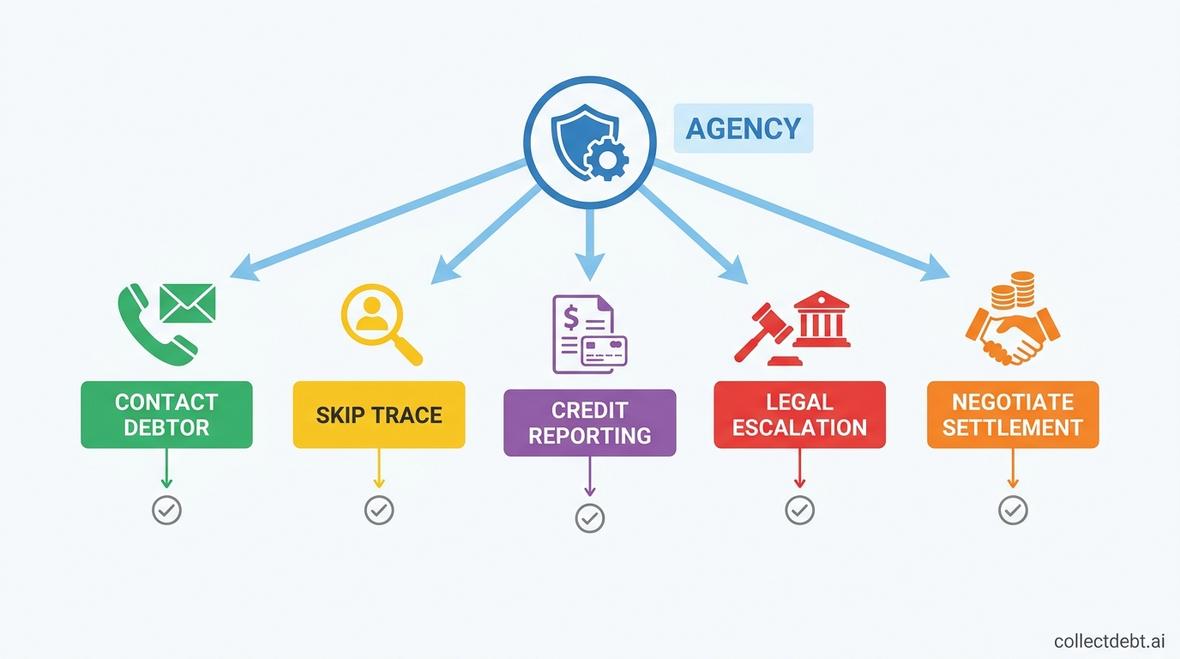
Contact Debtors Through Multiple Channels
Third-party collection agencies can initiate contact with debtors through various communication channels, including telephone calls, written correspondence, emails, and text messages. According to the Consumer Financial Protection Bureau (CFPB) overview of debt collector rules, collectors may contact consumers between 8 a.m. and 9 p.m. in the consumer's local time zone, though frequency limits apply to prevent harassment.
Modern agencies increasingly leverage omnichannel support to reach debtors where they are most responsive. This multi-touch approach respects consumer preferences while maximizing contact rates, a critical factor when industry right-party contact rates average only 30-40% through traditional methods.
Verify Debt and Provide Validation
Collection agencies must provide debtors with validation information either in their initial communication or within five days of first contact. This validation notice must include the amount owed, the name of the creditor, and a statement informing the consumer of their right to dispute the debt within 30 days.
This verification requirement protects consumers from erroneous collection attempts and ensures transparency. Agencies that fail to provide proper validation risk regulatory penalties and litigation. Advanced platforms now automate validation delivery through self-service debt resolution portals, ensuring compliance while reducing manual workload.
Negotiate Payment Arrangements
One of the most important functions of third-party agencies is negotiating payment plans that work within a debtor's financial capacity. Collectors can offer settlement options, extended payment schedules, or reduced balances in exchange for immediate payment.
The ability to negotiate settlements is particularly valuable for both parties. Creditors recover a portion of the debt rather than writing it off entirely, while debtors gain manageable repayment terms. Modern AI systems enhance this process through promise-to-pay features that automatically generate personalized payment schedules based on debtor financial profiles and historical payment behavior.
Conduct Skip Tracing
When debtors cannot be reached at known contact information, collection agencies employ skip tracing investigative techniques to locate individuals who have moved or changed their contact details. This can include searching public records, credit databases, utility connections, and other legal information sources.
Skip tracing must be conducted within legal boundaries and cannot involve deceptive practices. Agencies cannot misrepresent their identity or purpose when contacting third parties for location information. The effectiveness of skip tracing has improved dramatically with data analytics and machine learning, which can predict likely locations and contact methods with greater accuracy.
Report to Credit Bureaus
Third-party collection agencies can report delinquent accounts to the three major credit bureaus Experian, Equifax, and TransUnion. This reporting can significantly impact a consumer's credit score, potentially lowering it by 50 to 100 points or more depending on the account size and prior credit history.
However, agencies must ensure the accuracy of reported information. The Fair Credit Reporting Act (FCRA) requires collectors to investigate disputes and correct inaccurate information promptly. Recent regulatory changes have also introduced requirements around medical debt reporting and validation before reporting, adding complexity to credit bureau communications.
Pursue Legal Action
When other collection efforts fail, third-party agencies can initiate legal proceedings to recover debts. This may include filing lawsuits in civil court to obtain judgments against debtors. Once a judgment is secured, agencies may pursue wage garnishment, bank account levies, or property liens, depending on state law.
Legal action represents a significant escalation and is typically reserved for larger debts where the cost of litigation is justified by the potential recovery. According to data from the CFPB consumer complaints database, lawsuits and judgments represent a substantial portion of consumer complaints about debt collection, highlighting the need for agencies to ensure proper documentation and legal compliance before pursuing court action.
Utilize Automated Communication Systems
Collection agencies can employ automated calling systems, including predictive dialers and AI voice agents, to increase contact rates and operational efficiency. These systems must comply with the Telephone Consumer Protection Act (TCPA), which restricts certain automated communications and requires prior express consent for calls to cell phones using automated dialing systems.
AI-powered systems like those offered through CollectDebt.ai's AI debt collection platform are transforming this space by enabling natural, compliant conversations at scale. These systems can handle inbound conversational AI interactions, process payments, and even perform right-party verification autonomously, significantly reducing cost-per-contact while maintaining regulatory compliance.
What Third-Party Collection Agencies Cannot Do
While third-party agencies possess considerable authority, federal and state laws strictly prohibit numerous practices to protect consumer rights. Understanding these boundaries is essential for compliance and risk management.
Harassment and Abusive Conduct
The FDCPA explicitly prohibits harassment, oppression, or abuse in connection with debt collection. This includes repeated phone calls intended to annoy, the use of obscene or profane language, threats of violence, and publishing lists of consumers who refuse to pay debts.
Collectors cannot call repeatedly with the intent to harass, though the FDCPA does not specify an exact number of permissible calls. Recent CFPB regulations clarify that calling more than seven times within seven consecutive days, or within seven days after having a phone conversation about the debt, creates a presumption of harassment.
False or Misleading Representations
Debt collectors cannot make false statements or misrepresent material facts. Prohibited misrepresentations include falsely claiming to be attorneys, government representatives, or credit bureau employees; misrepresenting the amount or legal status of the debt; or threatening actions that are not legally permissible or that the agency does not intend to take.
These prohibitions extend to communications with third parties. Collectors cannot disclose debt information to employers, neighbors, or family members except in very limited circumstances, and they cannot use deceptive practices to obtain location information.
Unfair Practices
The FDCPA prohibits unfair collection practices, including collecting amounts not authorized by the agreement or law, depositing post-dated checks prematurely, and threatening to repossess property when there is no legal right or intention to do so.
Collectors also cannot communicate with consumers at times or places known to be inconvenient, such as before 8 a.m. or after 9 p.m., or at the consumer's workplace if the employer prohibits such communications. Modern systems address these constraints through intelligent scheduling and batch calling features that respect time zones and do-not-call windows automatically.
Ignore Cease-and-Desist Requests
When a consumer submits a written request to cease communication, the collection agency must stop contacting them, with limited exceptions. After receiving such a request, the agency can only contact the consumer to confirm cessation of communication, notify them of specific actions (such as filing a lawsuit), or inform them that collection efforts are being terminated.
This requirement places significant importance on documentation and workflow management. Platforms with integrated compliance management features automatically flag accounts with cease-and-desist requests, preventing inadvertent violations.
Pursue Time-Barred Debts Improperly
While collectors can attempt to collect on time-barred debts (debts beyond the statute of limitations for legal action), they cannot threaten or pursue litigation on such debts. They also cannot use language that implies legal action is possible when it is not.
Many states have specific disclosure requirements when attempting to collect time-barred debt, and some prohibit the practice entirely. Agencies must maintain sophisticated systems to track statutes of limitations across jurisdictions and ensure communications comply with applicable state laws.
Regulatory Framework Governing Third-Party Collections
Third-party collection agencies operate within a complex regulatory environment that includes federal laws, state regulations, and industry-specific rules.
Fair Debt Collection Practices Act (FDCPA)
The FDCPA, enforced by the Federal Trade Commission and the CFPB, is the primary federal law governing third-party debt collection. It applies to third-party collectors and debt buyers but generally does not cover first-party creditors collecting their own debts.
Recent amendments and interpretations have expanded FDCPA coverage to include modern communication methods, including email, text messages, and social media, providing clearer guidance on permissible practices in digital channels.
Telephone Consumer Protection Act (TCPA)
The TCPA restricts telemarketing calls, autodialed calls, prerecorded messages, and text messages, particularly to mobile phones. Violations can result in penalties of $500 to $1,500 per call, making TCPA compliance a critical concern for collection agencies using automated calling systems.
For agencies leveraging automated debt collection calls, implementing consent management systems and maintaining detailed call logs is essential to mitigate TCPA risk.
State Regulations
Many states have enacted their own debt collection laws that may be more restrictive than federal requirements. For example, some states limit the interest and fees that can be collected, impose shorter statutes of limitations, or require specific licensing for collection agencies.
Agencies operating across multiple states must navigate this patchwork of regulations carefully. Compliance management systems that incorporate jurisdiction-specific rules are invaluable for ensuring adherence to varying state requirements.
The Role of Technology in Modern Third-Party Collections
Technology is fundamentally transforming what third-party collection agencies can do, improving both efficiency and compliance while reducing operational costs.
AI-Powered Collection Platforms
Artificial intelligence is revolutionizing debt collection by enabling personalized, compliant, and scalable interactions. CollectDebt.ai represents the forefront of this transformation, offering conversational AI that can handle thousands of simultaneous collection interactions with natural language understanding and empathetic communication.
These platforms use machine learning to analyze debtor behavior, predict payment likelihood, and optimize communication strategies in real time. By automating routine interactions, agencies can focus human collectors on complex cases requiring negotiation or empathy, significantly improving overall recovery rates while reducing cost-per-dollar-collected.
Compliance Automation
Given the complexity of debt collection regulations, automated compliance systems are increasingly essential. These systems monitor communications for prohibited language, enforce time-of-day restrictions, manage cease-and-desist lists, and maintain detailed audit trails for regulatory examinations.
Platforms with built-in compliance features reduce the risk of violations that can result in costly penalties, litigation, and reputational damage. They also enable agencies to adapt quickly to regulatory changes without extensive manual process updates.
Data Analytics and Segmentation
Advanced analytics allow agencies to segment accounts based on likelihood to pay, preferred communication channels, and optimal contact times. This data-driven approach improves efficiency by focusing resources on accounts with the highest recovery potential.
Predictive models can identify accounts at risk of default earlier in the delinquency cycle, enabling proactive intervention before accounts are charged off. This early-stage engagement often results in higher recovery rates and better customer relationships.
Omnichannel Communication
Modern consumers expect to communicate through their preferred channels, whether phone, email, SMS, or web portals. Third-party agencies that offer seamless omnichannel experiences see significantly higher engagement rates.
Integrated platforms enable debtors to start a conversation via phone, continue it through text, and complete payment through a self-service portal, all while maintaining context and compliance across channels. This flexibility improves both the debtor experience and collection outcomes.
Best Practices for Third-Party Collection Agencies
To maximize recovery while maintaining compliance and protecting brand reputation, third-party collection agencies should adhere to industry best practices.
Prioritize Compliance Training
Regular training on FDCPA, TCPA, and state-specific regulations is essential for all collection staff. Even with automated systems, human oversight remains critical, and well-trained collectors are the first line of defense against violations.
Implement Robust Quality Assurance
Systematic call monitoring, script review, and post-call analysis help identify compliance risks and training opportunities. Quality assurance should include both automated monitoring and human review to catch subtle issues that technology might miss.
Leverage Self-Service Options
Offering self-service debt resolution portals reduces operational costs while providing debtors with convenient, low-pressure payment options. Many consumers prefer to manage their debts digitally, and self-service options can significantly improve engagement rates.
Personalize Communication Strategies
One-size-fits-all collection approaches are increasingly ineffective. Using data analytics to tailor communication frequency, channel, and messaging to individual debtor profiles improves outcomes while reducing complaints.
Maintain Detailed Documentation
Comprehensive records of all communications, payment arrangements, and disputes are essential for regulatory compliance and litigation defense. Automated systems that capture and store interaction data reduce the administrative burden while improving record accuracy.
Measuring Third-Party Collection Agency Performance
Understanding what can a third-party collection agency do also means evaluating how effectively they perform these functions. Key performance indicators for collection agencies include:
- Liquidation Rate: The percentage of placed debt that is recovered, typically benchmarked by account age and industry.
- Right Party Contact Rate: The percentage of outreach attempts that successfully reach the intended debtor, a critical metric for assessing operational efficiency.
- Promise-to-Pay Conversion: The percentage of contacts that result in payment commitments, indicating the effectiveness of negotiation strategies.
- Cost Per Dollar Collected: The operational cost required to recover each dollar of debt, with AI-powered solutions often reducing this metric by 40-60% compared to traditional call centers.
- Compliance Score: The rate of regulatory violations or consumer complaints, reflecting the agency's adherence to legal requirements.
Agencies leveraging AI-powered debt collection solutions consistently demonstrate superior performance across these metrics, combining scalability with compliance and improved debtor experience.
Industry-Specific Considerations
Different industries face unique challenges in third-party collections, requiring specialized approaches.
Healthcare Collections
Medical debt collection involves additional regulatory considerations, including HIPAA privacy requirements and restrictions on credit reporting for medical debts. Agencies serving healthcare clients must balance aggressive recovery with patient satisfaction and provider reputation.
Financial Services Collections
Banks and credit unions require collection partners who understand consumer lending regulations, including Truth in Lending Act disclosures and state usury laws. Financial services collections often involve higher-value accounts requiring sophisticated negotiation and litigation capabilities.
Utilities and Telecom Collections
These industries face high-volume, lower-balance accounts with specific regulatory frameworks around service disconnection and restoration. Effective utilities and telecom collection strategies emphasize early intervention and payment plan flexibility to maintain customer relationships.
The Future of Third-Party Collections
The debt collection industry is undergoing rapid transformation driven by technology, regulatory evolution, and changing consumer expectations. Key trends shaping the future include:
- Increased Automation: AI and machine learning will handle an ever-larger share of routine collection interactions, with human collectors focusing on complex negotiations and high-value accounts.
- Enhanced Personalization: Data analytics will enable hyper-personalized collection strategies tailored to individual debtor financial situations, communication preferences, and payment capacity.
- Regulatory Expansion: Expect continued regulatory attention to collection practices, particularly around emerging communication channels and consumer data protection.
- Integration with Creditor Systems: Deeper integrations between creditor and agency systems will enable real-time data sharing, faster account placement, and more coordinated collection strategies.
Agencies that embrace these trends while maintaining unwavering commitment to compliance will thrive in the evolving collections landscape.
Frequently Asked Questions
Can a third-party collection agency garnish my wages without a court order?
No. Wage garnishment requires a court judgment. A collection agency must first sue the debtor, obtain a judgment, and then seek a garnishment order from the court. Federal and state laws limit the amount that can be garnished, typically 25% of disposable earnings or the amount by which weekly earnings exceed 30 times the federal minimum wage, whichever is less.
How many times can a collection agency legally call me?
The FDCPA does not specify an exact number, but recent CFPB regulations create a presumption of harassment if a collector calls more than seven times within seven consecutive days or within seven days after having a phone conversation about the debt. However, excessive calls intended to annoy or harass violate the law regardless of the specific number.
Can collection agencies contact me on social media?
Yes, but with significant restrictions. Collectors can send private messages on social media but cannot publicly post about the debt or communicate in ways that disclose the debt to third parties. They must identify themselves and disclose the communication is from a debt collector.
What should I do if a collection agency violates the FDCPA?
Document the violation with detailed notes, recordings if legal in your state, and correspondence. File a complaint with the CFPB and your state attorney general's office. You may also have grounds to sue the collector in state or federal court within one year of the violation, potentially recovering damages up to $1,000 plus attorney fees.
Can a collection agency reopen a settled account?
Once a debt is settled and you have written confirmation of the settlement, the agency cannot attempt to collect additional amounts beyond the agreed settlement. If they do, this constitutes a violation of the settlement agreement and potentially the FDCPA. Always obtain written settlement agreements before making payment.
Conclusion
Understanding what can a third-party collection agency do is essential for both creditors evaluating collection partners and consumers navigating debt recovery. These agencies possess substantial legal authority to contact debtors, negotiate settlements, report to credit bureaus, and pursue legal action but always within the boundaries established by the FDCPA and related consumer protection laws. Modern technology, particularly AI-powered platforms like CollectDebt.ai, is transforming the collections landscape by enhancing efficiency, personalizing communication, and ensuring compliance at scale. As the industry continues to evolve, agencies that balance aggressive recovery with regulatory adherence and respect for consumer rights will achieve the best outcomes for all stakeholders.
Ready to Transform Your Collections Process?
See how CollectDebt.ai can help you automate debt collection, reduce costs, and improve compliance.