Decagon Vs Intercom: Which Customer Support Platform Works For Debt Collection In 2026?

Introduction
In the evolving landscape of customer engagement platforms, decision-makers in debt collection and accounts receivable management are increasingly evaluating solutions beyond traditional customer support tools. The comparison of Decagon vs Intercom surfaces frequently among operations directors and collections managers who seek AI-powered communication capabilities. However, neither platform was purpose-built for the unique compliance, automation, and recovery optimization challenges facing modern collection agencies.
While Decagon and Intercom excel in general customer support scenarios, debt collection requires specialized features including FDCPA and TCPA compliance frameworks, right-party verification, payment negotiation workflows, and multi-channel debtor engagement. This comprehensive analysis examines how Decagon vs Intercom stack up for collections use cases and introduces collectdebt.ai as the purpose-built alternative designed specifically for maximizing recovery rates while minimizing operational costs and regulatory risk.
Understanding Decagon and Intercom: Core Capabilities
What Is Decagon?
Decagon is an AI-powered customer support platform that leverages large language models to automate responses, resolve tickets, and handle routine inquiries. The platform focuses on reducing support workload through intelligent automation, natural language processing, and integration with existing helpdesk systems. Decagon's strength lies in its ability to understand context from previous interactions and provide consistent, accurate responses across support channels.
For general SaaS companies and e-commerce businesses, Decagon offers significant value by deflecting routine questions and scaling support operations without proportional headcount increases. The platform can handle inquiries about product features, account status, and basic troubleshooting with minimal human intervention.
What Is Intercom?
Intercom has established itself as a comprehensive customer communication platform that combines live chat, chatbots, product tours, and targeted messaging. The platform emphasizes proactive engagement, enabling businesses to reach customers at critical moments in their journey. Intercom's messenger appears across web and mobile applications, providing a unified communication channel for sales, support, and marketing teams.
With sophisticated segmentation capabilities, workflow automation, and a robust API, Intercom serves businesses looking to create personalized customer experiences at scale. The platform's Resolution Bot uses machine learning to suggest relevant help articles and automate simple support requests, while more complex issues route to human agents.
Decagon vs Intercom: Direct Feature Comparison
When evaluating Decagon vs Intercom for general support purposes, several distinctions emerge. Decagon prioritizes AI-first automation with deeper language model integration, while Intercom offers a broader suite of engagement tools including marketing automation and product onboarding features. Decagon typically demonstrates stronger performance in complex query resolution without human intervention, whereas Intercom provides more comprehensive customer journey mapping and proactive engagement capabilities.
Both platforms integrate with popular CRM and helpdesk systems, support multiple communication channels, and offer analytics dashboards for monitoring performance metrics. However, neither platform addresses the specific regulatory, workflow, and outcome requirements inherent to debt collection operations.
Why Debt Collection Requires Specialized Solutions
Regulatory Compliance Frameworks
Debt collection operates under stringent federal and state regulations that general customer support platforms do not address. The Fair Debt Collection Practices Act (FDCPA) mandates specific disclosure requirements, restricts communication times and methods, and prohibits certain collection practices. The Telephone Consumer Protection Act (TCPA) imposes additional constraints on automated calling and text messaging to debtors.
According to Federal Reserve: Collections Compliance and Regulatory Requirements, regulatory violations in automated collections carry substantial penalties, with enforcement actions increasingly targeting firms that fail to implement adequate safeguards in their communication systems. A purpose-built collections platform must embed these compliance requirements into every interaction, ensuring proper disclosures, honoring opt-out requests, and maintaining detailed audit trails.
General platforms like those in the Decagon vs Intercom comparison lack these built-in compliance frameworks. Implementing manual workarounds introduces significant risk and operational overhead, as collections teams must constantly monitor conversations for regulatory violations that the platform itself cannot prevent or flag.
Specialized Collection Workflows
Effective debt recovery requires workflows fundamentally different from standard customer support. Collections conversations must accomplish specific objectives: verify debtor identity, present account information compliantly, negotiate payment arrangements, process payments securely, and document promises to pay. These interactions follow structured patterns that optimize for financial outcomes rather than customer satisfaction scores.
Right-party verification represents a critical workflow component absent from general support platforms. Before discussing account details, collectors must confirm they're speaking with the actual debtor or authorized party. This process involves specific questioning sequences and documentation requirements that standard chatbots cannot execute properly.
Similarly, promise-to-pay workflows require sophisticated logic to evaluate proposed payment schedules against account parameters, calculate settlement offers, and secure binding commitments. These capabilities extend far beyond the ticket resolution or inquiry handling focus of platforms like Decagon and intercom.
Recovery Rate Optimization
While general support platforms optimize for metrics like first response time, ticket resolution rate, and customer satisfaction, collections platforms must prioritize fundamentally different outcomes: liquidation rate, right-party contact rate, promise-to-pay conversion, and dollars collected per account. Every feature and workflow should contribute directly to maximizing recoveries while minimizing cost per dollar collected.
This outcome focus requires capabilities including predictive dialing optimization, channel preference learning, optimal contact time modeling, and payment plan performance tracking. The AI models powering collections automation must train on recovery outcomes rather than satisfaction surveys, learning which communication strategies actually drive payment behavior rather than simply closing tickets.
CollectDebt.ai: The Purpose-Built Alternative
Compliance-First Architecture
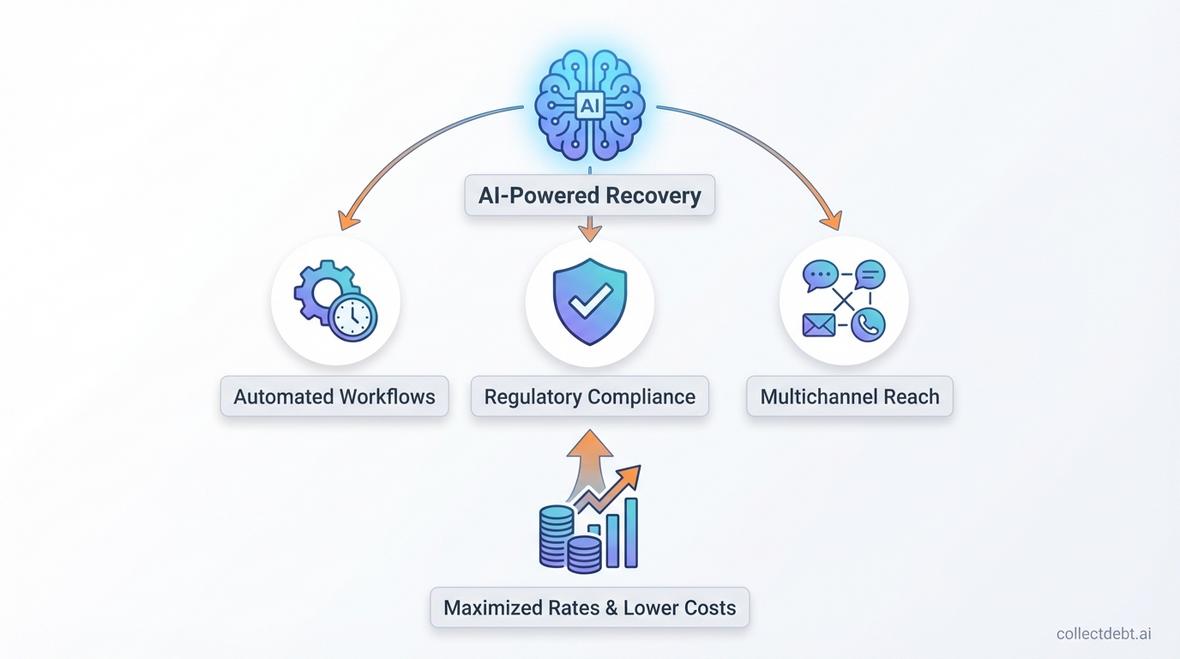
Unlike general platforms in the Decagon vs Intercom discussion, collectdebt.ai builds compliance into its foundational architecture. Every communication channel voice, SMS, email, or chat automatically includes required disclosures, respects communication preferences, and maintains comprehensive documentation for regulatory audits. The platform continuously updates its compliance logic as regulations evolve, ensuring agencies remain protected without manual policy updates.
The system automatically flags potentially problematic interactions before they occur, preventing violations rather than simply logging them after the fact. When debtors invoke their rights under FDCPA such as requesting cease communication or disputing the debt the platform immediately implements the required workflow changes across all channels and documents the request with timestamp precision.
AI-Powered Recovery Optimization
CollectDebt.ai's AI models train specifically on debt recovery outcomes, learning which communication strategies, timing, channels, and messaging drive actual payment behavior. The platform's conversational AI understands the nuances of collection conversations, recognizing payment objections, financial hardship indicators, and commitment signals that generic language models miss.
The system dynamically adjusts its approach based on debtor responses, escalating to payment-focused strategies when detecting ability and willingness to pay, or shifting to empathetic hardship workflows when appropriate. This contextual intelligence dramatically outperforms the one-size-fits-all responses of general support platforms, directly impacting recovery rates and operational efficiency.
Omnichannel Debtor Engagement
Modern debtors expect communication flexibility across their preferred channels. CollectDebt.ai provides seamless omnichannel support that maintains conversation context whether debtors engage via phone, SMS, email, or web chat. A debtor might receive an initial SMS reminder, respond with questions via email, and complete payment through a phone conversation with the AI maintaining full context throughout.
This channel flexibility significantly improves contact rates compared to voice-only approaches, while the unified context prevents the frustrating experience of repeating information across channels. The platform intelligently determines optimal channel selection based on debtor preferences, historical response patterns, and account characteristics, maximizing engagement efficiency.
Automated Collection Workflows
From initial account placement through final resolution, collectdebt.ai automates the complete collection lifecycle. The platform executes sophisticated end-to-end collection workflows including account validation, skip tracing integration, multi-touch campaign sequences, payment processing, and promise-to-pay monitoring.
The system's self-service debt resolution capabilities empower debtors to resolve accounts 24/7 without agent involvement, dramatically reducing operational costs while improving debtor experience. Debtors can review account details, negotiate payment plans within predefined parameters, and complete payments through integrated processing all while the AI ensures compliance and documents every interaction.
Enterprise Integration Capabilities
Collections operations require deep integration with existing technology stacks including core collection platforms, CRM systems, payment processors, and compliance monitoring tools. CollectDebt.ai provides comprehensive integration capabilities through APIs, webhooks, and pre-built connectors to major industry platforms.
This integration depth ensures seamless data flow between systems, eliminating manual data entry, reducing errors, and providing real-time visibility into collection activities across the technology ecosystem. The platform synchronizes account updates, payment posting, and disposition codes automatically, maintaining data consistency that general platforms like those in the Decagon vs Intercom comparison cannot achieve for collections-specific workflows.
Cost-Benefit Analysis: ROI Comparison
Operational Cost Reduction
Traditional call center-based collections carry substantial per-account costs including agent salaries, training, supervision, telecommunications, and facilities. Even general AI platforms require significant customization investment to approximate collection workflows, with ongoing maintenance costs as regulations and strategies evolve.
CollectDebt.ai's purpose-built approach eliminates these adaptation costs while dramatically reducing per-account collection expenses. The platform handles routine accounts entirely through automation, escalating only complex situations requiring human judgment. This automation enables agencies to redirect human collectors toward high-value accounts where their expertise generates maximum impact, optimizing resource allocation across the portfolio.
Recovery Rate Improvement
Beyond cost reduction, purpose-built collections AI significantly improves recovery outcomes compared to general platforms. By optimizing for payment behavior rather than ticket closure, the system applies proven collection strategies consistently across thousands of simultaneous interactions. The AI never experiences fatigue, maintains optimal persistence without aggression, and applies sophisticated negotiation logic to maximize recovered amounts.
The platform's post-call analysis capabilities continuously improve performance by identifying successful patterns and replicating them across the portfolio. This continuous learning cycle compounds recovery improvements over time, generating increasingly better results as the system accumulates interaction data.
Compliance Risk Mitigation
Regulatory violations carry both direct costs fines, settlements, and legal fees and indirect costs including reputational damage and increased regulatory scrutiny. Purpose-built collections platforms dramatically reduce this risk through embedded compliance frameworks that prevent violations before they occur.
While adapting general platforms like those in the Decagon vs Intercom evaluation requires ongoing compliance monitoring and manual intervention to prevent violations, collectdebt.ai's architecture makes compliant operation the default state. This compliance-by-design approach provides substantial risk mitigation value that becomes increasingly important as regulatory enforcement intensifies.
Implementation Considerations
Deployment Timeline and Onboarding
General support platforms typically require extensive customization, workflow development, and integration work to approximate collections functionality. This adaptation process can extend for months, delaying value realization and consuming significant implementation resources.
CollectDebt.ai's purpose-built design enables rapid deployment with pre-configured collection workflows, compliance frameworks, and industry-standard integrations. Most implementations reach production within weeks rather than months, accelerating time-to-value and reducing implementation risk. The platform's configuration options allow agencies to tailor approaches to their specific strategies without requiring custom development.
Team Training and Change Management
Introducing AI automation into collections operations requires thoughtful change management to help teams transition from traditional approaches. CollectDebt.ai provides comprehensive training resources, best practice guidance, and ongoing support to ensure successful adoption. The platform's intuitive interface minimizes learning curves, while its agent-assist capabilities support hybrid models where human collectors work alongside AI automation.
By positioning AI as a tool that amplifies human collector capabilities rather than replacing them, agencies can maintain team engagement while realizing automation benefits. Senior collectors focus on complex negotiations and high-value accounts, while AI handles routine workflows and initial contact attempts.
Scalability and Flexibility
Collections volumes fluctuate significantly based on economic conditions, seasonal patterns, and portfolio acquisitions. Purpose-built collections platforms provide elastic scalability, handling volume surges without capacity planning, infrastructure investment, or hiring delays that constrain traditional operations.
CollectDebt.ai scales seamlessly from hundreds to millions of accounts, maintaining consistent performance and compliance regardless of volume. This scalability enables agencies to pursue growth opportunities and accept portfolio acquisitions without operational constraints, fundamentally changing the economics of collections businesses.
Industry-Specific Applications
Financial Services Collections
Banks, credit unions, and lenders require collections solutions that integrate deeply with loan servicing platforms and maintain the customer relationships critical to financial institutions. Financial services collections through collectdebt.ai preserve customer goodwill while maximizing recoveries, using empathetic communication strategies and flexible resolution options that general platforms cannot deliver.
Healthcare Revenue Cycle Management
Medical debt collection presents unique challenges including patient sensitivity, insurance coordination complexity, and specialized regulatory requirements. Healthcare-specific capabilities address these nuances with patient-friendly communication, insurance verification workflows, and financial assistance program integration that standard platforms lack.
Auto Finance and Transportation
Vehicle financing and lease portfolios require specialized collection approaches including repossession coordination, refinancing options, and vehicle return logistics. Auto finance collections capabilities address these unique workflows with asset-specific logic that general customer support platforms cannot accommodate.
Frequently Asked Questions
Can Decagon or Intercom be customized for debt collection?
While both platforms offer customization capabilities, adapting general support tools for collections requires extensive development work to address compliance requirements, specialized workflows, and recovery optimization. The ongoing maintenance burden and compliance risk make purpose-built alternatives like collectdebt.ai more practical for serious collections operations.
How does collectdebt.ai ensure compliance?
CollectDebt.ai embeds compliance into its core architecture rather than treating it as an add-on feature. The platform automatically includes required disclosures, respects communication preferences, honors debtor rights, and maintains comprehensive audit trails. Compliance logic updates automatically as regulations evolve, ensuring ongoing protection without manual intervention.
What systems does collectdebt.ai integrate with?
The platform provides APIs, webhooks, and pre-built connectors to major collection platforms, CRM systems, payment processors, and compliance tools. This integration ecosystem enables seamless data flow and unified operations across your technology stack.
What ROI timeline should agencies expect?
Most agencies realize positive ROI within the first quarter of deployment through operational cost reduction and improved recovery rates. The combination of lower per-account costs and higher liquidation percentages typically generates substantial savings that exceed platform costs quickly.
Does AI replace human collectors entirely?
CollectDebt.ai augments rather than replaces human collectors, handling routine workflows while escalating complex situations requiring human judgment. This hybrid approach optimizes resource allocation, directing expensive human expertise toward high-value accounts while automation handles routine collections efficiently.
Conclusion
The Decagon vs Intercom comparison reveals capable customer support platforms that excel in their intended domains but lack the specialized capabilities debt collection requires. Neither platform addresses the compliance frameworks, recovery-optimized workflows, or outcome metrics essential to modern collections operations.
CollectDebt.ai provides the purpose-built alternative that collections agencies and accounts receivable departments need combining regulatory compliance, AI-powered recovery optimization, and complete workflow automation in a platform designed specifically for debt recovery outcomes. Decision-makers seeking to maximize recovery rates while minimizing operational costs and compliance risk should evaluate purpose-built solutions rather than adapting general support tools. Explore collectdebt.ai to discover how specialized collections AI transforms recovery operations in 2026.
Ready to Transform Your Collections Process?
See how CollectDebt.ai can help you automate debt collection, reduce costs, and improve compliance.