Debt Collection Voicemail Script: Proven Templates & Compliance Best Practices For Maximum Recovery

Introduction
A well-crafted debt collection voicemail script is a critical component of any modern collections strategy. With consumers increasingly screening calls and preferring asynchronous communication, voicemail messages have evolved from simple reminders to strategic touchpoints that drive engagement, maintain compliance, and improve recovery rates. For decision-makers at collection agencies and enterprises managing accounts receivable, the voicemail script represents both an opportunity and a compliance challenge.
According to industry research, approximately 70-80% of collection calls go unanswered, making voicemail one of the most frequent points of contact with debtors. The effectiveness of these messages directly impacts right-party contact rates, payment arrangements, and overall portfolio performance. However, strict regulations governing what can and cannot be said in these messages make script development a delicate balance between persuasion and compliance.
This comprehensive guide examines everything collection professionals need to know about debt collection voicemail scripts, from regulatory requirements and proven templates to AI-powered automation strategies that maximize recovery while minimizing risk.
Understanding the Regulatory Framework for Debt Collection Voicemails
Before crafting any voicemail script, collections managers must understand the complex regulatory landscape that governs these communications. The legal framework has evolved significantly, particularly with the CFPB definition and requirements for limited-content debt collection voicemails under Regulation F, which clarified what constitutes permissible voicemail content.
Regulation F and Limited-Content Messages
Regulation F, which became effective in November 2021, introduced the concept of 'limited-content messages' specifically designed to address voicemail scenarios. These messages allow collectors to leave voicemails without triggering full disclosure requirements under the Fair Debt Collection Practices Act (FDCPA).
A compliant limited-content message may include only:
- The business name (which must not indicate debt collection)
- A request for the consumer to return the call
- A telephone number for callbacks
- The name or names of one or more natural persons the consumer can contact
Critically, these messages cannot include information about the debt itself, the creditor's name, or any language that would indicate to a third party that the communication relates to debt collection. This protects consumer privacy when voicemails might be heard by family members, roommates, or others with access to the consumer's phone.
FDCPA Compliance Considerations
Beyond Regulation F, the broader Fair Debt Collection Practices Act imposes additional requirements that affect voicemail scripts. These include prohibitions on harassment, false or misleading representations, and unfair practices. Collection agencies must ensure their scripts avoid threatening language, false urgency, or misrepresentation of legal status.
The ACCC and ASIC guidelines further clarify that leaving a message on a debtor's voicemail counts as a separate contact, which has implications for frequency restrictions and harassment concerns. Collections managers should track voicemail attempts as part of their overall contact strategy to ensure they remain within reasonable boundaries.
TCPA and Consent Requirements
The Telephone Consumer Protection Act (TCPA) adds another layer of compliance, particularly when using automated dialing systems or prerecorded messages. While the regulatory landscape continues to evolve, obtaining prior express consent before leaving automated voicemails on mobile phones remains a best practice. Modern compliance-focused collection platforms build these consent checks directly into their workflows.
Essential Components of an Effective Debt Collection Voicemail Script
A successful debt collection voicemail script balances compliance requirements with psychological principles that encourage callbacks and payment. Understanding these fundamental components helps collections managers craft messages that drive results.
Proper Identification and Disclosure
The opening of your voicemail script must immediately establish legitimacy without triggering third-party disclosure concerns. Using a business name that doesn't indicate debt collection (such as 'Financial Services Department' or 'Account Services') satisfies Regulation F requirements while maintaining professionalism.
Example opening: 'Hello, this message is for [First Name]. This is [Agent Name] from Account Services. I'm calling regarding an important account matter.'
Creating Urgency Without Threats
Effective scripts create a sense of importance without crossing into harassment or false urgency. Phrases like 'time-sensitive matter' or 'important account information' convey significance without making false representations about legal consequences.
Research from behavioral economics demonstrates that appropriately framed urgency increases callback rates by 15-25%, but this must be balanced against compliance risks. Collections managers should regularly review scripts with legal counsel to ensure language remains compliant as interpretations evolve.
Clear Call-to-Action and Contact Information
Every voicemail must include a clear, specific callback number and a straightforward action request. Vague messages reduce callback rates, while specific instructions ('Please return this call at [number] to discuss resolution options') provide clarity that drives engagement.
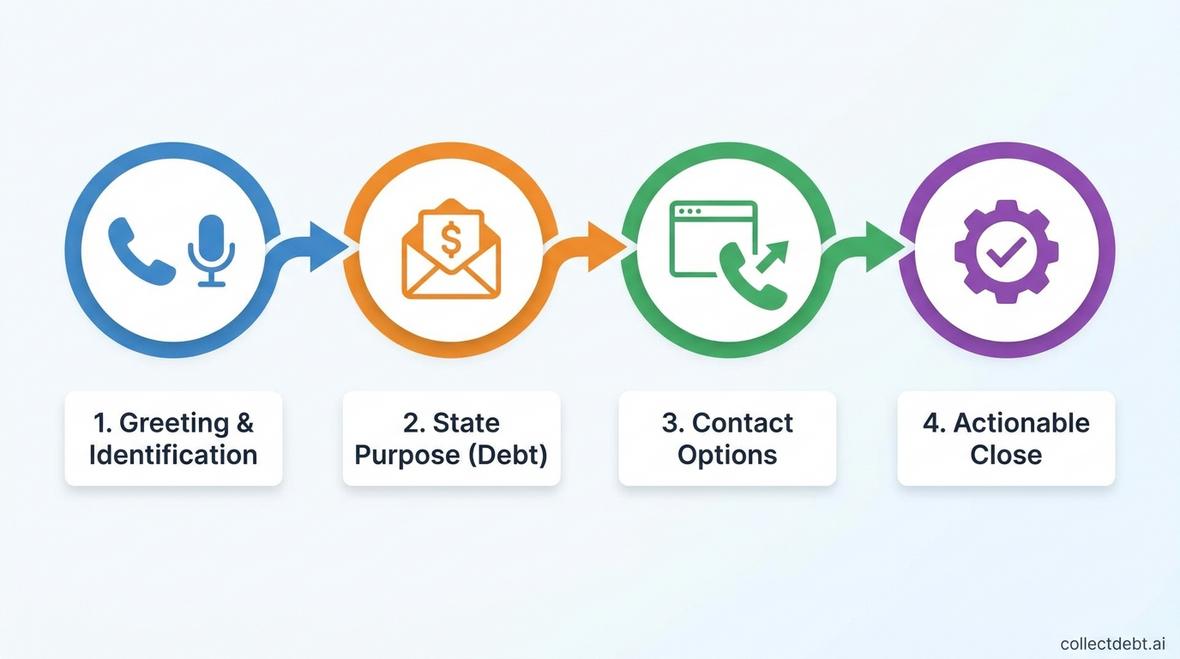
This four-step framework illustrates the essential flow of an effective debt collection communication, applicable to both live calls and voicemail scripts. Beginning with proper identification, stating the purpose within compliance boundaries, offering multiple contact options, and closing with actionable next steps creates a structured approach that improves both engagement and outcomes.
Proven Debt Collection Voicemail Script Templates
Different stages of the collection cycle require different messaging approaches. The following templates have been tested across thousands of accounts and represent current best practices for compliant, effective voicemail communication.
Early-Stage Collection Voicemail Template
For accounts 1-30 days past due, the tone should remain friendly and assume good faith:
'Hello [First Name], this is [Agent Name] from [Company Name] Account Services. I'm reaching out regarding your account ending in [last 4 digits]. We'd like to discuss some options that might be helpful. Please give me a call back at [callback number]. Again, that's [repeat number slowly]. I'm available [days/times], and I look forward to speaking with you. Thank you.'
This script maintains a service-oriented tone, focuses on 'options' rather than immediate payment, and provides specific availability to reduce phone tag.
Mid-Stage Collection Voicemail Template
For accounts 31-90 days past due, the message should convey greater urgency while remaining compliant:
'[First Name], this is [Agent Name] from Account Resolution Services. It's important that we speak regarding your account. Several options remain available to resolve this matter, but time is limited. Please contact me directly at [callback number]. That number again is [repeat]. Reference code [account reference]. I'm here to help find a solution that works for your situation.'
This template introduces greater urgency ('time is limited') without making false threats, and positions the collector as a problem-solver rather than adversary.
Late-Stage Collection Voicemail Template
For seriously delinquent accounts (90+ days), the message must convey the severity of the situation within compliance boundaries:
'This message is for [First Name Last Name]. This is [Agent Name] from [Company Name], and this is an attempt to collect a debt. It's critical that you return this call to [callback number] before [specific date] to discuss resolution options for account [reference number]. Waiting to respond limits available options. Please call [repeat number] as soon as possible.'
This script includes the required mini-Miranda disclosure ('attempt to collect a debt') for third-party collectors and establishes a specific deadline that creates appropriate urgency.
Limited-Content Message Template
For maximum privacy protection and Regulation F compliance, agencies may opt for the most conservative approach:
'This message is for [First Name]. Please contact [Agent Name] at [Company Name]. You can reach me at [callback number]. Again, [repeat number]. Thank you.'
This template strictly adheres to limited-content requirements, making no reference to debt, the nature of the call, or any urgency. It's particularly useful early in the contact sequence or when privacy concerns are paramount.
Integrating Voicemail Scripts into a Multichannel Collection Strategy
Modern debt collection has evolved beyond single-channel approaches. Research from Forrester report on digital collections and customer communication preferences demonstrates that consumers respond better to coordinated multichannel strategies that blend voice, text, email, and digital self-service options.
Coordinating Voicemail with SMS and Email
The most effective collection strategies use voicemail as one touchpoint in a coordinated sequence. A typical early-stage sequence might include:
- Day 1: Initial email notification
- Day 3: First phone call attempt with voicemail
- Day 5: Follow-up SMS with payment link
- Day 7: Second call attempt with voicemail
- Day 10: Email with payment options
This approach, supported by omnichannel collection platforms, ensures consistent messaging across channels while respecting consumer preferences and compliance requirements.
Directing to Self-Service Channels
Many consumers prefer to resolve debts without speaking to a collector. Progressive voicemail scripts reference self-service resolution options, allowing debtors to make payments or set up arrangements online immediately after hearing the message. This approach improves resolution rates while reducing operational costs.
Example integration: 'For immediate resolution, you can also visit [secure URL] to view your account and explore payment options 24/7.'
AI-Powered Voicemail Automation and Personalization
Artificial intelligence has transformed debt collection voicemail strategies, enabling personalization at scale while maintaining strict compliance. Modern AI debt collection platforms analyze account data, payment history, and behavioral signals to optimize message timing, content, and delivery.
Dynamic Script Selection Based on Debtor Profile
AI systems can automatically select the most appropriate voicemail script based on factors including:
- Account balance and age
- Previous payment history
- Communication preferences
- Response patterns to previous messages
- Time of day and day of week
This intelligent routing ensures each debtor receives the most effective message for their specific situation, improving callback rates by 20-35% compared to one-size-fits-all approaches.
Natural Language Generation for Personalization
Advanced AI platforms use natural language generation to create personalized voicemails that sound natural while maintaining compliance. These systems can incorporate the debtor's name, account specifics, and contextual information while ensuring every message adheres to regulatory requirements.
The technology behind conversational AI in debt collection has matured to the point where AI-generated voicemails are indistinguishable from human-recorded messages, but with perfect consistency and compliance.
Voice Cloning and Synthetic Voice Considerations
Some platforms now offer voice cloning technology that allows agencies to create consistent, on-brand voicemail messages using synthetic versions of actual collector voices. While this technology offers scalability benefits, collections managers must consider the ethical and regulatory implications of synthetic voice use, particularly regarding transparency and consumer protection.
Testing and Optimizing Voicemail Script Performance
Continuous improvement is essential for maximizing voicemail effectiveness. Leading collection operations implement systematic testing protocols to identify the highest-performing scripts and messaging approaches.
A/B Testing Voicemail Variations
Sophisticated collection operations use A/B testing to compare script variations across statistically significant sample sizes. Variables to test include:
- Message length (brief vs. detailed)
- Tone (formal vs. conversational)
- Urgency level (neutral vs. time-sensitive)
- Call-to-action specificity
- Callback number placement
Even small script modifications can produce significant performance differences. One major collection agency found that simply slowing down the callback number recitation increased callbacks by 12%.
Key Performance Metrics for Voicemail Campaigns
Collections managers should track several metrics to evaluate voicemail script effectiveness:
- Callback rate: Percentage of voicemails that result in returned calls
- Resolution rate: Percentage of voicemails that lead to payment or payment arrangements
- Time-to-callback: How quickly debtors respond to messages
- Dispute rate: Percentage of voicemails that trigger disputes or complaints
- ROI per voicemail: Revenue generated relative to the cost of the voicemail attempt
Modern platforms with post-call analysis capabilities automatically track these metrics and provide actionable insights for continuous improvement.
Common Voicemail Script Mistakes and How to Avoid Them
Even experienced collections professionals can fall into voicemail scripting traps that reduce effectiveness or create compliance risk. Understanding these common mistakes helps organizations refine their approach.
Information Overload
One of the most common errors is attempting to convey too much information in a single voicemail. Messages longer than 30-45 seconds see significantly reduced callback rates as consumers lose interest or become confused. Focus on the essential elements: identification, callback request, and contact information.
Overly Generic Messaging
Voicemails that sound robotic or completely generic reduce credibility and callback likelihood. While maintaining compliance, incorporate elements that demonstrate the message is specifically for the recipient (using their name, account reference numbers, or contextual details about their account).
Unclear Callback Instructions
Rushing through the callback number or failing to repeat it is a surprisingly common error that directly reduces response rates. Always state the number clearly, pause between digit groups, and repeat it at least once. Consider the format: '800-555-1234, that's 800-555-1234' rather than running all digits together.
Threatening or Aggressive Language
Scripts that employ threatening language, false urgency about legal action, or aggressive tone create compliance risk and often backfire by making consumers defensive rather than cooperative. Maintain a professional, solution-oriented tone that positions the collector as helpful rather than adversarial.
Industry-Specific Voicemail Script Considerations
Different industries face unique challenges in debt collection that affect optimal voicemail messaging strategies.
Healthcare Collections
Medical debt collection requires particular sensitivity due to HIPAA privacy requirements and the emotional nature of healthcare financial obligations. Healthcare collection voicemails must avoid any disclosure of medical information and often benefit from a more empathetic, service-oriented tone that acknowledges the difficult circumstances patients may face.
Financial Services and Credit Cards
Financial services collections often deal with more sophisticated debtors who understand their rights and options. Voicemails in this sector benefit from being more direct about available resolution options and potential consequences of non-payment, while maintaining strict regulatory compliance.
Utilities and Telecom
Utility and telecom collections face unique challenges as services may still be active while accounts are delinquent. Voicemail scripts in this industry often emphasize the risk of service interruption as a natural consequence of non-payment, which can be highly motivating without being threatening.
Implementation Best Practices for Debt Collection Voicemail Scripts
Successfully implementing voicemail scripts across a collection operation requires more than just writing good copy. Operational excellence in execution determines real-world results.
Agent Training and Consistency
When human collectors leave voicemails, consistency becomes a challenge. Comprehensive training programs should include:
- Script memorization or internalization
- Tone and pacing guidelines
- Compliance review and regular updates
- Recording and feedback sessions
- Quality assurance monitoring
Organizations using AI voice bots for debt collection eliminate consistency concerns while ensuring perfect compliance on every call.
Timing and Frequency Optimization
When voicemails are left matters almost as much as what they say. Research indicates optimal voicemail timing varies by debtor demographics:
- Working professionals: Early morning (7-9 AM) or evening (6-8 PM)
- Retirees: Mid-morning (9-11 AM) or early afternoon (1-3 PM)
- Small business owners: Early morning (6-8 AM) before business hours
Frequency must balance persistence with harassment concerns. A typical schedule leaves voicemails every 3-5 days in early stages, potentially increasing frequency as accounts age, while always remaining within regulatory and internal policy limits.
Quality Assurance and Compliance Monitoring
Regular review of voicemail messages is essential for maintaining both quality and compliance. Best practices include:
- Random sampling and review of recorded voicemails
- Quarterly legal review of all active scripts
- Monitoring of dispute and complaint patterns
- Regular updates based on regulatory changes
- Documentation of script approval and deployment dates
Future Trends in Debt Collection Voicemail Technology
The debt collection voicemail landscape continues to evolve with technological advancement and regulatory development. Understanding emerging trends helps collections leaders prepare for the future.
Visual Voicemail and Rich Media Integration
As visual voicemail becomes standard on smartphones, collections operations are beginning to explore enhanced voicemail experiences that include clickable payment links, account information displays, and interactive options directly within the voicemail interface. This convergence of voice and digital channels represents a significant opportunity for improving engagement.
Predictive Analytics for Message Optimization
Machine learning algorithms are increasingly capable of predicting which specific voicemail approach will be most effective for individual debtors based on historical data, demographic information, and behavioral signals. These predictive capabilities enable unprecedented personalization at scale.
Continued Regulatory Evolution
The regulatory landscape governing debt collection voicemails continues to develop. Collections managers should monitor proposed rules from the CFPB, FCC, and state regulators, and maintain relationships with compliance counsel to ensure scripts remain compliant as interpretations evolve.
Frequently Asked Questions About Debt Collection Voicemail Scripts
Can debt collectors leave voicemails?
Yes, debt collectors can leave voicemails, but they must comply with specific regulations. Under Regulation F, collectors can leave 'limited-content messages' that include only the business name (which must not indicate debt collection), a request for a callback, a telephone number, and names of persons to contact. For more details, see our guide on whether collection agencies can leave voicemails.
What information must be included in a debt collection voicemail?
At minimum, a compliant voicemail must include a callback number and some form of identification. For limited-content messages under Regulation F, you can include the business name, request for callback, phone number, and agent names, but cannot mention the debt, creditor, or anything indicating debt collection to third parties.
How often can collectors leave voicemails?
There is no specific federal limit on voicemail frequency, but the FDCPA prohibits harassment, which includes excessive call attempts. Best practice suggests spacing voicemails 3-5 days apart in early stages, with careful documentation to demonstrate reasonable contact patterns. Note that some state laws impose specific frequency limits.
What happens if a debt collection voicemail violates regulations?
Violations of the FDCPA, TCPA, or Regulation F can result in statutory damages up to $1,000 per violation, actual damages, attorney's fees, and regulatory enforcement actions. Repeated violations can lead to significant financial penalties and reputational damage, making compliance essential.
Should voicemails mention the word 'debt'?
For third-party debt collectors, the mini-Miranda disclosure ('this is an attempt to collect a debt') is required in communications with the consumer, including voicemails. However, limited-content messages specifically avoid this disclosure to prevent third-party disclosure. The choice depends on your compliance strategy and script type.
Can AI voice systems legally leave debt collection voicemails?
Yes, AI-powered systems can leave compliant debt collection voicemails, provided they adhere to all applicable regulations including the TCPA requirements for automated calls and prerecorded messages. Many organizations use AI-powered collection solutions to ensure perfect script compliance while achieving scale.
Conclusion
The debt collection voicemail script remains a critical tool in modern collection strategies, bridging the gap between traditional phone-based collection and emerging digital channels. Success requires balancing regulatory compliance, psychological persuasion, and operational efficiency a challenge that has become significantly more manageable with AI-powered automation.
By implementing the proven templates, best practices, and optimization strategies outlined in this guide, collection agencies and accounts receivable departments can significantly improve their callback rates, resolution rates, and overall recovery performance. As the regulatory landscape continues to evolve and consumer communication preferences shift toward digital-first experiences, organizations that master compliant, effective voicemail messaging while integrating these efforts into broader omnichannel strategies will maintain a competitive advantage in an increasingly challenging collections environment.
Ready to Transform Your Collections Process?
See how CollectDebt.ai can help you automate debt collection, reduce costs, and improve compliance.