Collection Call Scripts Examples: Proven Templates For Maximum Debt Recovery In 2026

In the high-stakes world of debt collection, the words your agents use can make the difference between a successful recovery and a compliance violation. For Directors of Operations, Collections Managers, and CFOs overseeing accounts receivable departments, having proven collection call scripts examples is essential for training teams, maintaining regulatory compliance, and maximizing recovery rates. This comprehensive guide provides actionable templates, regulatory considerations, and AI-powered alternatives that transform how modern agencies approach debtor communication.
Whether you're managing a traditional call center or exploring automated solutions, understanding the anatomy of effective collection call scripts is fundamental to operational success. The right script balances empathy with assertiveness, compliance with conversion, and personalization with scalability a challenge that has driven many industry leaders toward AI-enhanced solutions.
Understanding Collection Call Scripts: Foundation for Recovery Success
Collection call scripts serve as structured conversation frameworks that guide agents through debtor interactions while ensuring consistent messaging and regulatory compliance. These scripts are not rigid word-for-word documents but rather strategic roadmaps that help collectors navigate various debtor responses, objections, and payment scenarios.
The primary objectives of well-designed collection call scripts include establishing contact with the right party, verifying debt details, understanding the debtor's financial situation, negotiating payment arrangements, and documenting all interactions for compliance purposes. Each element must align with federal regulations including the Fair Debt Collection Practices Act (FDCPA) and CFPB Regulation F: Strict limits on collection call frequency to ensure FDCPA compliance, which restricts collectors to a maximum of seven calls per week per debt.
For agencies managing high call volumes, the consistency provided by tested collection call scripts examples reduces training time, minimizes compliance risks, and creates measurable performance benchmarks. However, as operational demands scale, many organizations discover that traditional scripting approaches face inherent limitations in personalization and efficiency challenges that AI-powered debt collection solutions are uniquely positioned to address.
Essential Components of Effective Collection Call Scripts
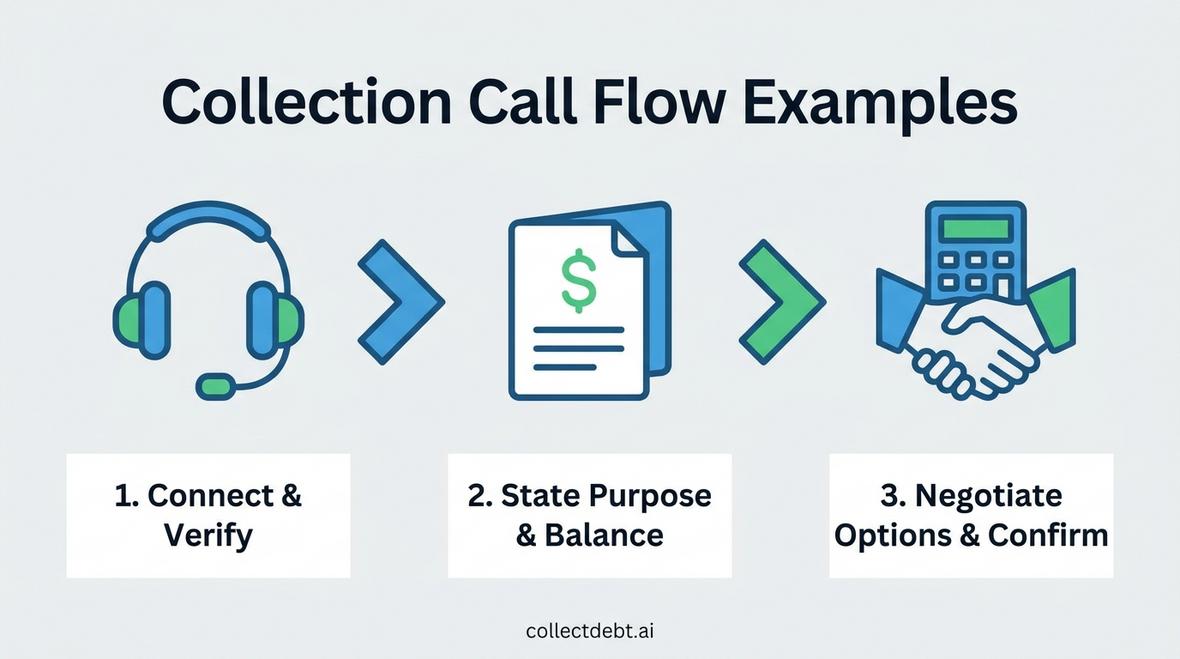
Every high-performing collection call script contains several critical components that work together to create productive debtor conversations. Understanding these elements helps agencies craft their own templates or evaluate existing scripts for effectiveness.
Opening and Identification Verification
The script opening sets the tone for the entire interaction. It must include a clear identification of the caller, the agency or creditor they represent, and the purpose of the call. According to FDCPA requirements, collectors must provide a 'mini-Miranda' warning stating that the call is from a debt collector attempting to collect a debt and that any information obtained will be used for that purpose.
A compliant opening might sound like: 'Hello, may I speak with [Debtor Name]? This is [Agent Name] calling from [Agency Name]. This communication is from a debt collector attempting to collect a debt. Any information obtained will be used for that purpose. Is now a convenient time to discuss your account ending in [last four digits]?'
This approach incorporates right party verification techniques that confirm you're speaking with the correct individual before disclosing sensitive information a critical compliance step that protects both the agency and consumer privacy.
Debt Validation and Disclosure
Following identification, the script must address debt validation requirements. Collectors are legally obligated to provide specific information about the debt, including the creditor's name, the amount owed, and the consumer's right to dispute the debt within 30 days of initial contact.
An effective disclosure section states: 'I'm calling regarding an account with [Original Creditor Name] in the amount of $[Amount]. You have the right to dispute this debt within 30 days. If you dispute any portion of this debt in writing within that timeframe, we will obtain verification and mail it to you. Do you recall this account?'
This transparent approach builds trust while fulfilling regulatory obligations. For agencies managing multiple account types, having industry-specific templates for healthcare debt collection, auto finance recovery, or utilities collections ensures relevance and compliance across diverse portfolios.
Needs Assessment and Empathy Statements
The most successful collection call scripts examples incorporate empathy-driven language that acknowledges the debtor's situation without judgment. This section transitions from information disclosure to understanding the debtor's circumstances and ability to pay.
Effective empathy statements include: 'I understand that unexpected financial challenges can happen to anyone. Can you help me understand what led to this account becoming past due?' or 'Many people we speak with are dealing with similar situations. What would be most helpful for you in resolving this matter?'
This consultative approach transforms the interaction from confrontational to collaborative, significantly increasing the likelihood of payment arrangements. Research consistently shows that debtors who feel heard and respected are more likely to engage in productive payment discussions.
Payment Negotiation and Options
The negotiation section is where scripts must balance firmness with flexibility. Effective collection call scripts examples provide agents with tiered payment options that start with the full balance but include realistic alternatives based on the debtor's expressed ability to pay.
A structured negotiation framework might include: 'The total balance due is $[Amount]. Are you able to pay this in full today to resolve the account? [Pause for response] I understand. We also offer payment arrangements. Based on your situation, what monthly payment amount would work within your budget?'
This approach uses the 'down-sell' technique, starting high but demonstrating willingness to work with the debtor. For agencies implementing promise-to-pay automation, these negotiation frameworks can be translated into intelligent decision trees that guide conversations toward realistic commitments.
Proven Collection Call Script Templates by Scenario
Different collection scenarios require tailored approaches. Here are proven collection call scripts examples for the most common situations agencies encounter, complete with compliance considerations and expected outcomes.
Initial Contact Script for First-Time Debtors
First-time contact requires the most comprehensive disclosure and establishes the foundation for all future interactions. This script prioritizes compliance while building rapport:
Agent: 'Hello, is this [Debtor Name]? My name is [Agent Name], and I'm calling from [Agency Name]. Our phone number is [Phone Number]. This communication is from a debt collector attempting to collect a debt, and any information obtained will be used for that purpose. Is this a good time to speak privately for a few moments?'
[Wait for confirmation]
Agent: 'Thank you. I'm calling regarding an account you have with [Original Creditor] that currently has an outstanding balance of $[Amount]. By law, I need to inform you that you have 30 days from today to dispute this debt in writing if you believe it's inaccurate. If you dispute it within that time, we'll send you verification. Do you recall this account with [Creditor]?'
[If yes] 'I appreciate your acknowledgment. Can you share what circumstances led to this account falling behind?'
[If no] 'I understand. Let me provide you with the account details so you can review your records. The account number ends in [last four digits], and the original charge was on [Date]. Would reviewing your records help you recall this obligation?'
This template ensures full FDCPA compliance while creating space for the debtor to engage voluntarily. For agencies scaling operations, AI compliance solutions can automatically track whether all required disclosures have been made across thousands of daily interactions.
Payment Arrangement Follow-Up Script
When a debtor has expressed willingness to pay but needs a structured arrangement, this script facilitates commitment:
Agent: 'Thank you for your willingness to resolve this account, [Debtor Name]. Based on our conversation, it sounds like you can commit to $[Amount] per month. Is that correct?'
[Confirm amount]
Agent: 'Excellent. Let's set up a payment schedule that works for you. What day of the month would be best for your payment perhaps after your paycheck arrives?'
[Establish day]
Agent: 'Perfect. So we'll have your first payment of $[Amount] due on [Date], and then the same amount on the [Day] of each following month until the balance is paid. Does that timeline work with your budget?'
[Confirm agreement]
Agent: 'Great. I'll send you a confirmation letter outlining these terms. The easiest way to make your payments is [Payment Method]. Can I help you set up your first payment right now?'
This script uses commitment-building language and confirmation techniques that psychologically bind the debtor to the agreement. Agencies implementing self-service debt resolution platforms can automate these arrangements entirely, allowing debtors to set up payment plans without agent involvement.
Broken Promise Script for Missed Payments
When debtors miss agreed-upon payments, the script must balance accountability with understanding:
Agent: 'Hello [Debtor Name], this is [Agent Name] from [Agency Name]. I'm calling because we had an agreement for a payment of $[Amount] on [Date], and we haven't received it yet. I wanted to check in and see if everything is okay.'
[Listen to reason]
Agent: 'I understand that [restate their situation]. The challenge is that when payment arrangements aren't kept, it affects your account status and could lead to [consequences be specific and truthful]. What can we do today to get this payment processed and keep your arrangement on track?'
[If they commit to immediate payment] 'Thank you. I can process that payment right now over the phone. Do you have your [payment method] available?'
[If they cannot pay immediately] 'I hear that you're experiencing difficulties. Given the missed payment, I'll need a commitment from you for a specific date and amount. When exactly can you make this payment? I need to note in your file that you'll be paying $[Amount] on [Specific Date]. Can you commit to that?'
This approach holds debtors accountable while offering a pathway to resolution. For high-volume operations, automated batch calling systems can trigger these follow-up scripts immediately when payments are missed, significantly improving promise-to-pay conversion rates.
Financial Hardship Script
When debtors express genuine inability to pay due to hardship, this compassionate approach explores alternatives:
Agent: 'I appreciate you being honest with me about your financial situation, [Debtor Name]. No one wants to be in this position, and I want to help you find a solution. Can you tell me more about your current circumstances?'
[Listen actively and note details]
Agent: 'Thank you for sharing that. Given what you've described, let's look at options that might work for you. Even a small payment today shows good faith and can prevent further collection actions. Is there any amount, even $[Small Amount], that you could put toward this balance right now?'
[If truly unable] 'I understand. Are you currently receiving any income at all perhaps unemployment, disability, or assistance from family? [Pause] Based on that, what monthly amount could you realistically commit to, even if it's small? We'd rather work with you on a longer payment plan than escalate this matter.'
[Document everything] 'I'm going to note in your file that you're experiencing [specific hardship] and that we discussed payment options. I'll follow up with you in [timeframe]. In the meantime, if your situation improves, please call us immediately at [Number]. Does that sound fair?'
This empathetic script builds trust while still pursuing resolution. For agencies serving specialized industries like healthcare collections, where patient financial hardship is common, having compassionate yet effective scripts is essential for maintaining both recovery rates and institutional reputation.
Compliance Considerations in Collection Call Scripts
Creating effective collection call scripts examples requires thorough understanding of regulatory requirements that govern debt collection communications. Non-compliance can result in lawsuits, regulatory penalties, and reputational damage that far outweigh any short-term recovery gains.
FDCPA and Regulation F Requirements
The Fair Debt Collection Practices Act establishes fundamental rules for collector behavior, including prohibitions on harassment, false statements, and unfair practices. Every script must avoid threatening language, profanity, or implications of legal action that isn't actually intended. The frequency limitations outlined in Regulation F restrict collectors to no more than seven calls per week per debt, making call quality and script effectiveness even more critical.
Scripts must never imply arrest, property seizure, or other consequences that aren't legally applicable to consumer debt. Phrases like 'You could face jail time' or 'We'll garnish your wages immediately' are prohibited unless such actions are legally permissible and genuinely intended. For comprehensive guidance, review the complete FDCPA compliance guide for AI-powered debt collection.
TCPA Consent and Documentation
The Telephone Consumer Protection Act requires prior express consent before calling cell phones with automated systems. Collection call scripts examples must include language that confirms consent: 'We may contact you using an automated telephone dialing system or artificial or prerecorded voice. By continuing this call, you consent to receive future calls at this number. Is that acceptable?'
Documenting this consent is critical, as TCPA violations carry penalties of $500 to $1,500 per call. Agencies implementing omnichannel communication platforms must ensure consent is tracked across voice, SMS, and email channels to maintain compliance across all touchpoints.
Call Recording and Privacy Disclosures
Many jurisdictions require notification when calls are recorded. Scripts should include: 'This call may be recorded for quality assurance and compliance purposes.' Some states require two-party consent, meaning both parties must agree to recording. Understanding your jurisdiction's requirements is essential before implementing any recording strategy.
Additionally, collectors must safeguard personally identifiable information (PII) and avoid discussing debts with third parties. Scripts should verify the debtor's identity before disclosing any account details: 'For security purposes, can you verify your date of birth and the last four digits of your social security number?' This protects both the agency and consumers from privacy breaches.
AI-Powered Alternatives to Traditional Collection Call Scripts
While traditional collection call scripts examples provide structure for human agents, they face inherent scalability and consistency limitations. AI-powered voice agents represent the next evolution in debt collection communication, offering advantages that dramatically improve recovery rates while reducing operational costs.
Benefits of Conversational AI in Collections
Modern AI voice agents don't simply read scripts they engage in dynamic conversations that adapt to debtor responses in real-time. These systems analyze tone, sentiment, and language patterns to personalize interactions while maintaining perfect compliance. Unlike human agents who may deviate from scripts under pressure or fatigue, AI consistently follows best practices across every interaction.
The operational advantages are substantial. AI agents can handle unlimited concurrent conversations, operate 24/7 without breaks, and scale instantly during high-volume periods. For Collections Managers concerned about cost-per-contact metrics, AI typically reduces expenses by 60-70% compared to traditional call centers while improving right-party contact rates by 30-40%. Explore detailed ROI comparisons in our generative AI versus traditional debt collection analysis.
Natural Language Processing and Script Flexibility
AI-powered collection systems use natural language processing to understand debtor intent beyond scripted responses. When a debtor says 'I can't pay that much,' traditional scripts offer limited branching options. AI agents dynamically explore alternatives: 'I understand. What amount would fit your budget right now?' followed by intelligent negotiation based on the account's parameters and the agency's settlement authority.
This flexibility dramatically improves payment conversion. Rather than rigid if-then logic, AI creates personalized payment solutions that feel consultative rather than adversarial. For agencies managing diverse portfolios across retail, real estate, or transportation sectors, AI adapts conversation strategies to industry-specific debtor behaviors and payment patterns.
Automated Compliance and Quality Assurance
Perhaps AI's most valuable contribution is eliminating compliance risk. Every conversation automatically includes required disclosures, respects call frequency limits, and avoids prohibited language. Post-call analysis identifies any potential compliance issues before they become regulatory problems, something that's impossible with traditional script-based approaches at scale.
AI systems provide 100% call monitoring versus the 2-5% sampling typical in traditional quality assurance programs. Every interaction is analyzed for script adherence, regulatory compliance, and effectiveness metrics. This comprehensive oversight gives Directors of Operations and CFOs unprecedented visibility into collection performance and risk exposure. Learn more about automated post-call analysis capabilities that transform quality assurance.
Implementing Effective Collection Call Scripts in Your Organization
Having excellent collection call scripts examples is only valuable if your organization implements them effectively. Success requires training, measurement, and continuous optimization based on performance data.
Agent Training and Development
Scripts are frameworks, not word-for-word mandates. Effective training teaches agents when to follow scripts closely (during disclosures and compliance-critical moments) and when conversational flexibility improves outcomes. Role-playing exercises using various debtor personas help agents internalize scripts while developing natural delivery.
Training should cover objection handling, de-escalation techniques, and emotional intelligence alongside script mastery. The best collectors balance script structure with authentic empathy a skill that requires practice and feedback. Regular coaching sessions that review recorded calls help agents refine their approach while maintaining compliance standards.
Performance Metrics and Optimization
Track specific metrics for each script variation: right-party contact rate, promise-to-pay conversion, payment arrangement completion, and compliance incident rate. A/B testing different script approaches provides data-driven insights into what language and structure produce optimal results for your specific debtor population.
Monitor average handle time, but don't optimize solely for speed. Rushed calls often result in lower payment conversion and higher compliance risk. The goal is efficiency without sacrificing effectiveness a balance that requires ongoing measurement and refinement based on your agency's unique portfolio characteristics.
Technology Integration for Script Delivery
Modern collection platforms integrate scripts directly into agent interfaces, providing real-time guidance based on debtor responses and account status. Screen pop technology displays relevant scripts automatically when calls connect, while supervisor alerts flag when agents deviate from compliance-critical language.
For organizations ready to transcend traditional scripting limitations entirely, end-to-end AI collection platforms eliminate the need for human-delivered scripts while maintaining the consultative, empathetic approach that drives payment commitments. These systems represent the future of scalable, compliant, and highly effective debt recovery operations.
Frequently Asked Questions About Collection Call Scripts
What makes a collection call script legally compliant?
A compliant collection call script includes the mini-Miranda disclosure, identifies the caller and agency, provides debt validation information, respects call frequency limitations under Regulation F, avoids prohibited practices under FDCPA including threats or harassment, and documents all interactions properly. Scripts must be reviewed by legal counsel familiar with federal and state collection laws to ensure full compliance.
How often should collection call scripts be updated?
Review scripts quarterly at minimum, and immediately following any regulatory changes or when performance metrics indicate declining effectiveness. Additionally, update scripts whenever your agency adds new account types, expands into new states with specific regulations, or when quality assurance identifies compliance gaps or common objections that current scripts don't address adequately.
Can AI voice agents truly replace human collectors?
For routine, high-volume collections on standardized consumer accounts, AI voice agents often outperform human collectors in contact rates, consistency, and cost efficiency. However, complex commercial collections, accounts requiring nuanced negotiation, or situations involving vulnerable consumers may still benefit from human expertise. Many successful agencies use hybrid models where AI handles initial contact and routine follow-ups while human agents manage escalations and complex negotiations.
What's the ideal length for a collection call script?
Effective collection calls typically last 3-7 minutes for initial contact and 2-4 minutes for follow-ups. Scripts should provide enough structure to ensure compliance and consistency without being so lengthy that they feel robotic or waste time. Focus on essential elements: identification, validation, needs assessment, payment negotiation, and commitment confirmation. Longer doesn't mean better clarity and efficiency drive results.
How can I measure the effectiveness of different script variations?
Implement A/B testing by assigning different script versions to comparable account segments and measuring promise-to-pay rates, payment completion percentages, and average dollars collected. Track metrics by script version, agent, account type, and debtor demographic. Use statistical significance testing to ensure observed differences reflect true performance variations rather than random chance. Most agencies find that even small script changes can produce measurable impact on recovery rates.
Conclusion
Effective collection call scripts examples provide the foundation for successful debt recovery operations, balancing regulatory compliance with persuasive communication that drives payment commitments. For Directors of Operations, Collections Managers, and CFOs seeking to maximize recovery rates while minimizing risk, investing in proven script frameworks is essential whether deployed by human agents or AI-powered systems. As the industry evolves toward automation, the principles underlying successful scripts remain constant: clear identification, transparent disclosure, empathetic engagement, and structured negotiation. Organizations that master these elements while embracing AI capabilities position themselves for superior performance in an increasingly competitive and regulated environment. The future of collections belongs to agencies that combine strategic scripting expertise with technological innovation to achieve scalability, consistency, and compliance simultaneously.
Ready to Transform Your Collections Process?
See how CollectDebt.ai can help you automate debt collection, reduce costs, and improve compliance.