Collection Agent Script: Complete 2026 Guide To AI-Powered Debt Recovery Communication

Introduction: The Evolution of Collection Agent Scripts in 2026
The traditional collection agent script has undergone a dramatic transformation in recent years. What was once a rigid, one-size-fits-all approach to debt recovery has evolved into a sophisticated, AI-driven communication framework that balances regulatory compliance with personalized debtor engagement. For decision-makers in debt collection agencies and accounts receivable departments, understanding modern collection agent scripts is no longer optional it's essential for maximizing recovery rates while minimizing legal exposure.
According to CFPB FDCPA complaint data shows rising violations in debt collection calls, over 70,000 debt collection complaints were filed in 2023, with many stemming from improper call scripts and harassment tactics. This highlights a critical challenge: traditional, manually-delivered collection agent scripts often fail to adapt to individual debtor circumstances, leading to both compliance violations and poor recovery outcomes.
This comprehensive guide explores how modern collection agent scripts leverage artificial intelligence, regulatory best practices, and behavioral psychology to achieve recovery rates that surpass traditional methods. Whether you're evaluating AI debt collection solutions or refining your existing call center operations, this resource provides actionable insights for 2026 and beyond.
What Is a Collection Agent Script?
A collection agent script is a structured communication framework that guides conversations between debt collectors and debtors. These scripts serve multiple critical functions: ensuring regulatory compliance with laws like the Fair Debt Collection Practices Act (FDCPA) and Telephone Consumer Protection Act (TCPA), maintaining consistency across collection teams, and providing a roadmap for navigating common debtor responses.
Modern collection agent scripts differ significantly from their predecessors. While traditional scripts were static documents that agents read verbatim, contemporary approaches particularly those powered by AI offer dynamic, conversational frameworks that adapt in real-time based on debtor responses, sentiment analysis, and account-specific data.
Essential Components of Effective Collection Agent Scripts
Every compliant and effective collection agent script must include several foundational elements:
- Mini-Miranda disclosure: Clear identification of the caller as a debt collector attempting to collect a debt
- Debtor verification: Confirmation of speaking with the correct party or authorized representative
- Account information: Accurate debt amount, creditor name, and account details
- Validation rights: Explanation of the debtor's right to dispute the debt within 30 days
- Payment options: Clear presentation of resolution pathways, from full payment to structured payment plans
- Compliance safeguards: Built-in limitations on communication frequency, timing, and language to prevent FDCPA violations
Research from Forrester: ROI of 3-5x from AI collection tools demonstrates that agencies implementing AI-optimized collection agent scripts achieve 3-5x return on investment compared to traditional manual approaches, with 40% faster cycle times and significantly higher promise-to-pay conversion rates.
Regulatory Compliance: Building FDCPA-Compliant Collection Agent Scripts
Compliance is the cornerstone of any effective collection agent script. The financial and reputational consequences of violations are severe individual FDCPA violations can result in penalties up to $1,000 per incident, with class-action lawsuits reaching millions of dollars in settlements.
Data from the FTC: 80% FDCPA complaints from call harassment reveals that approximately 80% of Fair Debt Collection Practices Act complaints stem from aggressive or non-compliant collection call scripts, particularly those involving harassment, false representations, or communication at inappropriate times.
FDCPA Requirements for Collection Agent Scripts
Your collection agent script must adhere to specific FDCPA provisions:
- Communication restrictions: No contact before 8 AM or after 9 PM in the debtor's time zone
- Workplace communication limits: Cease contact at employer locations if the debtor indicates such calls are prohibited
- Third-party disclosure prohibition: Never reveal debt information to anyone other than the debtor, their spouse, or attorney
- Harassment prevention: Eliminate threatening language, profanity, or repeated calls intended to annoy
- False representation avoidance: Ensure all statements about debt amounts, legal consequences, and collector identity are accurate
Advanced compliance solutions now integrate real-time monitoring into collection agent scripts, automatically flagging potential violations before they occur. AI-powered systems can detect sentiment escalation, recognize prohibited language patterns, and ensure every conversation adheres to regulatory requirements across all communication channels.
Traditional Collection Agent Scripts vs. AI-Powered Approaches
The limitations of traditional collection agent scripts have become increasingly apparent in today's complex debt recovery environment. Static scripts cannot account for the nuanced variations in debtor circumstances, emotional states, or communication preferences that significantly impact resolution likelihood.
Limitations of Traditional Collection Agent Scripts
Conventional collection agent scripts present several operational challenges:
- Rigidity: Inability to adapt to unexpected debtor responses or unique account situations
- Training dependency: Extended onboarding periods (typically 6-8 weeks) before agents achieve proficiency
- Inconsistency: Variation in script delivery quality across different agents and shifts
- Scalability constraints: Linear relationship between call volume capacity and headcount
- Compliance variability: Human error leading to inadvertent violations despite training
AI-powered collection agent scripts address these limitations through dynamic conversation management. Rather than following a predetermined path, AI systems leverage natural language processing to understand debtor intent, emotional state, and communication preferences, then adjust the conversation flow accordingly.
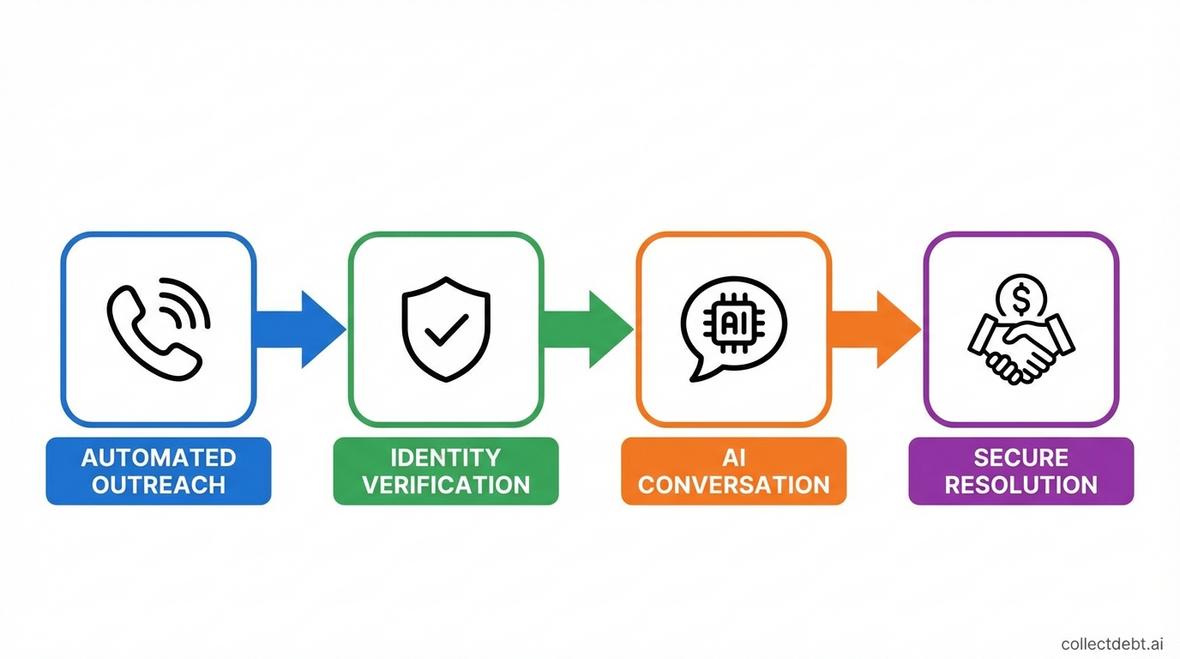
Advantages of AI-Driven Collection Agent Scripts
Modern AI voice bot solutions offer transformative benefits:
- 24/7 availability: No limitation on operating hours or shift coverage
- Infinite scalability: Handle thousands of simultaneous conversations without additional infrastructure
- Perfect compliance: 100% adherence to regulatory requirements with automatic documentation
- Personalization at scale: Tailor communication style, language preference, and payment options to individual debtor profiles
- Continuous improvement: Machine learning algorithms optimize script performance based on millions of interaction data points
Organizations implementing conversational AI for debt collection report significant improvements in key performance metrics, including 35-50% increases in right-party contact rates and 25-40% improvements in promise-to-pay conversion.
Collection Agent Script Examples and Templates
While every debt collection scenario requires customization based on account type, debtor segment, and regulatory jurisdiction, certain script frameworks have proven consistently effective across industries.
Opening Collection Agent Script Template
Agent: 'Hello, this is [Agent Name] calling from [Company Name]. I'm calling regarding an important financial matter. Am I speaking with [Debtor Name]?'
Debtor: 'Yes, this is [Debtor Name].'
Agent: 'Thank you for confirming. This call is from a debt collector attempting to collect a debt, and any information obtained will be used for that purpose. I'm calling about your account with [Original Creditor]. The current balance is [Amount]. Do you have a few moments to discuss resolution options?'
This opening establishes compliance through the mini-Miranda disclosure while maintaining a professional, non-threatening tone. The script prioritizes verification to prevent unauthorized disclosure and sets expectations for the conversation's purpose.
Objection Handling in Collection Agent Scripts
Effective collection agent scripts must address common debtor objections with empathy while maintaining forward momentum toward resolution:
Objection: 'I can't afford to pay anything right now.'
Response: 'I understand you're facing financial challenges, and I appreciate you being upfront about your situation. Many people we work with feel the same way initially. Let me ask if we could create a payment arrangement that fits your current budget, even a small amount to start, would that be something you'd consider? We have flexible options designed specifically for situations like yours.'
This approach acknowledges the debtor's concern without accepting it as final, then redirects toward exploring manageable solutions. Advanced promise-to-pay systems can dynamically calculate payment plan options based on account age, balance, and debtor payment history.
Industry-Specific Collection Agent Scripts
Different debt types require tailored collection agent script approaches. Healthcare debt, for instance, demands greater sensitivity due to the personal nature of medical services, while commercial debt collection may involve more complex negotiation dynamics.
Healthcare Collection Agent Scripts
Healthcare debt collection requires scripts that balance firmness with compassion, recognizing that medical debt often results from unexpected emergencies rather than financial irresponsibility. Effective healthcare collection agent scripts emphasize:
- Understanding of medical billing complexity
- Explanation of insurance coordination issues
- Flexibility in payment arrangements due to ongoing treatment needs
- Awareness of financial assistance programs and charity care options
Auto Finance Collection Agent Scripts
For auto finance collections, the collection agent script must address the unique leverage point of collateral while maintaining compliance with repossession regulations. These scripts typically include:
- Clear communication about cure amounts and reinstatement options
- Timeline transparency regarding potential repossession
- Discussion of voluntary surrender as an alternative to forced repossession
- Deficiency balance explanation if repossession becomes necessary
Implementing AI-Powered Collection Agent Scripts
Transitioning from traditional collection agent scripts to AI-powered systems requires strategic planning, but the operational and financial benefits justify the investment. Organizations should approach implementation through a phased methodology that minimizes disruption while maximizing learning.
AI Collection Agent Script Implementation Roadmap
Phase 1: Assessment and Planning (Weeks 1-4)
- Audit existing collection agent scripts for compliance gaps and performance weaknesses
- Define success metrics: contact rates, promise-to-pay conversion, liquidation rates, compliance incident reduction
- Select pilot account segments for initial deployment
- Configure integration points with existing collection management systems
Phase 2: Script Development and Training (Weeks 5-8)
- Develop conversation flows incorporating compliance requirements and best-practice negotiation techniques
- Train AI models on historical call recordings and successful resolution patterns
- Configure right-party verification protocols
- Establish escalation pathways for complex scenarios requiring human intervention
Phase 3: Pilot Deployment (Weeks 9-16)
- Launch AI-powered collection agent scripts on limited account inventory
- Monitor performance metrics daily and adjust conversation logic as needed
- Conduct A/B testing comparing AI script performance against traditional approaches
- Gather debtor feedback through post-interaction surveys
Phase 4: Scaling and Optimization (Weeks 17+)
- Expand deployment across additional account segments and debt types
- Implement post-call analysis to identify continuous improvement opportunities
- Develop industry-specific script variations for retail, utilities, and other verticals
Measuring Collection Agent Script Performance
Quantifying the effectiveness of your collection agent script requires tracking metrics across multiple dimensions: operational efficiency, recovery outcomes, compliance adherence, and debtor experience.
Essential KPIs for Collection Agent Scripts
| Metric | Definition | Target Benchmark |
|---|---|---|
| Right Party Contact Rate | Percentage of outreach attempts reaching the actual debtor | 45-60% |
| Promise-to-Pay Conversion | Percentage of conversations resulting in payment commitments | 25-35% |
| Promise-to-Pay Keep Rate | Percentage of payment promises actually fulfilled | 65-75% |
| Average Handle Time | Mean duration of collection conversations | 4-7 minutes |
| Compliance Incident Rate | Number of potential violations per 1,000 interactions | <0.5 |
| Debtor Satisfaction Score | Post-interaction survey rating (1-5 scale) | 3.5+ |
AI-powered collection agent scripts typically outperform traditional approaches across all these metrics. The ability to analyze millions of interaction data points enables continuous refinement that human-delivered scripts cannot match.
Omnichannel Collection Agent Scripts: Beyond Voice
Modern debt collection extends far beyond telephone calls. Effective collection strategies now incorporate omnichannel support, requiring collection agent scripts that maintain consistency across SMS, email, chat, and voice interactions.
SMS Collection Agent Scripts
Text messaging has emerged as a highly effective collection channel, particularly for younger debtor demographics who prefer asynchronous communication. Effective SMS collection agent scripts must:
- Remain concise due to character limitations (typically 160 characters)
- Include clear opt-out mechanisms to maintain TCPA compliance
- Provide direct links to self-service payment portals
- Balance urgency with professionalism in limited space
Example SMS Collection Agent Script: '[Debtor Name], this is [Company] regarding your [Creditor] account ending in [Last 4 Digits]. Balance: $[Amount]. Pay now at [Secure Link] or call [Number]. Reply STOP to opt out.'
The Future of Collection Agent Scripts: 2026 and Beyond
The evolution of collection agent scripts continues to accelerate, driven by advances in natural language processing, sentiment analysis, and predictive analytics. Several emerging trends will shape the future of debt collection communication:
Multilingual AI Collection Agent Scripts
As debtor populations become increasingly diverse, multilingual collection capabilities have transitioned from competitive advantage to operational necessity. AI-powered systems now offer real-time translation across dozens of languages, enabling seamless conversations regardless of language barriers.
Predictive Collection Agent Scripts
Advanced AI systems are beginning to predict optimal script variations based on debtor behavioral profiles. By analyzing factors like previous payment history, communication channel preferences, time-of-day responsiveness, and demographic characteristics, these systems select the script approach most likely to result in successful resolution before the conversation even begins.
Real-Time Sentiment Analysis in Collection Agent Scripts
Emerging voice AI platforms now detect emotional indicators stress, anger, confusion, receptiveness during conversations and adjust script delivery accordingly. If a debtor exhibits signs of financial distress or emotional overwhelm, the system can automatically shift to more empathetic language and introduce extended payment plan options.
Frequently Asked Questions About Collection Agent Scripts
Are collection agent scripts legally required?
While federal law does not explicitly mandate scripted communications, collection agent scripts serve as essential compliance tools that ensure consistent adherence to FDCPA, TCPA, and state-specific regulations. The structured nature of scripts helps agencies document compliance and defend against allegations of improper practices.
How often should collection agent scripts be updated?
Collection agent scripts should undergo comprehensive review at least quarterly to incorporate regulatory changes, performance data insights, and emerging best practices. AI-powered scripts benefit from continuous optimization through machine learning, but human oversight should validate major changes before deployment.
What is the typical cost difference between traditional and AI-powered collection agent scripts?
While AI implementation requires upfront investment in technology and integration, the long-term cost advantages are substantial. Traditional call center operations typically cost $15-25 per productive collector hour, while AI-powered systems can reduce per-contact costs by 60-70% while simultaneously improving recovery rates.
Do AI collection agent scripts completely replace human collectors?
The most effective approach combines AI automation for routine communications with human expertise for complex negotiations, dispute resolution, and high-value accounts. AI handles the volume while humans focus on situations requiring emotional intelligence, judgment, and creative problem-solving.
Conclusion
The collection agent script has evolved from a static compliance document into a dynamic, AI-powered communication framework that drives superior recovery outcomes while ensuring regulatory adherence. For decision-makers in debt collection agencies and accounts receivable departments, embracing modern script approaches is no longer optional it's essential for competitive survival.
Organizations that transition to AI-powered collection agent scripts report transformative results: 3-5x ROI improvements, 40% faster cycle times, dramatically reduced compliance risk, and significantly enhanced debtor experiences. As regulatory scrutiny intensifies and debtor expectations for personalized, respectful communication rise, the gap between traditional and AI-enabled approaches will only widen.
The question facing collection leaders in 2026 is not whether to modernize collection agent scripts, but how quickly they can implement solutions that position their organizations for sustained success in an increasingly automated, compliance-focused industry.
Ready to Transform Your Collections Process?
See how CollectDebt.ai can help you automate debt collection, reduce costs, and improve compliance.