Collection Agency Software: 2026 Guide To AI-Powered Debt Recovery Platforms

Introduction to Collection Agency Software
The debt collection landscape is undergoing a dramatic transformation. Collection agency software has evolved from basic spreadsheet tracking systems to sophisticated AI-powered platforms that automate communication, ensure regulatory compliance, and maximize recovery rates. As the debt collection agencies market grows from $30.19 billion in 2025 to $35.32 billion by 2030, agencies face mounting pressure to adopt technology that delivers measurable ROI while maintaining strict adherence to regulations like FDCPA and TCPA.
For Directors of Operations, Collections Managers, and CFOs, selecting the right collection agency software isn't just about digitizing workflows it's about fundamentally reimagining how debt recovery operates. Modern platforms leverage artificial intelligence to personalize debtor communication, predict payment likelihood, and automate multi-channel engagement strategies that traditional call centers simply cannot match.
Market Growth and Industry Transformation
The debt collection software market is experiencing unprecedented expansion. According to Persistence Market Research, the market will surge from $6.4 billion in 2026 to $12.4 billion by 2033, representing a robust 9.9% CAGR. This growth reflects fundamental shifts in how agencies operate, driven by several converging factors.
North American software spending in the collections space is particularly noteworthy. Research from Prodigal Technologies indicates that spending will nearly double from $1.89 billion in 2025 to $3.96 billion by 2033, with AI-specific solutions growing at an impressive 17% CAGR. This acceleration reflects agencies' recognition that traditional methods manual dialing, scripted conversations, and reactive compliance monitoring are insufficient in today's regulatory and competitive environment.
The drivers behind this transformation include rising non-performing loans (NPLs), increased regulatory scrutiny requiring real-time compliance verification, consumer preferences for digital-first communication channels, and the proven ROI of automation in reducing cost-per-dollar collected. Forward-thinking agencies are adopting AI debt collection solutions that address all these challenges simultaneously.
Essential Capabilities of Modern Collection Agency Software
Automated Workflow Management
Top-tier collection agency software eliminates manual task assignment through intelligent workflow automation. The system automatically routes accounts based on debt age, balance size, debtor payment history, and agent specialization. This ensures high-value accounts receive priority attention while lower-balance accounts progress through automated digital touchpoints.
Advanced platforms incorporate batch calling capabilities that enable simultaneous outreach to thousands of accounts, with AI agents handling initial contact, right-party verification, and preliminary negotiation. Only accounts requiring human intervention escalate to live collectors, dramatically improving agent productivity.
Omnichannel Communication
Modern debtors expect communication flexibility. Effective collection agency software orchestrates seamless engagement across voice calls, SMS, email, web chat, and self-service portals. The system maintains conversation context across channels, ensuring debtors receive consistent messaging regardless of communication method.
Omnichannel support isn't merely about offering multiple contact methods it's about intelligently determining which channel yields optimal response rates for each debtor segment. Machine learning algorithms analyze historical engagement patterns to predict the highest-converting channel for individual accounts, then automatically initiates contact through that medium.
Regulatory Compliance Automation
Compliance violations carry severe consequences fines, litigation, and reputational damage. Leading platforms embed compliance directly into operational workflows through automated call-time restrictions based on debtor time zones, mandatory mini-Miranda disclosures, consent-based communication, and real-time monitoring of prohibited language patterns.
Systems like CollectDebt.ai's compliance framework continuously update regulatory requirements across state and federal jurisdictions, automatically adjusting communication protocols to maintain adherence to evolving FDCPA, TCPA, and state-specific regulations. This automated approach eliminates human error while providing comprehensive audit trails for regulatory inquiries.
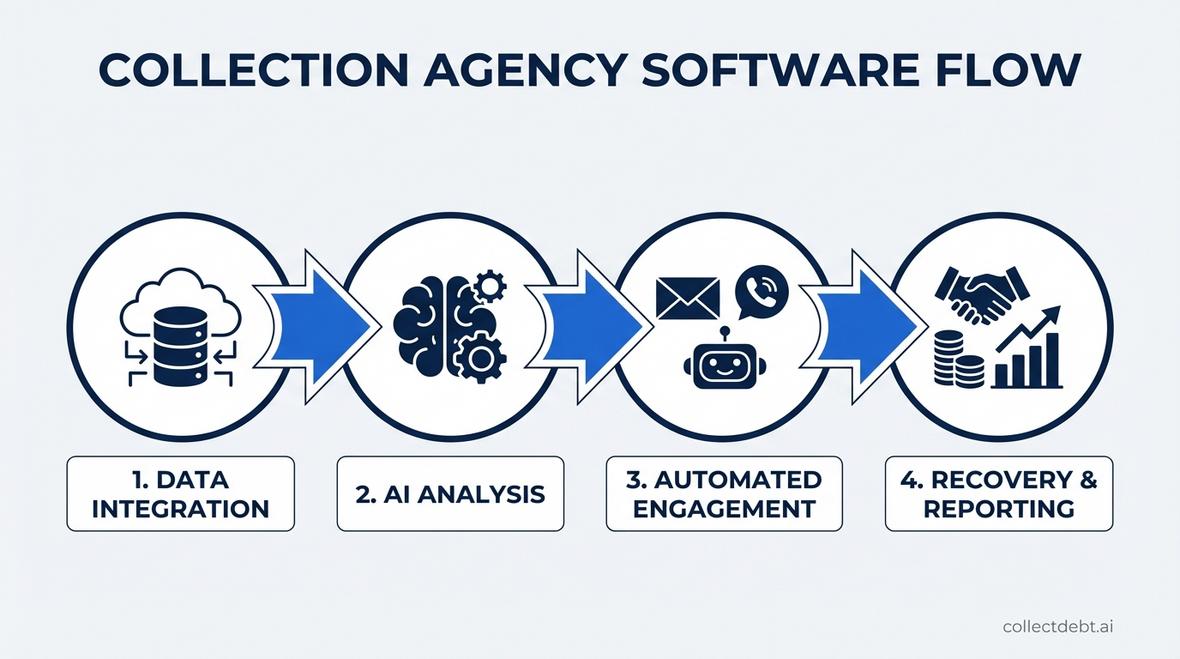
How AI is Revolutionizing Collection Agency Software
Conversational AI Agents
The most transformative advancement in collection agency software is the integration of conversational AI. Unlike rigid IVR systems that frustrate debtors with limited menu options, modern AI agents conduct natural, empathetic conversations that adapt based on debtor responses.
These conversational AI systems handle complex scenarios including payment plan negotiations, hardship verification, dispute resolution, and promise-to-pay scheduling. They understand intent even when debtors express themselves informally, recognize emotional cues that indicate financial stress, and adjust tone accordingly to maintain productive dialogue.
The ROI impact is substantial. Agencies implementing AI voice agents typically see 40-60% reductions in operational costs while simultaneously increasing contact rates by 200-300% compared to traditional call center approaches. AI agents work 24/7 without fatigue, handle unlimited simultaneous conversations, and maintain perfect compliance on every interaction.
Predictive Analytics and Prioritization
Not all accounts have equal recovery potential. Advanced collection agency software employs machine learning models that analyze hundreds of variables payment history, contact responsiveness, demographic indicators, economic conditions, and account characteristics to generate propensity-to-pay scores for each debtor.
These predictive models enable sophisticated portfolio segmentation. High-propensity accounts receive immediate attention through premium channels, while low-propensity accounts follow automated nurture sequences. This intelligent prioritization ensures collection resources focus where they'll generate maximum return, rather than treating all accounts identically.
Automated Right Party Contact Verification
Contacting wrong parties creates compliance risks and wastes resources. Modern platforms incorporate right party verification using voice biometrics, knowledge-based authentication, and behavioral analysis to confirm debtor identity before discussing account details.
AI systems can verify identity through natural conversation flow without the awkward, scripted question sequences that alert debtors to automated systems. This seamless verification improves debtor cooperation while maintaining strict compliance with privacy regulations.
Industry-Specific Collection Agency Software Applications
Healthcare Revenue Cycle Management
Healthcare providers face unique collection challenges complex billing systems, insurance coordination, patient financial assistance programs, and HIPAA compliance requirements. Specialized healthcare collection software integrates with EHR and billing systems to automatically identify patient responsibility amounts, verify insurance coverage, and initiate patient outreach for outstanding balances.
These systems handle pre-service cost estimates, payment plan establishment for high-deductible patients, and charity care screening all while maintaining strict HIPAA compliance on all communications. The result is accelerated cash flow and reduced bad debt write-offs without damaging patient satisfaction.
Auto Finance and BHPH Operations
Auto finance and buy-here-pay-here dealerships require collection agency software capable of GPS integration for asset tracking, coordinated repossession workflows, and title management. Auto finance-specific platforms track vehicle location, send automated payment reminders tied to GPS proximity alerts, and manage conditional reinstatement processes after repossession.
The software coordinates between collection teams and repossession agents, automatically triggering asset recovery protocols when accounts reach defined delinquency thresholds while maintaining compliance with state-specific repossession regulations.
Utilities and Telecommunications
Utility and telecom providers manage high-volume, lower-balance accounts requiring efficient, automated collection strategies. Industry-specific software integrates with billing systems to automatically suspend services for non-payment, reinstate upon payment, and manage installment agreements that prevent service disconnection.
These systems handle unique scenarios like disputed charges for service quality issues, seasonal payment plans for budget-constrained customers, and regulatory requirements around service disconnection notification timelines.
Critical Features to Evaluate in Collection Agency Software
System Integration and Data Exchange
Effective collection agency software doesn't operate in isolation. It must integrate seamlessly with your existing technology stack CRM systems, accounting platforms, payment processors, and dialer infrastructure. Look for platforms offering pre-built integrations with major enterprise systems through APIs, webhooks, and data connectors.
Data synchronization should be bidirectional and real-time, ensuring collection activity immediately updates debtor records in source systems while new account placements automatically flow into collection workflows without manual intervention.
Debtor Self-Service Capabilities
Self-service portals empower debtors to resolve accounts on their own terms, dramatically reducing operational costs. Robust self-service platforms enable debtors to view account details, make payments via multiple methods, establish payment plans, upload dispute documentation, and update contact information all without agent involvement.
The best systems use AI chatbots to guide debtors through complex processes, answer common questions, and escalate to human agents only when necessary. This approach increases resolution rates while freeing agents to focus on accounts requiring negotiation expertise.
Promise-to-Pay Tracking and Follow-Up
Converting debtor commitments into actual payments is critical. Advanced promise-to-pay systems automatically schedule follow-up contacts for commitment dates, send payment reminders via debtor's preferred channel, and escalate broken promises to appropriate collection strategies.
The system maintains detailed commitment history, enabling agents to reference previous promises during subsequent conversations and apply appropriate pressure based on debtor's track record of fulfilling commitments.
Performance Analytics and Reporting
Data-driven decision-making requires comprehensive analytics. Look for collection agency software providing real-time dashboards tracking key metrics liquidation rates, right-party contact percentages, promise-to-pay conversion, channel effectiveness, agent productivity, and compliance adherence.
Advanced platforms offer post-call analysis using natural language processing to evaluate conversation quality, identify coaching opportunities, and detect early indicators of compliance risks or debtor complaints.
Implementation Strategy and Change Management
Selecting the Right Platform
Choosing appropriate collection agency software requires thorough evaluation of your agency's specific requirements. Consider portfolio characteristics account volume, average balance, debtor demographics, and industry focus. Assess technical infrastructure including existing systems, IT resources, and integration complexity.
Evaluate vendor stability, implementation support, training programs, and ongoing customer success resources. Request detailed case studies from agencies with similar profiles, and insist on trial periods or pilot programs before committing to enterprise-wide deployment.
Staff Training and Adoption
Technology success depends on user adoption. Develop comprehensive training programs that address both technical system operation and strategic workflow changes. Help agents understand how automation enhances rather than replaces their role, focusing human expertise on complex negotiations while AI handles routine interactions.
Establish clear performance metrics aligned with new workflows, and celebrate early wins to build momentum. Identify internal champions who can provide peer-to-peer support during the transition period.
Phased Implementation Approach
Minimize risk through staged deployment. Start with a pilot program on a defined portfolio segment, establish baseline metrics, deploy the platform, and measure impact across key performance indicators. Use pilot learnings to refine configuration, workflows, and training before expanding to additional portfolios.
This approach allows you to demonstrate ROI to stakeholders, identify and resolve issues in a controlled environment, and build organizational confidence before full-scale implementation.
Measuring ROI and Performance Optimization
Essential Performance Indicators
Track these critical metrics to evaluate collection agency software effectiveness: liquidation rate improvement, cost per dollar collected reduction, right-party contact rate increases, average days to resolution decreases, and compliance violation elimination. Compare pre- and post-implementation performance across these dimensions to quantify return on investment.
Leading agencies also monitor debtor satisfaction metrics complaint rates, channel preference utilization, and self-service resolution percentages recognizing that positive debtor experiences lead to higher recovery rates and reduced regulatory risk.
Ongoing Performance Tuning
Initial deployment is just the beginning. Top-performing agencies continuously optimize their collection agency software through A/B testing of communication scripts, channel timing experiments, payment plan term variations, and AI model retraining based on portfolio performance.
Establish regular review cycles to analyze performance data, identify underperforming segments, and implement targeted interventions. Modern platforms incorporate machine learning that improves automatically over time, but strategic oversight ensures optimization aligns with business objectives.
Future Trends Shaping Collection Agency Software
The collection agency software landscape continues evolving rapidly. Emerging trends include hyper-personalization using advanced behavioral analytics to tailor communication strategies to individual debtor personalities and circumstances, expanded multilingual capabilities enabling agencies to effectively serve diverse debtor populations, blockchain integration for immutable compliance documentation and payment verification, and predictive compliance monitoring that identifies potential violations before they occur.
Agencies investing in platforms built on modern, extensible architectures position themselves to adopt these innovations as they mature, maintaining competitive advantage in an increasingly technology-driven industry.
Frequently Asked Questions
What is collection agency software?
Collection agency software is a specialized technology platform designed to automate and optimize debt recovery operations. It manages debtor accounts, orchestrates multi-channel communication, ensures regulatory compliance, processes payments, and provides analytics to maximize recovery rates while minimizing operational costs.
How does AI improve collection agency software?
AI enhances collection agency software through conversational agents that conduct natural debtor interactions, predictive analytics that prioritize high-value accounts, automated compliance monitoring that prevents violations, and continuous learning algorithms that improve performance based on historical outcomes. These capabilities dramatically increase efficiency while reducing costs.
What compliance features should collection agency software include?
Essential compliance features include automated FDCPA and TCPA adherence, state-specific regulation enforcement, call-time restrictions based on debtor time zones, mandatory disclosure delivery, consent management for communication preferences, prohibited language detection, and comprehensive audit trails documenting all debtor interactions for regulatory inquiries.
Can collection agency software integrate with existing systems?
Modern collection agency software offers robust integration capabilities through APIs, webhooks, and pre-built connectors for popular CRM, accounting, and dialer platforms. Quality vendors provide implementation support to ensure seamless data synchronization between the collection platform and your existing technology infrastructure.
How long does collection agency software implementation take?
Implementation timelines vary based on portfolio complexity, integration requirements, and customization needs. Simple deployments may complete within 4-6 weeks, while enterprise implementations with extensive integrations and custom workflows typically require 3-6 months. Phased rollout approaches allow agencies to realize value from initial deployments while completing full implementation.
Conclusion
Selecting the right collection agency software represents a strategic decision with profound implications for your agency's operational efficiency, recovery performance, and regulatory risk profile. As the market evolves toward AI-powered automation, forward-thinking agencies are abandoning outdated manual processes in favor of intelligent platforms that scale infinitely, maintain perfect compliance, and deliver measurable ROI.
Whether you're a third-party agency managing diverse portfolios or an enterprise accounts receivable department seeking to optimize internal collections, modern platforms like CollectDebt.ai offer the capabilities needed to compete effectively in 2026 and beyond. By prioritizing automation, compliance, and debtor experience, you position your organization for sustainable success in an increasingly competitive and regulated industry.
Ready to Transform Your Collections Process?
See how CollectDebt.ai can help you automate debt collection, reduce costs, and improve compliance.