B2B Debt Collection Agency Guide 2026: AI-Powered Solutions For Enterprise Recovery

The Evolution of B2B Debt Collection Agencies in 2026
The landscape of B2B debt collection has undergone a seismic transformation. Where traditional agencies once relied on phone banks and manual follow-ups, today's b2b debt collection agency operations are increasingly powered by artificial intelligence, automation, and omnichannel engagement strategies. For Directors of Operations, Collections Managers, and CFOs navigating this evolution, understanding how modern agencies leverage technology to maximize recovery rates while maintaining compliance has become mission-critical.
The market fundamentals support this transformation. According to B2B Debt Collection Service Market Projections & AI Integration, the B2B debt collection service market was valued at USD 10.7 billion in 2026 and is projected to reach USD 13.65 billion by 2030, growing at a 6.3% compound annual growth rate. This growth is primarily driven by AI-driven collection tools, digital-first engagement models, and the expansion of portfolio-based debt recovery strategies.
Modern decision-makers are no longer asking whether to integrate AI into their collections operations they're asking how to do it effectively while ensuring strict adherence to regulations like the FDCPA and TCPA. This comprehensive guide examines what defines a cutting-edge b2b debt collection agency in 2026, the technologies reshaping the industry, and how platforms like collectdebt.ai are enabling agencies to scale recovery efforts without proportionally scaling operational costs.
Market Dynamics Reshaping B2B Debt Collection Agencies
The B2B collections market is experiencing unprecedented growth across multiple dimensions. Research from B2B Debt Collection Market Growth & Regional Dynamics indicates that the market is projected to grow from USD 4.94 billion in 2023 to USD 9.29 billion by 2030 representing an 88% increase with a 9.8% CAGR. Particularly noteworthy is that the debt collection software segment alone is growing at a 10.3% CAGR, signaling the industry's rapid technology adoption.
Geographically, North America currently holds approximately 35% of the global market share, while the Asia Pacific region is achieving the highest growth rate at 12.8% CAGR. This regional variation reflects different stages of digital transformation and regulatory maturity across markets. For enterprise-level decision-makers, these statistics underscore a critical reality: competitors who adopt advanced collection technologies gain significant competitive advantages in recovery rates and operational efficiency.
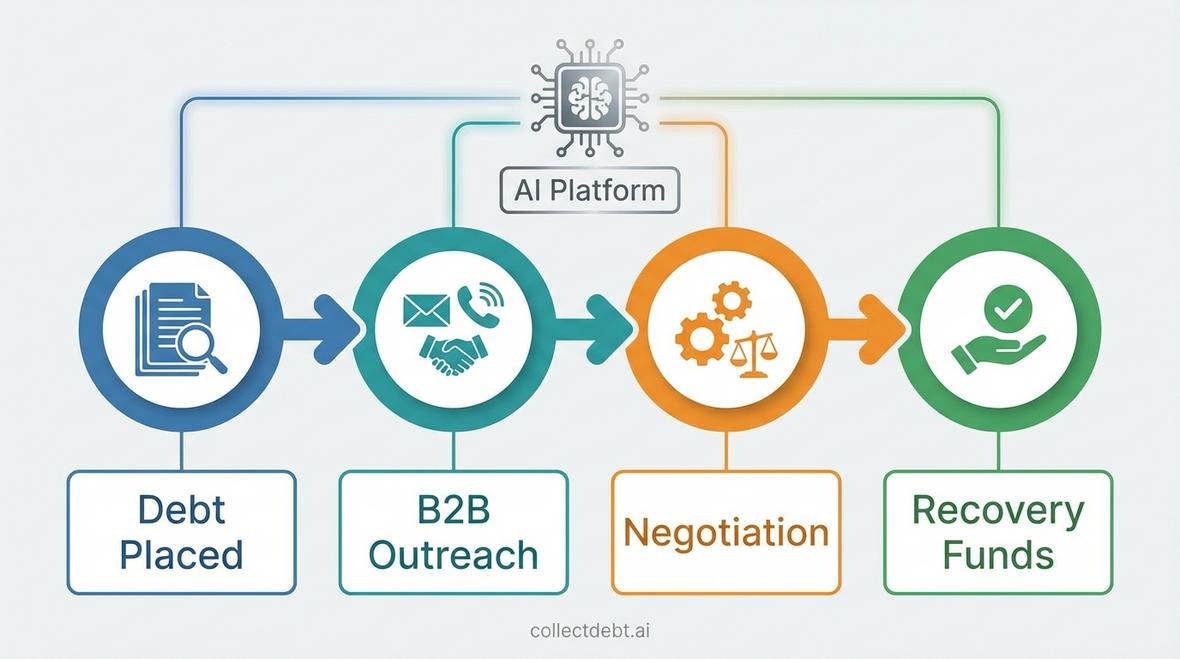
The regulatory landscape has also evolved substantially. Data from the Third-Party Debt Collections Tradelines Reporting Trends shows a 33% decline in collections tradelines from Q1 2018 to Q1 2022 (from 261 million to 175 million), with contingency-fee collectors furnishing 38% fewer tradelines. This regulatory pressure necessitates that modern b2b debt collection agencies maintain impeccable compliance systems an area where AI-powered platforms excel through automated documentation and adherence protocols.
Core Technology Infrastructure of Modern B2B Debt Collection Agencies
The technological foundation separating high-performing agencies from legacy operations centers on several critical capabilities. Enterprise decision-makers evaluating b2b debt collection agency partnerships or internal system upgrades should prioritize these infrastructure components.
AI-Powered Multi-Channel Communication Systems
Contemporary collection operations require seamless orchestration across voice, SMS, email, and digital channels. Omnichannel support enables agencies to engage debtors through their preferred communication medium while maintaining conversation continuity across platforms. Advanced systems employ conversational AI that can handle complex negotiations, process payment arrangements, and escalate appropriately to human agents when necessary.
The implementation of inbound conversational AI has proven particularly transformative. Rather than relying solely on outbound campaigns, agencies now deploy intelligent systems that can handle debtor-initiated contact with the same sophistication as experienced collection specialists. This capability reduces wait times, increases debtor satisfaction, and captures payment commitments during high-intent moments when debtors proactively reach out.
Compliance Automation and Documentation
Regulatory adherence represents both a legal necessity and a competitive differentiator. Modern b2b debt collection agencies implement compliance automation systems that automatically enforce FDCPA, TCPA, and industry-specific regulations at every customer touchpoint. These systems maintain comprehensive audit trails, automatically cease communication when required, and ensure all disclosures are properly delivered and documented.
For CFOs and compliance officers, this automation dramatically reduces regulatory risk exposure while eliminating the labor costs associated with manual compliance monitoring. The system intelligence extends to understanding jurisdiction-specific requirements, automatically adjusting collection approaches based on debtor location and applicable state regulations.
Identity Verification and Right Party Contact
One of the most significant cost drains in traditional collections involves contacting wrong parties or failing to properly verify debtor identity. Right party verification technology leverages voice biometrics, knowledge-based authentication, and data validation to ensure agencies connect with the correct individual before discussing account details.
This capability protects agencies from FDCPA violations related to third-party disclosure while dramatically improving contact efficiency. Rather than spending agent time on unproductive conversations, resources focus exclusively on verified debtor interactions that can progress toward resolution.
Operational Advantages of AI-Driven B2B Debt Collection Agencies
The operational benefits of technology-forward b2b debt collection agencies manifest across multiple performance dimensions that directly impact enterprise bottom lines.
Scalability Without Proportional Cost Increases
Traditional collection agencies face a fundamental constraint: increased collection volume requires proportional increases in staffing. AI-powered platforms fundamentally break this relationship. AI debt collection systems can handle thousands of simultaneous conversations, scaling instantly to accommodate portfolio growth or seasonal fluctuations without the recruitment, training, and infrastructure costs associated with human agent expansion.
For Directors of Operations managing large portfolios, this scalability translates to predictable per-account economics regardless of volume. The marginal cost of processing additional accounts approaches zero once the platform infrastructure is established, fundamentally altering the unit economics of collection operations.
Recovery Rate Optimization Through Personalization
Modern AI systems analyze debtor behavior patterns, payment history, and communication preferences to optimize outreach strategies for each individual account. This personalization extends to contact timing, channel selection, message framing, and payment plan structuring. The result is measurably higher recovery rates compared to one-size-fits-all approaches.
End-to-end collection platforms continuously learn from outcomes, refining their approaches based on what strategies prove most effective for different debtor segments. This machine learning capability means performance improves over time rather than degrading due to agent burnout or turnover a persistent challenge in traditional operations.
Automated Promise-to-Pay and Self-Service Resolution
Empowering debtors with self-service options dramatically improves both recovery rates and debtor satisfaction. Self-service debt resolution portals allow debtors to view balances, negotiate payment terms, and submit payments 24/7 without agent involvement. This accessibility removes friction from the payment process while reducing operational costs.
Integrated promise-to-pay functionality enables debtors to commit to payment schedules that fit their financial circumstances. The system automatically generates reminders, processes scheduled payments, and re-engages if commitments aren't honored all without manual intervention. For enterprise collections operations, this automation represents the difference between profitable and unprofitable small-balance recovery.
Industry-Specific B2B Debt Collection Agency Applications
Different industries present unique collection challenges that sophisticated b2b debt collection agencies must navigate with specialized approaches.
Financial Services Collections
Financial institutions managing consumer and commercial loan portfolios require collection systems that integrate seamlessly with core banking platforms. Financial service collections demand particularly rigorous compliance documentation and often involve complex regulatory reporting requirements. AI platforms serve these needs by maintaining comprehensive interaction records while automatically generating required regulatory reports.
Healthcare Revenue Cycle Management
Medical debt presents unique sensitivity requirements and regulatory constraints. Healthcare collections benefit from AI systems trained to handle patient financial conversations with appropriate empathy while navigating HIPAA compliance requirements. The ability to offer flexible payment arrangements and process insurance coordination makes AI particularly valuable in this vertical.
Auto Finance and Transportation
Vehicle repossession represents a last resort with significant costs and customer relationship damage. Auto finance collections leverage AI to maximize pre-repossession recovery through personalized payment arrangements that account for vehicle value, loan-to-value ratios, and debtor circumstances. The technology enables more debtors to retain their vehicles while satisfying obligations a win-win outcome that traditional approaches often miss.
Integration Architecture for Enterprise B2B Debt Collection
Enterprise-grade b2b debt collection agency technology must integrate seamlessly with existing business systems to maximize value and operational efficiency. Modern platforms provide robust integration capabilities that connect with:
- Customer Relationship Management (CRM) Systems: Bidirectional data synchronization ensures collection activities inform broader customer relationship strategies while leveraging existing customer data to personalize collection approaches.
- Accounts Receivable Platforms: Direct integration with accounts receivable systems enables real-time account status updates, automatic payment posting, and seamless workflow transitions between AR management and collections.
- Payment Processing Infrastructure: Native connections to payment gateways facilitate immediate payment processing during debtor conversations, capturing commitment while intent is highest.
- Analytics and Reporting Systems: Data extraction capabilities feed enterprise business intelligence platforms, enabling comprehensive performance analysis and strategic decision-making.
The data extraction capabilities of modern platforms ensure that collection performance metrics integrate into broader operational dashboards, providing CFOs and operations leaders with unified visibility across all revenue cycle components.
Performance Measurement and Analytics for B2B Debt Collection
Sophisticated measurement frameworks separate high-performing b2b debt collection agencies from mediocre operations. Decision-makers should evaluate agency performance whether internal or outsourced across these critical dimensions:
Recovery Rate and Liquidation Metrics
The fundamental measure remains dollars recovered as a percentage of dollars placed. However, sophisticated analysis segments this metric by account age, balance size, debtor demographics, and placement channel. This granularity reveals which strategies work for which segments, enabling continuous optimization.
Operational Efficiency Indicators
Cost per dollar collected, right party contact rate, and promise-to-pay conversion rate reveal operational efficiency. AI-powered platforms typically demonstrate 60-80% reductions in cost per dollar collected compared to traditional operations, while simultaneously improving debtor experience metrics.
Compliance and Quality Assurance
Regulatory violation rates, disclosure delivery confirmation rates, and dispute resolution timelines indicate compliance program effectiveness. Post-call analysis capabilities enable automated quality assurance at 100% coverage rather than the 2-5% sample rates typical in manual QA programs.
Selecting a B2B Debt Collection Agency Partner in 2026
For enterprises evaluating b2b debt collection agency partnerships, several critical factors should guide selection decisions:
Technology Maturity and Innovation Roadmap
Assess not only current capabilities but the vendor's technology roadmap and investment in innovation. The collections technology landscape evolves rapidly partners must demonstrate commitment to continuous advancement rather than static legacy platforms.
Compliance Track Record and Expertise
Request detailed compliance violation histories, regulatory audit results, and documentation of compliance training programs. Even minor violations can expose your enterprise to regulatory action and reputational damage.
Integration Flexibility and Implementation Support
Evaluate the technical requirements and timelines for integrating the agency's platform with your existing systems. Implementations that require extensive custom development or lengthy timelines delay value realization and increase total cost of ownership.
Performance Transparency and Reporting
Demand real-time performance dashboards with granular segmentation capabilities. Opaque reporting prevents the strategic analysis necessary for portfolio optimization and vendor accountability.
Implementation Strategy for AI-Powered B2B Debt Collection
Successfully transitioning to AI-powered b2b debt collection agency operations requires thoughtful implementation planning that addresses both technical and organizational change management dimensions.
Phased Rollout Approach
Rather than wholesale replacement of existing systems, successful implementations typically follow a phased approach. Begin with a defined portfolio segment perhaps recent delinquencies or specific balance ranges to validate performance and refine configurations before broader deployment.
Agent Augmentation Before Replacement
Position AI initially as agent augmentation rather than replacement to reduce organizational resistance and leverage the complementary strengths of human expertise and machine efficiency. Experienced collectors can focus on complex negotiations and relationship preservation while AI handles high-volume routine interactions.
Continuous Optimization Cycles
Establish regular review cycles to analyze performance data, adjust strategies, and incorporate learnings. AI systems improve through iteration organizations that treat implementation as ongoing optimization rather than one-time deployment realize substantially better outcomes.
Future Trends in B2B Debt Collection Agency Operations
The trajectory of b2b debt collection agency evolution points toward several emerging trends that forward-thinking decision-makers should monitor:
Predictive Analytics and Preemptive Engagement
Advanced analytics will increasingly enable agencies to identify accounts at risk of delinquency before payment failures occur, facilitating preemptive engagement that prevents collection placement entirely. This shift from reactive recovery to proactive account management represents a fundamental operational paradigm change.
Behavioral Economics Integration
Collection strategies will increasingly incorporate behavioral economics principles, leveraging insights about decision-making psychology to frame payment options in ways that maximize voluntary compliance while respecting debtor autonomy.
Regulatory Technology (RegTech) Advancement
As regulatory frameworks grow more complex and jurisdiction-specific, specialized regulatory technology will become essential infrastructure for compliant operations. AI systems will automatically navigate evolving regulatory requirements across multiple jurisdictions without manual policy updates.
Frequently Asked Questions
What makes a B2B debt collection agency different from consumer collections?
B2B debt collection involves business-to-business accounts receivable, typically featuring larger balance amounts, longer payment terms, and different regulatory frameworks than consumer debt. B2B agencies must navigate commercial contracts, business credit reporting, and often ongoing vendor-customer relationships that require more nuanced approaches than consumer collections.
How does AI improve recovery rates in B2B debt collection?
AI enhances recovery through personalized engagement strategies, optimal contact timing, multi-channel orchestration, and continuous learning from outcome data. By analyzing thousands of data points across successful and unsuccessful collection attempts, AI identifies patterns that maximize payment likelihood for each specific debtor profile.
What compliance risks should enterprises consider when partnering with a debt collection agency?
Primary compliance risks include FDCPA violations, TCPA infractions related to automated calling, improper third-party disclosures, and failure to validate debts when disputed. Enterprises retain liability exposure for agency violations in many jurisdictions, making partner compliance track records critically important in vendor selection.
Can AI-powered collection systems completely replace human collectors?
While AI handles routine interactions exceptionally well, complex negotiations, unique debtor circumstances, and relationship-sensitive situations often benefit from human judgment and empathy. The optimal model typically combines AI for scalable routine interactions with human expertise for complex cases, creating operational efficiency while maintaining resolution quality.
What ROI should enterprises expect from implementing AI debt collection technology?
Typical implementations demonstrate 15-30% improvements in recovery rates, 60-80% reductions in cost per dollar collected, and 40-60% decreases in time to resolution. However, ROI varies significantly based on portfolio characteristics, existing operational efficiency, and implementation quality.
Conclusion
The modern b2b debt collection agency landscape has fundamentally transformed through AI integration, regulatory evolution, and changing debtor expectations. For Collections Managers, Directors of Operations, and CFOs, understanding these changes is no longer optional it's essential for competitive positioning and financial performance. The market data demonstrates clear growth trajectories favoring technology-forward approaches, while regulatory pressures demand unprecedented compliance rigor. Platforms like collectdebt.ai represent the convergence of these trends, offering enterprise-grade solutions that maximize recovery rates while minimizing operational costs and regulatory risks. As the industry continues evolving toward AI-powered, omnichannel, compliance-first operations, decision-makers who proactively adopt these technologies will capture significant competitive advantages in both recovery performance and operational efficiency.
Ready to Transform Your Collections Process?
See how CollectDebt.ai can help you automate debt collection, reduce costs, and improve compliance.