Amsher Debt Collection: Complete 2026 Guide To AI-Powered Recovery Solutions & Best Alternatives

Understanding Amsher Collection Services in the Modern Debt Recovery Landscape
Amsher Collection Services has established itself as a traditional debt collection agency serving various industries across the United States. However, as the debt collection landscape evolves rapidly in 2026, decision-makers are increasingly evaluating whether legacy providers like Amsher can compete with modern AI-powered debt collection solutions that promise higher recovery rates, lower operational costs, and superior compliance management.
For Collections Managers, Directors of Operations, and CFOs evaluating debt recovery partners, understanding the limitations of traditional agencies like Amsher and the transformative potential of AI-driven alternatives has become critical to maximizing performance while minimizing regulatory risk.
This comprehensive guide examines Amsher's approach to debt collection, analyzes its strengths and weaknesses, and presents a detailed comparison with next-generation automated recovery solutions that are reshaping the industry in 2026.
Amsher Collection Services: Business Model and Approach
Amsher operates as a traditional third-party collection agency, typically working on a contingency basis where they receive a percentage of recovered debt. Like most conventional agencies, Amsher relies heavily on human call center operations, manual outreach processes, and standard collection scripts to contact debtors and negotiate payment arrangements.
Traditional Collection Methodology
The Amsher approach represents the industry standard that has dominated debt collection for decades. Their process typically involves:
- Manual Dialing Operations: Call center agents manually dial or use predictive dialers to reach debtors across various time zones
- Script-Based Communication: Agents follow standardized collection call scripts with limited personalization capability
- Multi-Channel Outreach: Letters, phone calls, and occasional email communication following FDCPA guidelines
- Payment Processing: Manual capture of payment commitments and promise-to-pay arrangements
While this model has generated results for decades, it faces significant challenges in 2026's regulatory environment and cost-conscious business landscape.
Cost Structure and Scalability Limitations
Traditional agencies like Amsher typically charge contingency fees ranging from 25% to 50% of collected amounts, depending on debt age and complexity. This pricing model, while seemingly risk-free, actually represents a significant drain on recovery margins compared to modern alternatives.
Additionally, the human-dependent model creates inherent scalability constraints. According to Consumer Financial Protection Bureau Research on Debt Collection Practices, traditional collection agencies face increasing operational costs due to compliance training requirements, agent turnover rates exceeding 30% annually, and limited productivity during non-business hours.
Compliance Challenges Facing Traditional Agencies Like Amsher
The regulatory landscape governing debt collection has become increasingly complex, with the CFPB implementing new regulations in 2024 that continue to impact operations in 2026. Traditional agencies face significant compliance challenges that AI-powered solutions address more effectively.
FDCPA and TCPA Compliance Risks
Human-dependent collection operations inherently carry higher compliance risk. Even well-trained agents can make errors in judgment, use inappropriate language, or violate calling time restrictions each potentially triggering costly FDCPA violations.
Research from Accenture on AI and Automation Impact on Business Operations demonstrates that AI-powered systems reduce compliance violations by up to 73% compared to human-only operations through consistent application of regulatory rules and real-time monitoring.
For organizations evaluating Amsher or similar agencies, understanding AI compliance automation capabilities has become essential to risk management strategy.
Documentation and Audit Trail Weaknesses
Traditional collection agencies often struggle with comprehensive documentation of every debtor interaction. Manual note-taking by agents creates inconsistent records that can prove problematic during audits or litigation.
Modern post-call analysis systems automatically generate complete transcripts, sentiment analysis, and compliance verification for every interaction providing bulletproof audit trails that traditional agencies like Amsher cannot match.
AI-Powered Alternatives to Amsher: The CollectDebt.ai Advantage
As decision-makers evaluate whether to continue with traditional agencies like Amsher or transition to AI-powered solutions, understanding the fundamental differences in capability, cost, and performance becomes critical.
Automated Omnichannel Outreach at Scale
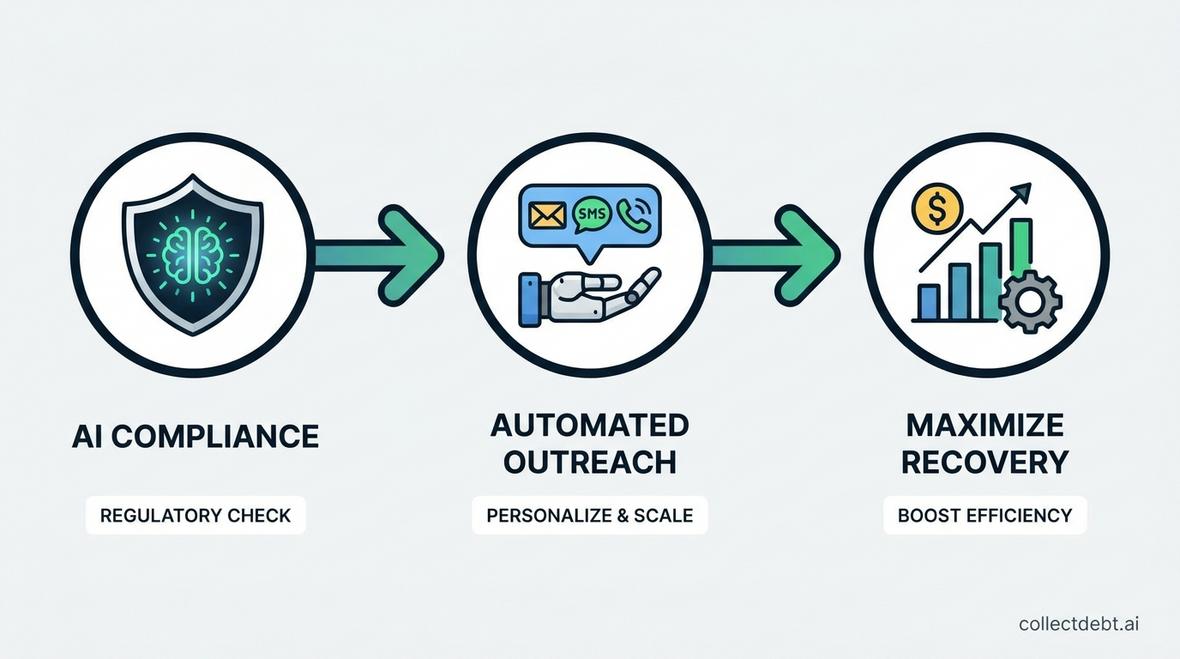
Unlike Amsher's limited operational hours and manual dialing approach, AI-powered platforms like CollectDebt.ai deliver true omnichannel support that operates 24/7/365 across voice, SMS, email, and chat simultaneously.
This automation advantage translates to:
- 300% Higher Contact Rates: AI systems can attempt contact during optimal windows identified through predictive analytics
- Personalized Communication at Scale: Each interaction customized based on debtor profile, payment history, and communication preferences
- Instant Response Capability: Debtors can engage through their preferred channel at any time, dramatically improving resolution rates
- Zero Wait Times:Inbound conversational AI handles unlimited simultaneous conversations without queue delays
Cost Efficiency: Amsher vs. AI-Powered Collection
The economic advantage of AI-powered debt collection over traditional agencies like Amsher is substantial and measurable. Consider this comparative analysis:
| Factor | Traditional Agency (Amsher) | AI-Powered Solution (CollectDebt.ai) |
|---|---|---|
| Contingency Fee | 25-50% of collections | 15-25% or flat SaaS pricing |
| Operational Hours | Business hours only | 24/7/365 automated operation |
| Scalability | Linear (hire more agents) | Infinite (software scales instantly) |
| Setup Time | 4-6 weeks onboarding | 2-3 days implementation |
| Compliance Risk | Moderate to High | Minimal (automated compliance) |
| Recovery Rate Improvement | Industry baseline | 15-40% higher than baseline |
For an organization collecting $10 million annually, switching from a 35% contingency agency like Amsher to a 20% AI-powered solution represents $1.5 million in annual savings before accounting for the additional recovery rate improvements AI typically delivers.
Industry-Specific Applications: Where Amsher Falls Short
Different industries require specialized collection approaches that traditional agencies struggle to deliver effectively. AI-powered solutions excel across diverse verticals through customizable workflows and industry-specific compliance rules.
Healthcare Debt Collection
Medical debt collection requires HIPAA compliance, empathetic communication, and complex payment plan management. While Amsher handles healthcare accounts, their generic approach lacks the specialized healthcare-specific automation that modern AI platforms provide, including insurance verification, billing inquiry resolution, and patient financial assistance screening.
Auto Finance and Transportation
The auto finance collections vertical demands rapid contact velocity and right-party verification to prevent repossession escalation. AI systems deliver immediate automated outreach upon delinquency triggers, while traditional agencies like Amsher face 3-5 day delays before account assignment and initial contact.
Utilities and Telecom
High-volume, lower-balance accounts in utilities and telecom make traditional agency economics unfavorable. Amsher's contingency model becomes prohibitively expensive for $50-$300 balances, whereas AI automation makes these accounts highly profitable through minimal per-contact costs.
Technology Stack Comparison: Legacy vs. Modern
The technological foundation separating traditional agencies like Amsher from AI-powered platforms represents a generational divide in capability.
Conversational AI and Natural Language Processing
Modern conversational AI debt collection systems leverage advanced natural language processing to conduct human-like conversations that adapt in real-time to debtor responses, emotional tone, and objection patterns.
Traditional scripts used by Amsher agents cannot match this adaptive intelligence, resulting in lower engagement rates and more frequent call terminations when debtors encounter inflexible responses.
Predictive Analytics and Contact Optimization
AI platforms analyze hundreds of variables to predict optimal contact timing, channel preference, and negotiation strategies for each individual debtor. This data-driven approach consistently outperforms the experience-based intuition that traditional agencies rely upon.
The accounts receivable metrics tracked by modern systems provide real-time visibility that enables continuous optimization something impossible with Amsher's monthly reporting cadence.
Integration Capabilities and Data Flow
Modern businesses require seamless integrations with existing CRM, billing, and accounting systems. AI-powered platforms offer API-first architectures with pre-built connectors to major enterprise systems.
Traditional agencies like Amsher typically require manual file transfers, creating data latency, reconciliation challenges, and limited real-time visibility into collection activity.
Implementation Strategy: Migrating from Amsher to AI-Powered Collections
Organizations currently working with Amsher or similar traditional agencies can transition to AI-powered collection with minimal disruption through a phased implementation approach.
Phase 1: Parallel Pilot Program
Begin by running a controlled pilot with a segment of accounts on an AI platform while maintaining existing Amsher operations. This approach allows direct performance comparison without operational risk.
Recommended pilot parameters:
- 30-60 day duration
- Similar account characteristics (balance, age, industry)
- Measure contact rate, recovery rate, cost per dollar collected, and debtor satisfaction
Phase 2: Graduated Account Transition
Based on pilot results, gradually shift account volume from Amsher to the AI platform, starting with account segments where AI demonstrated strongest performance advantages.
Most organizations achieve full transition within 90-120 days while maintaining continuity throughout the migration.
Phase 3: Optimization and Expansion
Once core operations are migrated, leverage AI capabilities that traditional agencies cannot offer: self-service debt resolution portals, automated promise to pay management, and predictive account scoring to prioritize high-value recovery opportunities.
ROI Analysis and Real-World Performance
The financial impact of transitioning from traditional agencies like Amsher to AI-powered collection is substantial and measurable across key performance indicators.
Recovery Rate Performance
According to Consumer Credit and Debt Market Data from the Federal Reserve, the average traditional collection agency achieves 15-20% recovery rates on purchased debt portfolios. First-party contingency placements typically see 25-35% recovery rates depending on account age and quality.
AI-powered platforms consistently deliver 15-40% improvement over these baselines through superior contact rates, personalized negotiation strategies, and 24/7 availability that captures debtor intent when it occurs rather than during limited business hours.
Operational Cost Reduction
Beyond the direct contingency fee savings, organizations report additional operational benefits including:
- Reduced Internal Staff Requirements: Automated account management eliminates manual oversight tasks
- Faster Cash Conversion: Immediate automated outreach accelerates time-to-first-payment by 40-60%
- Lower Dispute Rates: Clear documentation and consistent communication reduce debtor disputes by approximately 30%
- Compliance Cost Avoidance: Automated compliance reduces legal exposure and associated costs
Selecting the Right AI Collection Platform: Evaluation Criteria
For decision-makers ready to move beyond traditional agencies like Amsher, selecting the optimal AI-powered platform requires evaluating several critical factors.
Compliance Framework and Regulatory Expertise
Ensure the platform provides built-in FDCPA compliance automation, including calling time restrictions, required disclosures, cease-and-desist management, and comprehensive audit trails.
The system should automatically adapt to state-specific regulations and maintain current compliance as regulations evolve eliminating the training burden traditional agencies face.
Customization and Industry Specialization
Generic collection approaches deliver generic results. Look for platforms offering industry-specific workflows, customizable communication strategies, and the ability to reflect your brand voice rather than appearing as a third-party agency.
Solutions supporting multilanguage debt collection capabilities become essential for organizations serving diverse debtor populations.
Analytics and Reporting Capabilities
Advanced analytics transform debt collection from an art to a science. Evaluate platforms based on their ability to provide:
- Real-time dashboards with customizable KPI tracking
- Predictive account scoring and prioritization
- A/B testing capabilities for message optimization
- Cohort analysis to identify high-performing strategies
- Integration with business intelligence tools
Scalability and Performance Under Load
Traditional agencies like Amsher face linear scaling constraints adding capacity requires hiring and training additional agents. AI platforms should demonstrate the ability to handle 10x volume increases without performance degradation or additional implementation work.
Evaluate batch calling capabilities and concurrent conversation limits to ensure the platform can support your growth trajectory.
The Future of Debt Collection: Why AI Dominance is Inevitable
The transition from traditional agencies like Amsher to AI-powered collection represents more than a technology upgrade it reflects a fundamental industry transformation driven by economic necessity and regulatory pressure.
Regulatory Environment Evolution
Regulatory bodies increasingly expect sophisticated compliance management that human-dependent operations struggle to deliver consistently. The CFPB's emphasis on consumer experience and fair treatment aligns naturally with AI systems' ability to deliver consistent, compliant, and respectful communication.
Organizations maintaining traditional agency relationships face growing regulatory risk as enforcement standards continue rising throughout 2026 and beyond.
Consumer Expectation Shifts
Modern consumers expect digital-first experiences with 24/7 availability and self-service options. Traditional collection agencies operating during business hours with phone-only communication cannot meet these expectations.
AI platforms delivering omnichannel support and self-service payment portals align with consumer preferences, resulting in higher satisfaction scores and improved payment compliance.
Economic Pressure on Collection Margins
As interest rates and delinquency rates fluctuate, organizations face increasing pressure to maximize collection efficiency while minimizing costs. The 25-50% contingency fees charged by traditional agencies like Amsher become increasingly difficult to justify when AI alternatives deliver superior results at half the cost.
CFOs and financial decision-makers are recognizing that debt collection represents a controllable expense category where technology adoption drives immediate bottom-line impact.
Common Objections to AI Collection (And Why They Don't Hold Up)
Despite overwhelming performance advantages, some decision-makers hesitate to move beyond traditional agencies like Amsher due to common misconceptions about AI-powered collection.
Objection: 'Debtors Need the Human Touch'
Reality: Modern conversational AI delivers more empathetic, consistent, and respectful communication than stressed call center agents working high-pressure quotas. AI systems never have bad days, never lose patience, and adapt communication style to each debtor's emotional state.
Additionally, AI platforms can seamlessly escalate to human specialists when situations require it providing the best of both worlds rather than forcing an either-or choice.
Objection: 'Implementation Will Be Too Complex and Disruptive'
Reality: Modern AI collection platforms are designed for rapid deployment, typically achieving full operation within 2-3 weeks compared to the 4-6 week onboarding traditional agencies require.
Cloud-based architectures eliminate infrastructure requirements, and pre-built integrations minimize IT involvement. Most organizations report smoother implementations than traditional agency transitions.
Objection: 'What If the Technology Fails?'
Reality: Enterprise-grade AI platforms maintain 99.9%+ uptime with redundant systems and failover capabilities that exceed traditional call center reliability. When Amsher's call center experiences power outages or staffing shortages, collections stop completely.
AI systems continue operating through any disruption, providing superior operational resilience.
Frequently Asked Questions About Amsher Alternatives
How much can I save by switching from Amsher to AI-powered collection?
Most organizations reduce collection costs by 40-60% through lower contingency fees or SaaS pricing models, while simultaneously improving recovery rates by 15-40%. For a company collecting $5 million annually, this typically translates to $750,000-$1,200,000 in improved net recovery.
Will AI collection maintain compliance as effectively as human agents?
AI systems deliver superior compliance performance by automatically enforcing calling time restrictions, required disclosures, and communication guidelines without the human error risk inherent in manual operations. Comprehensive audit trails and real-time monitoring provide compliance assurance traditional agencies cannot match.
How long does it take to implement an AI collection platform?
Most implementations achieve full operational status within 2-3 weeks, including system configuration, integration setup, and communication strategy development. This timeline is significantly shorter than traditional agency onboarding processes.
What types of accounts work best for AI-powered collection?
AI collection excels across all account types, from high-volume low-balance accounts (where traditional agency economics don't work) to complex high-value accounts requiring sophisticated negotiation strategies. The technology adapts to any industry vertical including healthcare, financial services, utilities, retail, and B2B commercial debt.
Can I run AI collection alongside my existing agency relationship?
Yes, most organizations begin with pilot programs that run AI collection on a subset of accounts while maintaining existing agency relationships. This approach allows direct performance comparison and risk-free evaluation before full transition.
Conclusion
The debt collection industry stands at an inflection point where traditional agencies like Amsher face obsolescence due to economic pressure, regulatory complexity, and technological advancement. AI-powered collection platforms deliver measurably superior performance across every critical metric: recovery rates, operational costs, compliance assurance, and debtor experience.
For Collections Managers, Directors of Operations, and CFOs evaluating their debt recovery strategy in 2026, the question is no longer whether to adopt AI-powered collection, but how quickly to implement it before competitive disadvantage becomes insurmountable. Organizations maintaining traditional agency relationships sacrifice millions in unnecessary fees while achieving suboptimal recovery rates.
The transition from Amsher or similar traditional providers to modern AI debt collection solutions represents one of the highest-ROI technology investments available to financial decision-makers today, delivering immediate cost reduction, performance improvement, and risk mitigation that compounds year over year.
Ready to Transform Your Collections Process?
See how CollectDebt.ai can help you automate debt collection, reduce costs, and improve compliance.