3rd Party Collect: The Complete 2026 Guide To Third-Party Debt Collection With AI

Understanding Third-Party Debt Collection in 2026
Third-party debt collection, commonly referred to as 3rd party collect, is a critical component of the financial services ecosystem. When original creditors are unable to recover outstanding debts through their internal collections efforts, they turn to specialized agencies that operate as intermediaries between debtors and creditors. These agencies work on either a contingency-fee basis or through debt purchasing arrangements, representing a multi-billion dollar industry that continues to evolve rapidly in response to technological innovation and regulatory pressures.
The landscape of 3rd party collect has undergone significant transformation in recent years. According to 38% reduction in tradelines furnished by contingency-fee-based third-party collectors, the number of contingency-fee-based debt collectors declined 18% from 815 to 672 between Q1 2018 and Q1 2022. This consolidation reflects both market pressures and the increasing complexity of compliance requirements, pushing agencies toward more sophisticated operational models.
Despite these challenges, the debt collection market continues to show robust growth. Research indicates a 3.4% CAGR growth in debt collection market from 2025 to 2026, with the market expanding from $30.19 billion in 2025 to $31.2 billion in 2026. This growth is attributed to rising non-performing loans and an increasing trend toward outsourced collection services as businesses seek to optimize their accounts receivable management.
Traditional Third-Party Collection Models and Their Limitations
Historically, 3rd party collect operations have relied on high-volume call centers staffed with human agents who manually dial through lists of delinquent accounts. These traditional models present several inherent challenges that limit their effectiveness and scalability.
High Operational Costs and Resource Intensity
Traditional collection agencies face substantial overhead costs associated with maintaining large teams of trained collectors, supervisory staff, and compliance officers. The average cost per contact attempt can range from $8 to $15, making it economically unfeasible to pursue smaller-balance accounts aggressively. These cost pressures have intensified as agencies struggle to maintain profitability while adhering to increasingly stringent regulatory frameworks.
Regulatory Compliance Complexity
Third-party collectors must navigate a complex web of federal and state regulations, including the Fair Debt Collection Practices Act (FDCPA), Telephone Consumer Protection Act (TCPA), and numerous state-specific statutes. Manual processes increase the risk of compliance violations, which can result in costly lawsuits and reputational damage. The legal environment remains challenging, with up to 4.7 million debt collection lawsuits filed in 2022, reaching pre-pandemic highs and representing a significant portion of civil court dockets.
Limited Scalability and Coverage
Human-powered collection operations face natural constraints on the number of accounts they can effectively manage. Collector fatigue, turnover rates averaging 30-40% annually, and the inability to contact consumers across multiple time zones simultaneously all contribute to suboptimal recovery rates. These limitations become particularly acute when dealing with high-volume portfolios or geographically dispersed debtor populations.
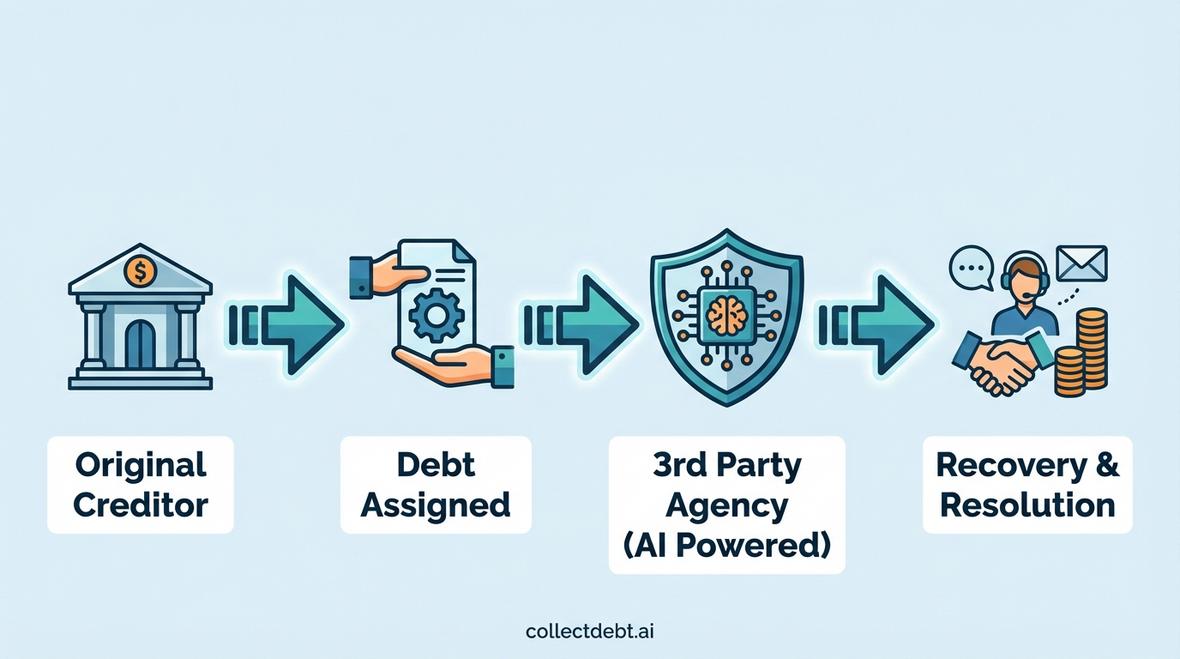
The AI Transformation of 3rd Party Collect Operations
Artificial intelligence is fundamentally reshaping how third-party collection agencies operate, offering solutions to the challenges that have plagued traditional models. AI-powered debt collection platforms leverage sophisticated technologies including natural language processing, machine learning, and predictive analytics to automate and optimize the collections process.
Automated Multi-Channel Outreach
Modern AI collection systems can simultaneously engage thousands of debtors across multiple communication channels including voice calls, SMS, email, and chat. This omnichannel approach ensures that consumers receive communications through their preferred methods, significantly improving contact rates and engagement. AI voice agents can conduct natural, empathetic conversations that are indistinguishable from human interactions, while maintaining perfect compliance with all regulatory requirements.
Intelligent Debtor Segmentation and Prioritization
AI algorithms analyze vast datasets to segment debtors based on likelihood to pay, preferred communication channels, optimal contact times, and payment capacity. This data-driven approach enables agencies to allocate resources more effectively, focusing human collectors on high-value accounts that require nuanced negotiation while automating routine interactions. Predictive models can identify the most effective collection strategies for each account, dramatically improving recovery rates while reducing operational costs.
Built-In Compliance and Quality Assurance
One of the most significant advantages of AI in 3rd party collect operations is the ability to hardcode regulatory compliance into every interaction. Compliance-focused AI systems ensure that every communication adheres to FDCPA requirements, including proper disclosure of Mini-Miranda rights, accurate debt validation, and respect for communication preferences. Post-call analysis features provide comprehensive documentation of all interactions, creating an audit trail that protects agencies from litigation while identifying opportunities for process improvement.
Key Technologies Enabling AI-Powered 3rd Party Collect
Several technological innovations have converged to make AI-driven collections not only feasible but superior to traditional approaches.
Conversational AI and Natural Language Understanding
Advanced conversational AI platforms utilize large language models (LLMs) to understand context, sentiment, and intent in debtor communications. These systems can handle complex dialogues, answer questions, address objections, and negotiate payment arrangements with a level of sophistication that rivals human collectors. The ability to maintain context across multiple interactions and channels creates a seamless experience that improves debtor satisfaction and willingness to engage.
Voice AI and Speech Recognition
Modern voice AI technology enables automated outbound calling at scale, with systems capable of conducting thousands of simultaneous conversations. These voice AI agents incorporate natural speech patterns, appropriate pauses, and empathetic tone modulation that makes interactions feel genuinely human. Advanced speech recognition ensures accurate transcription of debtor responses, enabling real-time decision-making and appropriate escalation when necessary.
Right Party Contact Verification
A critical component of compliant 3rd party collect operations is ensuring that communications reach the intended debtor and not unauthorized third parties. AI-powered right party verification uses voice biometrics, knowledge-based authentication, and behavioral analysis to confirm identity before discussing sensitive account information, protecting both the agency and the consumer from unauthorized disclosure.
Implementation Strategies for Third-Party Collection Agencies
Successfully transitioning to AI-enhanced 3rd party collect operations requires strategic planning and phased implementation.
Portfolio Analysis and Strategic Segmentation
Begin by conducting a comprehensive analysis of your existing portfolio to identify accounts most suitable for AI automation. Typically, agencies find success starting with high-volume, lower-balance accounts where the economics of manual collection are least favorable. As confidence in the AI system grows, gradually expand to more complex accounts while maintaining human oversight for the most sensitive or high-value cases.
Integration with Collection Management Systems
Effective AI implementation requires seamless integration with existing collection management software, payment processors, and CRM systems. This integration ensures that all account information, payment history, and interaction records are synchronized in real-time, enabling AI agents to access current data and update records immediately following each interaction. API-based integrations typically offer the most flexibility and reliability for connecting disparate systems.
Establishing Robust Compliance Frameworks
While AI systems come with built-in compliance capabilities, agencies must establish comprehensive governance frameworks that define acceptable communication parameters, escalation protocols, and quality assurance procedures. Regular audits of AI-generated communications, ongoing training of the AI models on evolving regulations, and maintaining human oversight of edge cases ensure that automation enhances rather than compromises compliance posture.
Industry-Specific Applications of 3rd Party Collect AI
Different industries present unique challenges and opportunities for AI-powered collections.
Healthcare and Medical Debt
The healthcare industry faces particularly sensitive collection scenarios where empathy and understanding are paramount. AI systems can be trained to recognize when debtors are experiencing financial hardship or medical crises, offering appropriate payment plans and connecting patients with financial assistance programs. The ability to handle high volumes of smaller-balance accounts makes AI particularly valuable in medical collections, where manual follow-up on every outstanding bill is economically prohibitive.
Auto Finance and Transportation
For auto finance collections and truck and transportation industries, AI enables proactive early-out strategies that engage borrowers before accounts become severely delinquent. AI systems can identify payment patterns that predict default risk, triggering automated outreach that offers alternative payment arrangements before repossession becomes necessary. This approach preserves customer relationships while protecting asset values.
Financial Services and Banking
The financial services sector benefits from AI's ability to handle diverse portfolio types including credit cards, personal loans, and mortgages. AI-powered systems can dynamically adjust collection strategies based on account type, balance, delinquency stage, and debtor behavior, optimizing recovery while maintaining the professional standards expected in banking relationships.
Measuring Success and ROI in AI-Powered 3rd Party Collect
Evaluating the effectiveness of AI implementation requires tracking specific metrics that demonstrate both operational efficiency and financial performance.
Key Performance Indicators
Critical metrics include right party contact rate, promise-to-pay conversion rate, payment fulfillment rate, cost per dollar collected, and overall recovery rate. Leading agencies implementing AI report contact rate improvements of 40-60%, cost reductions of 50-70%, and recovery rate increases of 20-35% compared to traditional methods. These improvements directly impact the bottom line while enabling agencies to accept lower contingency fees, making them more competitive in the marketplace.
Compliance and Risk Metrics
Beyond financial performance, agencies must monitor compliance-related metrics including complaint rates, cease-and-desist requests, regulatory inquiries, and litigation events. Properly implemented AI systems typically demonstrate significant improvements in these areas, with some agencies reporting 80-90% reductions in compliance-related incidents due to the elimination of human error and consistent application of regulatory requirements.
Future Trends Shaping 3rd Party Collect Operations
The evolution of AI technology continues to unlock new capabilities that will further transform the collections industry.
Advanced Predictive Analytics
Next-generation AI systems will leverage increasingly sophisticated predictive models that not only identify likelihood to pay but also predict optimal settlement amounts, ideal payment plan structures, and even life events that might impact payment capacity. This prescriptive approach moves beyond simple automation to truly intelligent decision-making that maximizes recovery while respecting debtor circumstances.
Hyper-Personalization at Scale
As AI systems accumulate interaction data and refine their understanding of individual debtor preferences and behaviors, collections communications will become increasingly personalized. This hyper-personalization extends beyond using the debtor's name to tailoring message content, tone, timing, and channel selection to match each individual's unique profile, dramatically improving engagement and conversion rates.
Regulatory Technology (RegTech) Integration
The convergence of AI collections technology with regulatory technology will create systems that not only comply with current regulations but proactively adapt to regulatory changes. These systems will monitor regulatory developments, automatically adjust communication parameters, and provide real-time guidance to ensure continuous compliance even as the regulatory landscape evolves.
Selecting the Right AI Platform for 3rd Party Collect
Choosing an appropriate AI collections platform requires careful evaluation of several critical factors.
Technology Maturity and Capabilities
Assess the platform's underlying technology, including the sophistication of its natural language processing, the quality of its voice synthesis, and its ability to handle complex dialogues. Request demonstrations with actual account scenarios from your portfolio to evaluate how the system performs with real-world complexity. Leading platforms like collectdebt.ai offer comprehensive capabilities across voice, SMS, email, and chat channels with proven performance in production environments.
Compliance and Security Features
Verify that the platform includes robust compliance controls for all applicable regulations, including FDCPA compliance frameworks, TCPA safeguards, and state-specific requirements. Security features should include end-to-end encryption, secure payment processing, and comprehensive audit logging. The platform should also support self-service debt resolution capabilities that empower consumers to manage their accounts securely.
Implementation Support and Scalability
Evaluate the vendor's implementation methodology, training resources, and ongoing support capabilities. The platform should scale seamlessly from pilot programs to full portfolio deployment without performance degradation. Look for vendors with proven experience in your specific industry vertical and portfolio types, as this domain expertise significantly accelerates time-to-value and reduces implementation risk.
Frequently Asked Questions About 3rd Party Collect
How does AI-powered 3rd party collect compare in cost to traditional methods?
AI-powered collection systems typically reduce operational costs by 50-70% compared to traditional call center operations. While there are upfront technology costs, the elimination of per-agent expenses, reduced training costs, and improved recovery rates result in significantly better ROI. Most agencies see positive returns within 3-6 months of implementation.
Are AI collection systems compliant with FDCPA and TCPA regulations?
When properly implemented, AI collection systems offer superior compliance compared to human-operated systems. They can be programmed to strictly adhere to all regulatory requirements, including proper disclosures, respect for communication preferences, and accurate record-keeping. However, agencies must select platforms with robust compliance frameworks and maintain appropriate oversight.
How do consumers respond to AI-driven collections communications?
Research indicates that when AI communications are well-designed, consumers often prefer them to human interactions due to reduced confrontation, 24/7 availability, and consistent professionalism. The key is ensuring that AI agents are empathetic, helpful, and offer genuine solutions rather than aggressive collection tactics. Transparency about the automated nature of communications is also important for maintaining trust.
What role do human collectors play in AI-powered 3rd party collect operations?
Human collectors remain valuable for handling complex negotiations, managing high-value accounts, addressing escalated complaints, and providing strategic oversight. The optimal model typically involves AI handling routine communications and account management while humans focus on situations requiring judgment, empathy, and creative problem-solving. This hybrid approach maximizes both efficiency and effectiveness.
Conclusion
The 3rd party collect industry stands at a transformative inflection point. As traditional collection models face mounting pressures from consolidation, regulatory complexity, and cost structures, AI-powered solutions offer a compelling path forward. By automating routine communications, enhancing compliance, and enabling data-driven decision-making, AI technologies allow collection agencies to achieve superior recovery rates while reducing operational costs and regulatory risk. Agencies that embrace these technologies strategically starting with appropriate account segments, ensuring robust compliance frameworks, and maintaining human oversight where needed position themselves to thrive in an increasingly competitive and regulated marketplace. The future of third-party collections belongs to organizations that successfully blend technological capability with human judgment, creating operations that are both more efficient and more respectful of consumer needs.
Ready to Transform Your Collections Process?
See how CollectDebt.ai can help you automate debt collection, reduce costs, and improve compliance.