Yay Pay Alternatives: AI-Powered Accounts Receivable Solutions For 2026

Introduction to Modern Accounts Receivable Challenges
In the rapidly evolving landscape of financial operations, businesses are increasingly scrutinizing their accounts receivable (AR) management solutions. Yay Pay, a traditional accounts receivable platform, has served organizations for years with its manual processes and basic automation features. However, as we move into 2026, the limitations of legacy AR systems become increasingly apparent. Companies seeking to optimize collection rates, reduce days sales outstanding (DSO), and improve cash flow are exploring more advanced alternatives that leverage artificial intelligence and automation.
The shift from manual, time-consuming processes to intelligent, automated systems represents more than just a technological upgrade it's a fundamental transformation in how organizations approach debt collection and accounts receivable management. Modern businesses require solutions that can scale effortlessly, comply with evolving regulations, and deliver measurable improvements in recovery rates. This comprehensive guide explores the landscape of yay pay alternatives, with particular focus on AI-powered solutions that are redefining the industry standard for AR management in 2026.
Understanding Yay Pay: Traditional AR Management
Yay Pay has positioned itself as an accounts receivable automation platform designed to help finance teams manage invoicing, collections, and cash application processes. The platform integrates with various ERP systems and provides dashboards for tracking outstanding invoices. However, users frequently report that yay pay relies heavily on manual intervention, requiring staff to personally review accounts, craft individual communications, and make strategic decisions about collection priorities.
The traditional approach embodied by yay pay typically involves scheduled reminders, template-based emails, and basic workflow automation. While these features represented innovation several years ago, they fall short of the capabilities businesses need in today's competitive environment. Manual processes introduce delays, increase operational costs, and limit scalability. Finance teams spend countless hours on repetitive tasks that could be automated, reducing their ability to focus on strategic initiatives that drive business growth.
Furthermore, yay pay and similar legacy platforms often struggle with integration complexity, limited analytics capabilities, and inflexible communication channels. As customer expectations evolve and payment preferences diversify, these limitations become increasingly problematic for organizations seeking to maintain competitive advantage in collections and cash flow optimization.
Key Limitations of Legacy AR Systems Like Yay Pay
Manual Processing and Human Dependency
One of the most significant drawbacks of yay pay and comparable platforms is the heavy reliance on manual processing. Collection agents must individually review accounts, determine appropriate actions, and execute communications. This approach not only increases labor costs but also introduces inconsistency in collection strategies. Human error, fatigue, and subjective decision-making can lead to missed opportunities and suboptimal recovery rates.
According to research, manual AR processes typically result in collection cycles that are 30-40% longer than automated alternatives. The time lag between invoice issuance and collection outreach, coupled with inconsistent follow-up, directly impacts DSO and working capital availability. Organizations using manual systems often experience collection rates that plateau at levels significantly below what's achievable with intelligent automation.
Scalability and Resource Constraints
As businesses grow, manual AR systems like yay pay encounter severe scalability challenges. Adding more accounts receivable requires proportional increases in staff, training, and management oversight. This linear scaling model becomes economically unsustainable, particularly for high-volume operations or organizations experiencing rapid growth.
Traditional platforms struggle to handle seasonal fluctuations in collection volume, often requiring temporary staff augmentation that introduces quality control issues and training overhead. The inability to scale efficiently means businesses must choose between maintaining collection effectiveness and controlling operational costs a false dilemma that AI-powered solutions have eliminated.
Limited Intelligence and Predictive Capabilities
Legacy AR platforms like yay pay typically lack sophisticated analytics and predictive modeling capabilities. They report on past performance but provide limited insights into future collection probability, optimal contact strategies, or customer payment behavior patterns. This reactive approach misses opportunities to proactively address potential delinquencies before they escalate.
Without machine learning capabilities, traditional systems cannot continuously improve their effectiveness based on historical outcomes. Each collection interaction represents a learning opportunity that manual systems fail to capture and leverage for future optimization.
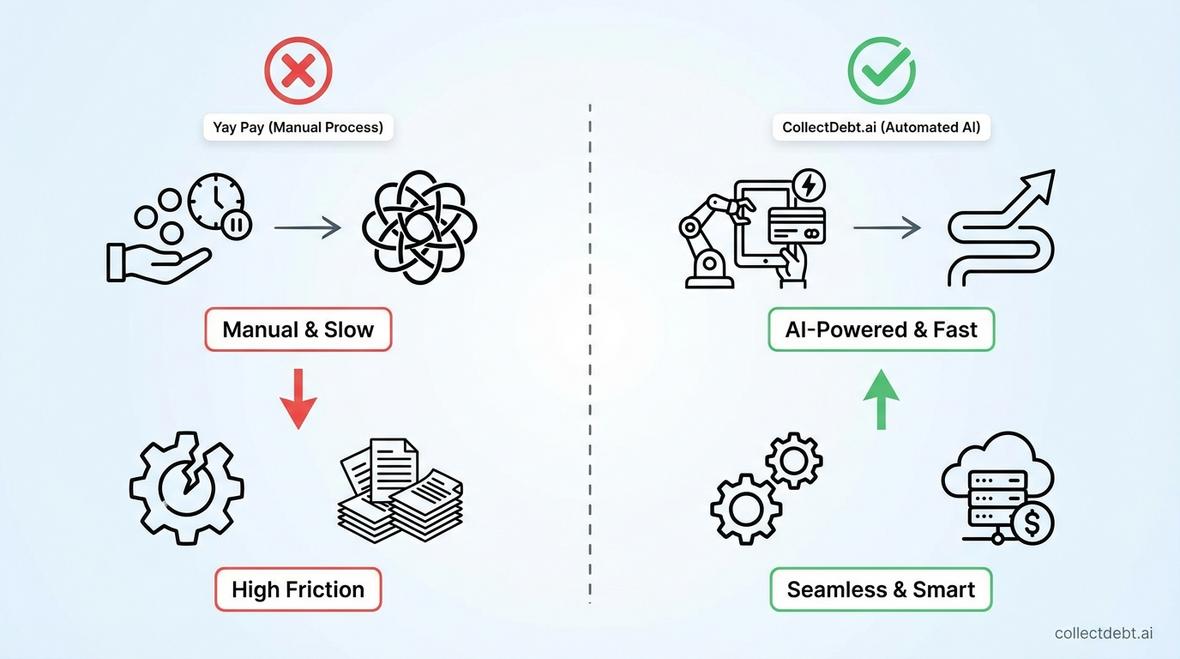
The AI-Powered Alternative: Transforming Accounts Receivable
The emergence of artificial intelligence in accounts receivable management represents a paradigm shift from the manual, friction-filled processes characteristic of yay pay and similar platforms. AI debt collection solutions leverage advanced technologies including natural language processing, machine learning, and predictive analytics to automate and optimize every aspect of the collection lifecycle.
Modern AI-powered platforms can analyze thousands of data points simultaneously, identifying patterns that human analysts would miss. They determine optimal contact timing, channel preferences, and communication strategies for each debtor individually. This personalization dramatically improves engagement rates and payment conversion while reducing the friction and frustration often associated with collection efforts.
Conversational AI and Natural Language Understanding
Unlike the template-based communications of yay pay, advanced conversational AI systems engage debtors in natural, context-aware dialogues. These systems understand intent, respond appropriately to questions and objections, and can navigate complex conversations without human intervention. The result is a collection experience that feels personalized and respectful rather than robotic and impersonal.
Conversational AI operates across multiple channels voice, SMS, email, and chat providing debtors with flexibility in how they engage with collection efforts. This omnichannel approach significantly improves contact rates and resolution speed compared to the limited channel options of traditional platforms.
Automated Compliance and Risk Management
Regulatory compliance represents a significant challenge and risk factor in collections. Manual processes like those in yay pay depend on human knowledge and vigilance to maintain compliance with regulations such as the Fair Debt Collection Practices Act (FDCPA), Telephone Consumer Protection Act (TCPA), and various state-specific requirements.
AI-powered compliance solutions automatically enforce regulatory requirements in every interaction. They ensure proper disclosures, respect communication time restrictions, maintain required documentation, and adapt to jurisdiction-specific rules without requiring manual oversight. This automation dramatically reduces compliance risk while freeing staff from the burden of constant regulatory monitoring.
Measurable Advantages of AI Over Traditional Systems
Enhanced Recovery Rates and Collection Speed
Organizations transitioning from manual systems like yay pay to AI-powered alternatives typically experience recovery rate improvements of 25-45%. These gains result from multiple factors: optimal timing of collection outreach, personalized communication strategies, consistent follow-up, and intelligent payment plan structuring.
AI systems can contact debtors at precisely the right moment when they're most likely to engage and able to pay. They automatically adjust strategies based on response patterns, escalating or de-escalating pressure appropriately. According to Federal Reserve Boston on AR trends and bad debt ratios, organizations that optimize their credit risk tolerance can maintain bad debt ratios in the optimal 1-2% range while maximizing revenue collection.
Operational Efficiency and Cost Reduction
The operational economics of AI-powered collections differ dramatically from manual systems. While yay pay requires staffing levels that scale linearly with account volume, AI solutions handle thousands of simultaneous interactions without additional resources. Organizations commonly report 60-75% reductions in per-account collection costs after implementing AI automation.
Beyond direct cost savings, AI systems eliminate the hidden expenses associated with manual processes: training overhead, quality assurance requirements, management supervision, and employee turnover. The consistency and scalability of end-to-end AI collection systems create predictable operational models that support business growth without proportional cost increases.
Improved Customer Experience and Retention
Traditional collection approaches often damage customer relationships through impersonal communications, inconvenient contact timing, and inflexible payment options. AI-powered systems transform collections from a friction point into an opportunity for positive engagement.
By offering self-service debt resolution options and respecting customer preferences, AI systems reduce the stress and embarrassment associated with collections. Debtors appreciate the convenience, transparency, and flexibility of modern collection experiences, which can actually strengthen rather than damage long-term customer relationships.
Industry-Specific Applications Beyond Yay Pay
Healthcare Revenue Cycle Management
Healthcare organizations face unique AR challenges including patient responsibility, insurance coordination, and regulatory complexity. Traditional systems like yay pay struggle with these specialized requirements, often requiring manual intervention for payment plan negotiations and insurance follow-up.
AI-powered healthcare collection solutions automate patient payment collection while maintaining the sensitivity and compliance required in medical debt situations. They integrate with electronic health record systems, automatically verify insurance eligibility, and manage complex payment arrangements that traditional platforms cannot handle efficiently.
Financial Services and Auto Finance
Financial institutions and auto finance companies manage high-volume collections across diverse debtor populations. The scale and complexity of these operations exceed the capabilities of manual systems like yay pay, requiring sophisticated automation and analytics.
Financial services collection platforms and specialized auto finance recovery solutions leverage AI to optimize repossession prevention, payment plan structuring, and deficiency balance collection. These systems process millions of accounts simultaneously while maintaining personalized engagement strategies for each debtor.
Utilities and Telecommunications
Utilities and telecommunications providers face constant collection challenges from service disconnection decisions to large customer bases with diverse payment behaviors. Traditional AR platforms like yay pay provide inadequate tools for balancing revenue protection with service continuity requirements.
AI-powered utilities and telecom collection systems automate payment reminder campaigns, manage disconnection workflows, and optimize reconnection processes. They reduce voluntary churn by identifying at-risk customers early and proactively offering payment assistance before accounts become seriously delinquent.
Implementation Considerations and Integration
Seamless Integration with Existing Infrastructure
Organizations considering alternatives to yay pay rightfully prioritize integration capabilities. Modern AI collection platforms offer extensive integration options with major ERP systems, CRMs, payment processors, and communication platforms. API-first architectures enable rapid deployment without disrupting existing workflows.
Unlike legacy systems that require complex custom development for integration, modern platforms provide pre-built connectors and standardized data exchange protocols. This approach reduces implementation timelines from months to weeks and minimizes the technical resources required for deployment.
Data Migration and Historical Analysis
Transitioning from yay pay to an AI-powered platform requires careful data migration planning. Historical account information, communication logs, payment histories, and debtor profiles must be accurately transferred to maintain operational continuity and enable AI models to learn from past performance.
Leading AI platforms provide migration support and validation tools that ensure data integrity throughout the transition. They can also analyze historical data to immediately optimize collection strategies based on past performance patterns, accelerating the time-to-value for organizations making the switch.
Return on Investment: Comparing Yay Pay to AI Solutions
The financial case for transitioning from yay pay to AI-powered collections is compelling across multiple dimensions. Organizations should evaluate ROI based on both direct financial impacts and strategic advantages that affect long-term competitiveness.
Direct financial benefits include increased recovery rates, reduced operational costs, and improved DSO. A typical mid-sized organization with $50 million in annual AR volume might realize $750,000 to $1.5 million in annual benefit from a 1.5-3% improvement in recovery rates alone. When combined with 60-70% reductions in collection operational costs, the payback period for AI implementation typically ranges from 4-8 months.
Strategic advantages include improved scalability, enhanced compliance protection, better customer retention, and competitive differentiation. These factors create sustained value that extends well beyond the initial implementation period. Organizations that embrace AI-powered AR management position themselves for growth and operational excellence that manual systems like yay pay cannot support.
Future Trends in AI-Powered Accounts Receivable
As we progress through 2026 and beyond, the gap between legacy AR systems like yay pay and AI-powered alternatives will continue widening. Emerging trends include hyper-personalization driven by advanced behavioral analytics, real-time payment facilitation through embedded finance capabilities, and predictive models that identify collection issues before they materialize.
The integration of generative AI will enable even more natural conversational experiences, while blockchain technologies may transform payment verification and dispute resolution. Organizations that delay adoption of modern AR technologies risk falling behind competitors who leverage these capabilities to optimize cash flow and customer relationships simultaneously.
Frequently Asked Questions
How does AI-powered debt collection differ from traditional platforms like Yay Pay?
AI-powered collection platforms automate decision-making, personalize communication strategies, and continuously optimize performance based on outcomes. Unlike yay pay and similar manual systems, AI solutions handle thousands of simultaneous interactions, adapt strategies in real-time, and require minimal human intervention for routine collections.
What recovery rate improvements can organizations expect when switching from Yay Pay?
Organizations typically experience 25-45% improvements in recovery rates after transitioning from manual systems to AI-powered platforms. Actual results vary based on industry, debtor demographics, and account characteristics, but the consistency of AI-driven outreach and personalization generally produces significant gains.
How long does it take to implement an AI collection system to replace Yay Pay?
Implementation timelines range from 4-12 weeks depending on integration complexity, data migration requirements, and customization needs. Modern AI platforms with pre-built integrations and standardized deployment processes can be operational much faster than legacy system replacements, which often required months of custom development.
Are AI collection systems compliant with FDCPA and other regulations?
Yes, leading AI collection platforms incorporate compliance requirements directly into their operational logic, automatically enforcing regulatory restrictions on contact timing, disclosure requirements, and communication practices. This automation reduces compliance risk compared to manual systems that depend on human knowledge and vigilance.
Can AI systems handle complex payment negotiations and disputes?
Advanced conversational AI can manage routine payment arrangements, answer common questions, and escalate complex situations to human specialists when appropriate. This hybrid approach ensures efficient handling of straightforward matters while reserving human expertise for situations that truly require it, optimizing both effectiveness and cost-efficiency.
Conclusion
The accounts receivable landscape has evolved dramatically, leaving legacy platforms like yay pay increasingly inadequate for organizations seeking operational excellence and competitive advantage. AI-powered collection solutions deliver measurable improvements in recovery rates, operational efficiency, compliance protection, and customer experience benefits that manual systems simply cannot match. As businesses face growing pressure to optimize cash flow while reducing costs, the transition from traditional AR platforms to intelligent automation represents not just an upgrade but a strategic imperative. Organizations that embrace AI-powered accounts receivable solutions position themselves for sustained success in an increasingly competitive marketplace, while those clinging to legacy systems risk falling behind competitors who leverage modern technology to transform collections from a cost center into a strategic advantage.
Ready to Transform Your Collections Process?
See how CollectDebt.ai can help you automate debt collection, reduce costs, and improve compliance.