Multi-Language Debt Collection: The Complete 2026 Guide To AI-Powered Global Recovery Solutions

Introduction
In today's increasingly diverse financial landscape, multi-language debt collection has evolved from a competitive advantage to an operational necessity. As collection agencies and accounts receivable departments manage portfolios spanning multiple demographics and geographies, the ability to communicate effectively across languages directly impacts recovery rates, compliance, and customer satisfaction. Research from the Consumer Finance Protection Bureau confirms that language access reduces friction and expands credit access, demonstrating that reducing language barriers streamlines financial processes and supports better consumer understanding in debt collection.
Traditional collection methods struggle with linguistic diversity, often resulting in miscommunication, regulatory violations, and lost recovery opportunities. Meanwhile, multi-language debt collection powered by AI automation delivers personalized, compliant communication at scale across dozens of languages. This comprehensive guide explores how modern collection agencies are leveraging artificial intelligence to transform multilingual debt recovery operations while maintaining strict FDCPA and TCPA compliance.
Why Multi-Language Debt Collection Matters in 2026
The demographic composition of debt portfolios has shifted dramatically. Census data indicates that over 21% of U.S. households speak a language other than English at home, with Spanish, Chinese, Tagalog, Vietnamese, and Arabic representing the most common non-English languages. This linguistic diversity creates significant challenges for traditional collection operations that rely primarily on English-speaking agents.
When debtors receive communications in their preferred language, several measurable benefits emerge. According to research from Divinity Software, clear payment options resolve 47% faster than accounts with unclear instructions. This finding underscores the direct financial impact of language clarity on collection efficiency and recovery timelines.
Furthermore, multi-language debt collection strategies demonstrate improved promise-to-pay rates. Studies from ResolvePay indicate that calls plus texts boost promise-to-pay by 18% when combining phone outreach with follow-up text messages a benefit that multiplies when communications are delivered in the debtor's native language.
Regulatory Compliance and Language Access
Beyond operational efficiency, regulatory frameworks increasingly mandate language accessibility. The Consumer Financial Protection Bureau has issued guidance emphasizing that financial service providers must ensure meaningful access to information for limited English proficiency (LEP) consumers. Failure to provide adequate language support can result in FDCPA violations, regulatory penalties, and reputational damage.
Compliance-focused collection solutions must therefore incorporate multi-language capabilities as a core feature rather than an afterthought. AI-powered platforms can automatically detect language preferences, route communications appropriately, and maintain detailed audit trails demonstrating compliance with language access requirements.
How AI Powers Multi-Language Debt Collection
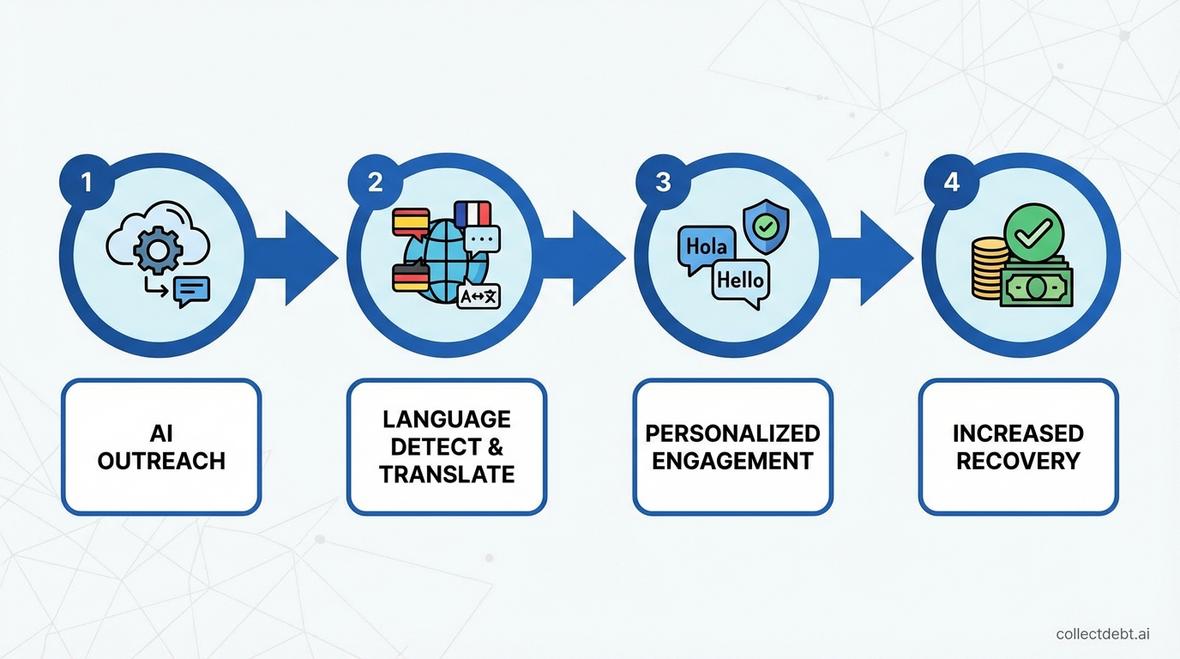
Artificial intelligence has fundamentally transformed how collection agencies approach linguistic diversity. Modern multi-language debt collection platforms leverage several interconnected AI technologies to deliver seamless cross-language communications at scale.
Automatic Language Detection
The first step in effective multi-language debt collection involves accurately identifying the debtor's preferred language. Advanced natural language processing algorithms analyze incoming communications whether voice, text, or email to detect the language being used. This detection happens in real-time, enabling immediate routing to appropriate language-specific resources or translation engines.
When combined with CRM data and historical interaction patterns, AI systems can predict language preferences before initial contact, allowing collection agencies to proactively initiate communications in the appropriate language. This predictive capability significantly improves first-contact resolution rates and reduces the friction that occurs when language barriers delay productive conversations.
Neural Machine Translation
Once language preference is established, neural machine translation engines convert collection messages, scripts, and documentation into the target language. Unlike rule-based translation systems of the past, modern neural networks trained on billions of multilingual text samples produce contextually accurate translations that preserve the tone, urgency, and legal precision required in debt collection communications.
These translation capabilities extend across multiple channels. Omnichannel support systems deliver consistent multilingual messaging whether the debtor engages via phone, SMS, email, or web portal. This consistency reinforces message comprehension and creates a cohesive collection experience regardless of communication medium.
Multilingual Voice Synthesis
For voice-based collection outreach, text-to-speech engines generate natural-sounding speech in dozens of languages and regional dialects. Modern voice AI platforms produce prosody, intonation, and pronunciation that closely mimics native speakers, eliminating the robotic quality that characterized earlier automated systems.
Research from Yale School of Management analyzing AI handling 22 million debt collection cases demonstrates that AI-driven voice interactions can match or exceed human performance in certain debt collection scenarios, particularly for smaller balance accounts. When these AI agents operate in the debtor's native language, engagement rates and payment commitments increase substantially.
Implementing Multi-Language Debt Collection: Strategic Considerations
Successfully deploying multi-language debt collection capabilities requires thoughtful planning beyond simply purchasing translation software. Collection agencies must address several strategic and operational considerations to maximize ROI and compliance.
Portfolio Language Analysis
Begin by conducting comprehensive analysis of your debt portfolio to identify language distribution. Examine demographic data, geographic concentration, and historical language preference indicators. This analysis reveals which languages warrant prioritization and helps establish realistic implementation timelines.
For agencies serving specific industries, language priorities may vary significantly. Healthcare debt collection operations in urban areas might prioritize Spanish, Mandarin, and Russian, while utilities and telecom collections in rural regions might focus on Spanish and Vietnamese. Understanding portfolio composition ensures resource allocation aligns with actual communication needs.
Communication Channel Prioritization
Not all collection channels require equal multilingual investment. Voice channels typically demand the highest translation quality due to real-time interaction requirements, while written channels like email and SMS allow for more extensive review and quality assurance.
Many agencies implement phased rollouts, beginning with automated SMS and email in priority languages before expanding to inbound conversational AI and finally outbound voice campaigns. This phased approach allows teams to refine translation quality, test compliance protocols, and build operational confidence before scaling to more complex interaction types.
Translation Quality Assurance
While AI translation has improved dramatically, human oversight remains essential for debt collection communications where legal precision and tone management are critical. Establish review processes involving native speakers who understand both the source and target languages, as well as debt collection regulations.
Quality assurance protocols should verify that translated messages maintain legal compliance, preserve intended urgency without becoming threatening, and accurately convey payment terms and debtor rights. Documentation of these review processes also supports regulatory audits and demonstrates good-faith efforts to provide meaningful language access.
Optimizing Recovery Rates Through Multilingual Engagement
The ultimate measure of multi-language debt collection effectiveness lies in improved recovery metrics. Several performance optimization strategies amplify the benefits of multilingual capabilities.
Cultural and Linguistic Personalization
Effective multilingual collection extends beyond literal translation to encompass cultural adaptation. Payment preferences, communication styles, and negotiation approaches vary across cultures. AI systems can learn these patterns and adjust engagement strategies accordingly.
For example, some cultures prioritize face-saving and indirect communication, making aggressive demand letters counterproductive. Others respond more favorably to formal, detailed explanations of debt obligations. Self-service debt resolution portals that adapt not just language but also navigation patterns and payment options to cultural preferences see significantly higher engagement.
Optimal Contact Timing by Language Segment
Data analysis reveals that optimal contact timing varies by language segment, likely reflecting different work schedules, time zone distributions, and cultural patterns. Spanish-speaking debtors in certain regions show higher answer rates during evening hours, while Mandarin-speaking segments may respond better to weekend outreach.
AI debt collection platforms can automatically optimize contact timing based on language preference, historical answer rates, and predictive models that identify the highest-probability windows for successful engagement. This optimization occurs dynamically as the system continuously learns from interaction outcomes.
Multi-Agent AI Frameworks
Cutting-edge research demonstrates that multi-agent AI systems significantly enhance debt recovery outcomes. According to findings published in the ACL Anthology, AI multi-agent framework improves debt recovery rates with the Multi-Agent Debt Negotiation (MADeN) framework using large language models increasing Collection Recovery Index (CRI) by more than 0.1 while maintaining debtor financial health above 0.7 across 975 debt records.
These frameworks deploy specialized agents for different aspects of the collection process one agent focuses on empathetic engagement, another on payment arrangement negotiation, and a third on compliance monitoring. When operating in multi-language debt collection environments, each agent can be optimized for specific languages and cultural contexts, creating sophisticated negotiation strategies that human collectors would find difficult to replicate at scale.
Technology Stack for Multi-Language Collections
Implementing robust multi-language debt collection requires integration of several technology components that work seamlessly together.
Core Platform Components
Modern collection platforms incorporate natural language understanding (NLU), automatic speech recognition (ASR), neural machine translation (NMT), and text-to-speech (TTS) engines as foundational elements. These components must integrate with existing collection management systems, dialers, and CRM platforms.
Integration capabilities determine implementation complexity and time-to-value. Platforms offering pre-built connectors to major collection software providers, payment processors, and communication infrastructure significantly reduce deployment timelines and technical risk.
Data Infrastructure Requirements
Multilingual AI systems require substantial data infrastructure to support real-time translation, voice synthesis, and interaction analysis. Cloud-based architectures provide the scalability and processing power necessary for handling concurrent multilingual conversations across thousands of accounts.
Data residency and privacy regulations add complexity in multilingual environments, as different countries impose varying requirements on where consumer data can be processed and stored. Collection agencies operating internationally must ensure their multi-language debt collection platforms comply with GDPR, CCPA, and other regional privacy frameworks.
Performance Evaluation and Metrics
Academic research from arXiv details that LLMs automate debt collection negotiations with 13 metrics across four key aspects, providing comprehensive frameworks for evaluating AI performance in collection contexts. These metrics should be applied separately for each language segment to identify performance variations and optimization opportunities.
Key performance indicators for multi-language debt collection include language-specific right party contact rates, promise-to-pay conversion by language, payment plan compliance rates, and customer satisfaction scores. Tracking these metrics enables continuous refinement of multilingual strategies and quantifies ROI from language access investments.
Industry-Specific Applications
Financial Services Collections
Financial service collections frequently encounter multilingual requirements due to diverse customer bases in urban banking markets and credit card portfolios. Banks and credit unions implementing multi-language debt collection report 15-25% improvements in early-stage delinquency resolution when communications match customer language preferences.
The financial services sector also benefits from AI-powered document translation for disclosure requirements, payment agreements, and settlement documentation. Automated translation of these legal documents with appropriate quality assurance ensures compliance while dramatically reducing operational costs compared to manual translation services.
Healthcare Revenue Cycle Management
Healthcare providers face unique multilingual challenges as patient populations often include recent immigrants, elderly patients with limited English proficiency, and diverse urban communities. Medical debt collection requires particular sensitivity, making language accessibility both a compliance issue and a patient experience imperative.
Multi-language debt collection in healthcare contexts must navigate complex regulations including HIPAA privacy requirements alongside language access mandates. AI platforms that provide secure, compliant multilingual patient communication channels help healthcare organizations maintain positive community relationships while improving collections performance.
Retail and BNPL Collections
The explosion of Buy Now, Pay Later services has created new multilingual collection challenges, as BNPL providers typically serve younger, more diverse demographics through digital channels. Retail collections benefit significantly from SMS and digital channel multilingual capabilities, as these customer segments prefer text-based communication over traditional phone calls.
AI-powered multi-language debt collection platforms excel in these environments by delivering instant, automated responses in preferred languages across messaging apps, SMS, and email matching the digital-first expectations of BNPL users while maintaining the persistent engagement necessary for successful collections.
Compliance and Risk Management
FDCPA and TCPA in Multilingual Contexts
Federal debt collection regulations apply equally regardless of communication language, but multilingual operations introduce additional compliance complexity. All translated communications must accurately convey required disclosures, debtor rights notifications, and opt-out mechanisms.
FDCPA compliance in AI debt collection requires careful validation that automated translation systems preserve legal precision. Terms like 'validation notice,' 'cease communication,' and 'dispute' carry specific legal meanings that must be accurately rendered in target languages.
Audit Trail and Documentation
Regulatory examinations increasingly scrutinize language access practices, making comprehensive documentation essential. Collection agencies should maintain records demonstrating language preference identification, translation quality assurance processes, and native speaker review protocols.
AI platforms provide significant advantages here through automated logging of language detection decisions, translation versions used, and interaction transcripts in both source and target languages. This documentation creates clear audit trails demonstrating good-faith compliance efforts and supports defense against potential regulatory claims.
ROI and Business Case Development
Cost-Benefit Analysis
The business case for multi-language debt collection involves both hard cost savings and revenue improvements. Traditional approaches requiring multilingual human agents or outsourced translation services carry significant ongoing expenses. A typical multilingual call center agent commands 15-30% premium wages compared to monolingual counterparts, while professional translation services cost $0.10-$0.25 per word.
AI-powered translation and voice synthesis eliminate per-use costs once platforms are deployed, creating attractive unit economics as volume scales. Generative AI versus traditional debt collection ROI analysis demonstrates that automated multilingual systems typically achieve payback within 6-12 months through a combination of improved recovery rates and reduced operational costs.
Revenue Impact Quantification
The revenue side of the equation proves even more compelling. Collection agencies implementing comprehensive multi-language debt collection capabilities report 12-18% improvements in liquidation rates for non-English speaking segments. When applied to typical portfolio values, these improvements generate substantial incremental revenue.
For example, an agency managing $50 million in annual placements with 25% non-English speaking accounts could realize $1.5-2.25 million in additional recoveries through effective multilingual engagement far exceeding the technology investment required.
Future Trends in Multi-Language Debt Collection
Emotion and Sentiment Analysis Across Languages
Next-generation multi-language debt collection platforms incorporate emotion detection and sentiment analysis that functions across languages. These systems identify frustration, confusion, or willingness to engage regardless of the language being spoken, enabling real-time conversation adaptation.
When a Spanish-speaking debtor exhibits confusion about payment terms, the AI system can automatically simplify explanations, offer visual aids through SMS links, or escalate to human assistance all while maintaining Spanish language throughout the interaction.
Regional Dialect Recognition
Language diversity extends beyond standard translations to encompass regional dialects and colloquialisms. Puerto Rican Spanish differs significantly from Mexican Spanish or Castilian Spanish in vocabulary, pronunciation, and cultural references. Advanced AI systems increasingly recognize and adapt to these regional variations.
This dialect awareness particularly matters for voice-based collections, where pronunciation differences can create comprehension barriers or signal cultural disconnect. Future multi-language debt collection platforms will offer dozens of regional dialect options for major languages, ensuring communications sound natural and locally appropriate.
Visual Communication and Video
Emerging collection strategies incorporate visual communication channels including video messages, animated payment explanations, and interactive visual IVR. These modalities reduce language barriers by supplementing verbal/written communication with universal visual cues.
Promise-to-pay processes particularly benefit from visual elements showing payment schedules, countdown timers, and confirmation graphics that transcend language limitations while reinforcing key messages delivered in the debtor's preferred language.
Building Your Multi-Language Collection Strategy
Phase 1: Assessment and Planning
Begin implementation by conducting thorough portfolio analysis to identify language distribution, prioritize languages for initial deployment, and establish baseline metrics. Engage compliance counsel to review regulatory requirements and establish quality assurance protocols.
Evaluate technology vendors based on language coverage, integration capabilities, compliance features, and scalability. Request demonstrations using your actual debt scenarios and languages to assess translation quality and conversation flow.
Phase 2: Pilot Deployment
Launch pilot programs in limited segments perhaps one language and one communication channel to validate technology performance, refine processes, and build internal expertise. Use pilot results to optimize conversation flows, identify training needs, and quantify performance improvements.
Collect feedback from both collectors and debtors to identify opportunities for enhancement. Many agencies discover unexpected insights during pilot phases, such as optimal messaging timing or particularly effective payment arrangement structures for specific language segments.
Phase 3: Scaled Deployment
Following successful pilots, systematically expand multilingual capabilities across additional languages, communication channels, and account segments. Maintain robust monitoring to ensure quality standards as volume increases and complexity grows.
End-to-end collection solutions that incorporate multilingual capabilities throughout the collection lifecycle from initial contact through payment processing and account closure deliver the highest value by creating consistent language-appropriate experiences across all touchpoints.
Selecting the Right Multi-Language Platform
Key Evaluation Criteria
When evaluating multi-language debt collection platforms, prioritize vendors offering comprehensive language coverage including the specific languages present in your portfolio. Verify that platforms support both written and voice channels across all offered languages, as some vendors provide limited modality support for less common languages.
Integration capabilities determine implementation success. Platforms should offer pre-built connectors to major collection management systems, dialers, payment processors, and CRM platforms. API flexibility enables custom integrations where standard connectors don't exist.
Compliance and Security Features
Ensure platforms provide robust compliance features including automated disclosure delivery, call recording and transcription in all languages, consent management, and comprehensive audit trails. Security certifications (SOC 2, ISO 27001) demonstrate vendor commitment to data protection.
Request detailed documentation of the vendor's translation quality assurance processes, including how they handle collection-specific terminology and legal language. Understanding whether translations undergo native speaker review and how frequently they're updated provides insight into ongoing quality management.
Frequently Asked Questions
How accurate is AI translation for debt collection communications?
Modern neural machine translation achieves 95%+ accuracy for common language pairs when properly trained on financial and collection-specific terminology. However, quality assurance through native speaker review remains essential for legally significant communications like validation notices and settlement agreements to ensure regulatory compliance and preserve legal precision.
What languages should collection agencies prioritize?
Prioritization should be driven by portfolio analysis identifying debtor language distribution. Nationally, Spanish represents the most common non-English language, followed by Chinese (Mandarin/Cantonese), Tagalog, Vietnamese, and Arabic. However, regional variations exist agencies in certain markets may prioritize Korean, Russian, or Portuguese based on local demographics.
What is the typical cost of implementing multi-language debt collection?
Implementation costs vary based on platform selection, language quantity, and integration complexity. SaaS-based AI platforms typically charge $0.05-$0.15 per multilingual interaction for voice channels and $0.01-$0.03 for text channels, with volume discounts available. Initial setup and integration may require $10,000-$50,000 depending on existing technology infrastructure and customization needs.
How does multi-language collection affect FDCPA compliance?
FDCPA requirements apply equally regardless of communication language. All required disclosures, debtor rights notifications, and opt-out mechanisms must be accurately translated. Multi-language debt collection actually enhances compliance by ensuring debtors fully understand their rights and obligations, reducing the risk of misunderstanding-based complaints. Comprehensive documentation of language preference identification and translation quality assurance strengthens compliance posture.
Can AI multilingual systems integrate with existing collection software?
Leading multi-language debt collection platforms offer pre-built integrations with major collection management systems including DAKCS, Latitude, Collect!, and others. API-based architectures enable integration with proprietary systems. Integration typically involves connecting to dialer infrastructure, importing account data, and establishing workflows for multilingual communication routing. Implementation timelines range from 4-12 weeks depending on complexity.
Conclusion
Multi-language debt collection has transitioned from competitive advantage to operational imperative in 2026's diverse financial landscape. AI-powered platforms deliver scalable, compliant multilingual communication that dramatically improves recovery rates while reducing operational costs. By automatically detecting language preferences, translating communications with high accuracy, and personalizing engagement based on cultural context, modern collection agencies can effectively serve diverse debtor populations while maintaining strict regulatory compliance. The substantial ROI from improved liquidation rates combined with decreased reliance on expensive multilingual human agents creates compelling business cases for adoption. Collection agencies that embrace AI-powered debt collection solutions with comprehensive multilingual capabilities position themselves for sustained competitive advantage in increasingly diverse markets.
Ready to Transform Your Collections Process?
See how CollectDebt.ai can help you automate debt collection, reduce costs, and improve compliance.