Collection Software For Law Firms: Complete 2026 Guide To AI-Powered Debt Recovery Solutions

Introduction
Law firms specializing in debt collection face mounting pressure to recover outstanding balances while navigating complex compliance requirements and managing operational costs. Traditional collection methods manual dialing, spreadsheet tracking, and disconnected communication channels no longer deliver the efficiency or recovery rates modern practices demand. Collection software for law firms has evolved dramatically, with AI-powered platforms now offering automated workflows, omnichannel engagement, and real-time compliance monitoring that transform how legal practices approach receivables management.
The legal industry is experiencing a fundamental shift in how work is performed and billed. According to research from Clio's comprehensive legal statistics report, 74% of billable hourly work could be automated by generative AI, with documentation, data collection, and analysis representing 66% of typical law firm hourly work. AI adoption among legal professionals surged from just 19% in 2023 to 79% in 2024-2025, with 25% of firms adopting legal AI widely or universally. This technological transformation is reshaping how law firms handle collections, creating opportunities for those who adopt advanced platforms while leaving traditional practices struggling to compete.
This comprehensive guide examines how collection software for law firms addresses the unique challenges legal practices face in 2026, from regulatory compliance and client communication to workflow automation and performance analytics. Whether you're a solo practitioner handling small claims or a mid-sized firm managing complex commercial collections, understanding the capabilities and selection criteria for modern collection platforms is essential for maximizing recovery rates and operational efficiency.
The Evolving Market for Collection Software in Legal Practice
The debt collection software market is experiencing unprecedented growth, driven by technological innovation and increasing demand for automated, compliant solutions. The Global Debt Collection Software Market was valued at USD 5.93 billion in 2025 and is projected to reach USD 15.04 billion by 2035, representing a compound annual growth rate of 9.76%. Within this broader market, the U.S. specifically calculated at USD 1.47 billion in 2025 is expected to reach USD 3.80 billion by 2035 at 9.96% CAGR, with North America dominating 33% of global market share in 2025.
This explosive growth reflects fundamental changes in how organizations approach receivables management. Law firms represent a particularly dynamic segment within this market, as they face unique pressures that general collection agencies do not encounter. Legal practices must balance aggressive recovery efforts with attorney-client privilege considerations, ethical obligations under state bar rules, and heightened regulatory scrutiny when collecting on behalf of clients or their own accounts.
The shift toward cloud-based deployment models has been particularly significant for legal practices. Cloud-based solutions dominate due to enhanced scalability and cost-effectiveness, allowing firms to avoid substantial upfront infrastructure investments while accessing enterprise-grade capabilities. For smaller and mid-sized law firms which according to Thomson Reuters' 2026 State of US Legal Market report captured the bulk of growth in 2025 while portions of Am Law 100 saw contraction this deployment model levels the playing field, providing access to AI-powered automation previously available only to the largest practices.
Key Challenges Law Firms Face in Debt Collection
Law firms pursuing debt recovery encounter distinct operational and regulatory challenges that differentiate them from traditional collection agencies. Understanding these challenges is critical when evaluating collection software for law firms.
Regulatory Compliance and Legal Risk
Legal practices handling collections must navigate a complex web of federal and state regulations, including the Fair Debt Collection Practices Act (FDCPA), Telephone Consumer Protection Act (TCPA), and state-specific consumer protection statutes. Unlike general creditors, law firms face dual compliance burdens: debt collection regulations that govern communication practices and professional conduct rules that govern attorney behavior. A single compliance violation can result in statutory damages, regulatory sanctions, and potential bar discipline.
Modern compliance-focused collection platforms address these risks through built-in guardrails that automatically enforce call time restrictions, maintain required disclosures, and document all debtor interactions for audit purposes. These systems prevent violations before they occur rather than relying on post-hoc review and correction.
Cost Efficiency and Profitability Pressures
The economics of legal collections have shifted dramatically. According to research on legal billing models and technology investment, nearly 90% of legal spend still runs through hourly billing despite massive investment in AI and efficiency tools, yet clients spent less per legal hour in 2025 than 2024 due to actively moving work to lower-cost providers. Standard rates at the largest firms crossed the USD 1,000 threshold while comparable work became available at firms closer to USD 600 per hour, driving mobile demand downstream.
This pricing pressure creates an imperative for operational efficiency. Traditional collection methods manual calling, paper-based tracking, disconnected communication systems require substantial paralegal and attorney time that erodes profitability on contingency arrangements and creates billing resistance on hourly engagements. Collection software for law firms addresses this challenge by automating routine tasks, enabling staff to focus on high-value activities like negotiation and litigation strategy rather than administrative overhead.
Scalability Limitations
Law firms handling collections typically face significant volume fluctuations as new client portfolios arrive or seasonal payment patterns shift. Scaling traditional operations requires hiring additional staff, expanding phone systems, and increasing supervision all of which create fixed costs that become burdensome during slower periods. Advanced collection software platforms enable firms to scale efforts without adding headcount by leveraging AI-powered automation that handles routine debtor interactions, payment processing, and workflow management across thousands of accounts simultaneously.
Essential Features of Collection Software for Law Firms
Not all collection platforms are created equal, and law firms have specific requirements that general-purpose solutions may not address. When evaluating collection software for law firms, these capabilities should be considered essential rather than optional.
Automated Workflow Management
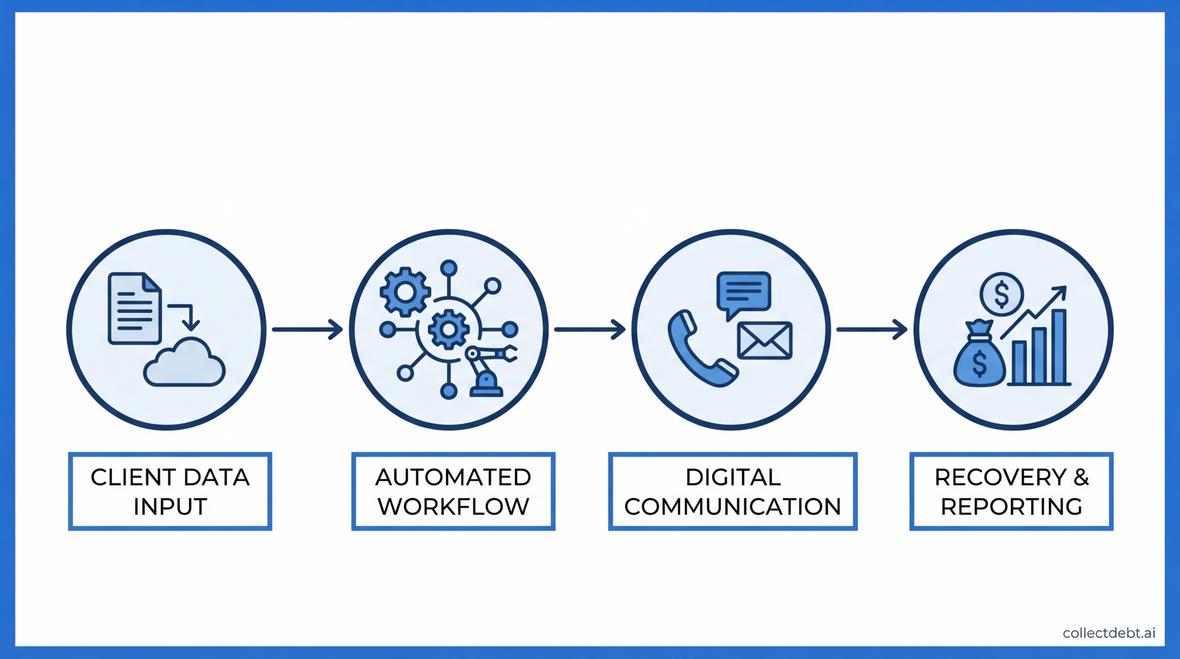
Effective collection software orchestrates complex, multi-step processes without requiring constant manual intervention. This includes automated case assignment based on debtor characteristics, systematic communication scheduling across multiple channels, escalation triggers when accounts meet specific criteria, and payment plan management with automatic reminders and default notifications.
The most sophisticated platforms employ AI to optimize these workflows continuously, learning which communication sequences produce the highest contact and payment rates for different debtor segments. This data-driven approach ensures that end-to-end collection processes become more effective over time rather than remaining static.
Omnichannel Communication Capabilities
Modern debtors expect to engage through their preferred channels whether phone, email, SMS, or digital portals. Omnichannel collection platforms unify these touchpoints within a single system, ensuring consistent messaging, complete interaction history, and seamless transitions between channels.
For law firms, this capability is particularly valuable because it maximizes contact rates while reducing compliance risk. When a debtor responds via text after receiving a voicemail, the system maintains complete context, preventing redundant or contradictory communications that could trigger regulatory violations or damage debtor relationships.
Built-In Compliance Automation
Regulatory compliance cannot be an afterthought in collection operations. Leading collection software for law firms incorporates compliance controls at the foundational level, including automated call time restrictions based on debtor time zones, mandatory disclosure delivery and confirmation, do-not-call list integration and automatic scrubbing, and communication frequency limits to prevent harassment claims.
These systems also generate comprehensive audit trails documenting every debtor interaction, disclosure delivery, and system action critical evidence in the event of regulatory scrutiny or litigation. The platform should support FDCPA compliance standards as a baseline requirement.
AI-Powered Conversational Capabilities
Conversational AI represents the cutting edge of collection technology, enabling systems to conduct natural-language interactions with debtors across voice and text channels. Advanced platforms employ inbound conversational AI that can handle common debtor inquiries, verify account information, process payments, and establish payment arrangements without human intervention.
For law firms, this technology dramatically improves efficiency by handling high-volume, routine interactions automatically while escalating complex situations to attorneys or paralegals. The AI maintains consistent, compliant communication across all interactions, reducing training requirements and eliminating the variability inherent in human-staffed operations.
Integrated Payment Processing
Friction in the payment process directly impacts recovery rates. Collection software should offer multiple payment options including credit/debit cards, ACH transfers, digital wallets, and payment plan establishment with automatic recurring charges. The system should process payments immediately upon debtor commitment, reducing the abandonment that occurs when debtors must navigate separate payment portals or wait for callback.
Promise-to-pay functionality that captures commitment, schedules follow-up, and automates reminders significantly improves conversion from agreement to actual payment, addressing one of the most significant leakage points in traditional collection processes.
Real-Time Analytics and Reporting
Data-driven decision-making requires visibility into collection performance at granular levels. Modern platforms provide real-time dashboards showing recovery rates by account age, debtor segment, communication channel, and collector/attorney. These systems enable firms to identify underperforming strategies quickly and reallocate resources to higher-yield approaches.
Client reporting capabilities are equally important, as law firms must demonstrate value to the businesses and individuals they represent. Automated reporting that shows collection progress, communication attempts, payment trends, and comparative performance metrics strengthens client relationships and supports retention.
Implementation Considerations for Law Firms
Selecting the right collection software for law firms is only the first step; successful implementation requires careful planning and execution across several dimensions.
Integration with Existing Systems
Collection software does not operate in isolation. Law firms typically use practice management systems, accounting platforms, client relationship management tools, and document management systems that must exchange data with collection software to avoid manual re-entry and maintain data consistency.
Leading platforms offer robust integration capabilities through APIs, pre-built connectors to popular legal software, and standardized data import/export formats. Evaluating integration requirements during the selection process prevents costly surprises during implementation.
Staff Training and Change Management
Technology adoption succeeds or fails based on user acceptance. Even the most sophisticated platform delivers minimal value if staff continue using legacy processes or struggle with the new system. Effective implementation includes comprehensive training programs, clear documentation and ongoing support resources, phased rollout that allows staff to build confidence gradually, and feedback mechanisms that identify and address user challenges quickly.
Law firms should budget adequate time for training and expect a learning curve as staff adapt to new workflows and capabilities.
Data Migration and Quality
Migrating existing account data from legacy systems to new collection software presents technical and operational challenges. Poor data quality incomplete debtor information, inconsistent formatting, duplicate records undermines collection effectiveness regardless of platform capabilities.
Successful implementations include data cleansing before migration, validation processes to identify and correct errors, and reconciliation procedures to ensure no accounts are lost or corrupted during transition.
Calculating ROI on Collection Software Investment
Law firms evaluating collection software for law firms must justify the investment through quantifiable returns. Key metrics for ROI calculation include increased recovery rates from improved contact and conversion, reduced operational costs through automation of routine tasks, improved compliance reducing regulatory risk and associated costs, and enhanced client satisfaction supporting retention and referrals.
According to analysis of generative AI versus traditional debt collection ROI, firms implementing advanced automation typically see 15-30% improvement in recovery rates combined with 40-60% reduction in cost per account. These improvements often generate payback periods of less than six months, even for mid-sized implementations.
Future Trends in Collection Software for Legal Practice
The collection software market continues evolving rapidly, with several trends likely to shape the landscape through 2026 and beyond.
Advanced AI and Machine Learning
Next-generation platforms will leverage increasingly sophisticated AI to predict debtor payment likelihood, optimize communication timing and channel selection, personalize messaging based on debtor characteristics and response history, and identify accounts requiring attorney intervention versus automated handling.
These capabilities will enable truly adaptive collection strategies that continuously improve based on outcomes rather than relying on static rule sets.
Enhanced Regulatory Technology
As regulatory requirements become more complex and enforcement more aggressive, collection platforms will incorporate advanced compliance capabilities including real-time regulation monitoring and automatic policy updates, predictive compliance scoring that identifies high-risk interactions before they occur, and blockchain-based audit trails providing immutable documentation of all collection activities.
Client Self-Service Portals
Debtor expectations for self-service capabilities continue rising, driven by consumer experiences in other industries. Future collection platforms will offer sophisticated self-service debt resolution portals where debtors can view account details, negotiate settlements, establish payment plans, and make payments without speaking to collectors all while maintaining full compliance with disclosure and documentation requirements.
Selecting the Right Collection Software Vendor
Choosing among the growing number of collection software providers requires systematic evaluation across several criteria. Law firms should assess vendor financial stability and market track record, platform security and data protection capabilities, customer support quality and responsiveness, roadmap alignment with firm's strategic needs, and pricing model transparency and total cost of ownership.
Firms should request demonstrations using their actual use cases, speak with reference customers in similar practice areas, and conduct proof-of-concept implementations before committing to enterprise-wide deployment.
Frequently Asked Questions
What is collection software for law firms?
Collection software for law firms is specialized technology designed to automate and optimize the debt recovery process for legal practices. These platforms integrate workflow management, multi-channel communication, compliance monitoring, payment processing, and analytics to improve recovery rates while reducing operational costs and regulatory risk.
How does AI improve debt collection for law firms?
AI enhances collection operations through conversational interfaces that handle routine debtor interactions, predictive analytics that optimize communication strategies, automated compliance monitoring that prevents violations, and intelligent workflow management that routes accounts based on characteristics and likelihood to pay. These capabilities enable law firms to scale collection efforts without proportional increases in staffing.
What compliance features should law firms look for in collection software?
Essential compliance features include automated call time restrictions, mandatory disclosure delivery and tracking, do-not-call list integration, communication frequency limits, complete interaction audit trails, and automatic updates reflecting regulatory changes. The platform should support FDCPA, TCPA, and state-specific requirements relevant to the firm's practice jurisdictions.
How much does collection software for law firms typically cost?
Pricing varies widely based on features, deployment model, and account volume. Cloud-based platforms typically charge monthly per-user fees ranging from USD 50 to USD 300 per user, plus transaction fees for payment processing. Enterprise implementations may involve custom pricing. Firms should evaluate total cost of ownership including implementation, training, integration, and ongoing support when comparing options.
Can collection software integrate with existing legal practice management systems?
Most modern collection platforms offer integration capabilities through APIs, pre-built connectors, or standard data exchange formats. The breadth and depth of integration varies by vendor, so firms should specifically evaluate compatibility with their existing practice management, accounting, and client relationship systems during the selection process.
What ROI can law firms expect from implementing collection software?
Typical implementations generate 15-30% improvement in recovery rates combined with 40-60% reduction in cost per account, according to industry analyses. These improvements often produce payback periods of less than six months. Actual ROI depends on current operational efficiency, account characteristics, and implementation quality.
Conclusion
The landscape of collection software for law firms has transformed dramatically, with AI-powered platforms now offering capabilities that were unimaginable just a few years ago. As the debt collection software market expands toward USD 15 billion globally by 2035 and legal practices face intensifying pressure to deliver efficiency and results, adopting advanced collection technology has shifted from competitive advantage to operational necessity.
Law firms that strategically implement comprehensive collection platforms featuring automated workflows, omnichannel communication, AI-powered interactions, and robust compliance controls position themselves to maximize recovery rates, reduce operational costs, and deliver superior client value. The question is no longer whether to adopt collection software, but which platform best aligns with your practice's specific needs and strategic direction. By carefully evaluating the capabilities outlined in this guide and selecting a vendor committed to ongoing innovation, your firm can transform collections from an administrative burden into a sustainable competitive advantage.
Ready to Transform Your Collections Process?
See how CollectDebt.ai can help you automate debt collection, reduce costs, and improve compliance.