Can Collection Agencies Leave Voicemails? Complete Compliance & Best Practices Guide

Debt collection agencies operate in a highly regulated environment where every communication channel including voicemail carries specific legal obligations and compliance requirements. If you're a collections manager, director of operations, or CFO evaluating communication strategies for your agency or accounts receivable department, understanding whether and how collection agencies can leave voicemails is critical to maintaining compliance while maximizing contact rates and recovery outcomes.
The short answer is yes, collection agencies can leave voicemails, but with stringent restrictions. The Consumer Financial Protection Bureau's (CFPB) Debt Collection Rule, which became effective in 2021, introduced the concept of 'limited-content messages' that allow debt collectors to leave voicemails without violating the Fair Debt Collection Practices Act (FDCPA). This guide explores the regulatory framework, best practices, automation opportunities, and strategic implications for modern collection operations.
Understanding the Regulatory Framework for Collection Voicemails
The FDCPA has long prohibited debt collectors from communicating debt information to third parties without the consumer's consent. Before the CFPB's Debt Collection Rule clarification, many agencies avoided leaving voicemails altogether, fearing that anyone accessing the consumer's voicemail a family member, roommate, or employer could constitute an unauthorized third-party disclosure.
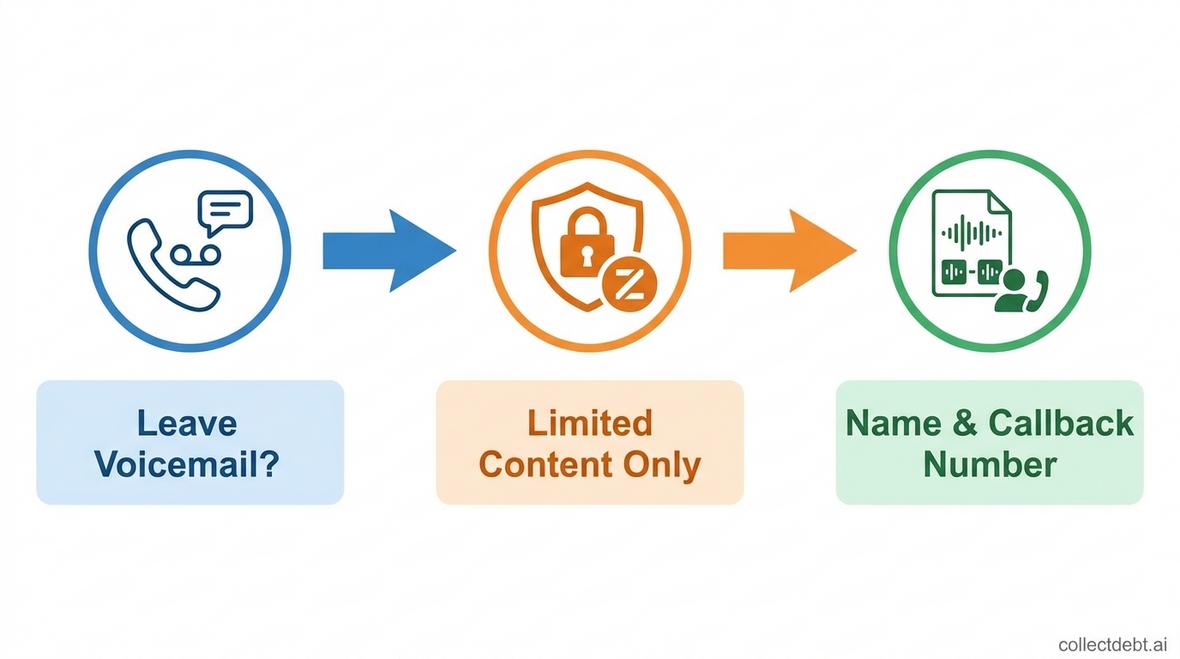
The introduction of limited-content messages under Regulation F changed this landscape significantly. According to the CFPB definition and rules for limited-content voicemail messages under Regulation F, a limited-content message is specifically designed to minimize the risk of third-party disclosure while still allowing collectors to establish contact.
What Qualifies as a Limited-Content Message?
A compliant limited-content voicemail must contain only the following elements:
- A business name that does not indicate debt collection
- A request for the consumer to reply to the message
- The name or names of one or more natural persons whom the consumer can contact
- A telephone number or numbers that the consumer can use to reply
Critically, the message must not include:
- Any reference to a debt or debt collection
- The name of the creditor or debt collector (if it indicates debt collection)
- The consumer's account number
- Any request for money or reference to owing money
This framework allows agencies to increase right-party contact rates without exposing themselves to FDCPA violations. For agencies evaluating compliance solutions, understanding these distinctions is foundational to implementing effective voicemail strategies.
The Business Case for Strategic Voicemail Use in Collections
Modern debt collection operations face a significant challenge: declining answer rates for outbound calls. Industry data suggests that live answer rates have fallen below twenty percent for many portfolios, forcing agencies to make multiple contact attempts per account. When collectors can leave compliant voicemails, they create additional touchpoints that can prompt consumer callbacks without consuming additional agent time.
Cost Efficiency and Resource Optimization
According to BLS occupational data for bill and account collectors, the median hourly wage for collection agents creates a significant operational cost when scaled across thousands of daily contact attempts. When agents can efficiently leave pre-scripted, compliant voicemails rather than hanging up on unanswered calls, they increase productive talk time and reduce cost per contact.
Automated voicemail solutions particularly those leveraging AI voice technology offer even greater efficiency gains. Platforms like AI debt collection solutions can leave thousands of compliant voicemails per hour, ensuring consistent messaging while freeing human agents to focus exclusively on live conversations and negotiation.
Impact on Right-Party Contact Rates
Strategic voicemail use has been shown to increase callback rates by creating urgency and establishing legitimacy. When consumers see missed calls paired with professional voicemails requesting contact, they are more likely to return the call during hours when they can have a private conversation. This is particularly valuable for right party verification workflows, where establishing initial contact is often the most resource-intensive phase of the collection cycle.
Compliance Risks and Common Violations
While the limited-content message framework provides a safe harbor for voicemail communications, agencies must vigilantly avoid common pitfalls that can trigger FDCPA violations, state law breaches, or consumer complaints.
Third-Party Disclosure Violations
Even with limited-content protections, agencies can still violate third-party disclosure rules if their business name clearly indicates debt collection (e.g., 'ABC Collections Agency'). Using a neutral business name like 'ABC Solutions' or 'ABC Services' is essential. Additionally, leaving messages on work phones or shared voicemail systems increases third-party exposure risk and should generally be avoided unless the consumer has provided explicit consent for workplace contact.
Frequency and Harassment Concerns
The CFPB's Debt Collection Rule also established a presumption that more than seven calls to a specific person within seven consecutive days violates the FDCPA's prohibition on harassment. While voicemails count toward this total, agencies must implement call-capping logic in their collection systems to prevent inadvertent violations.
Consumer complaint data from the CFPB consumer complaint database shows that 'frequent or repeated calls' remains one of the most commonly reported issues in debt collection. Agencies should monitor their voicemail strategies alongside overall contact frequency to maintain compliance and protect their reputations.
State Law Variations
While the FDCPA provides a federal baseline, many states impose additional restrictions on debt collection communications. Some states limit calling hours more restrictively than federal law, prohibit certain communication methods, or require specific disclosures. Collection agencies operating across multiple states must ensure their voicemail scripts and processes comply with the most restrictive applicable laws.
Crafting Effective, Compliant Voicemail Scripts
The content of your voicemail messages directly impacts both compliance risk and callback effectiveness. Here are proven templates and best practices for creating scripts that balance regulatory requirements with operational goals.
Basic Limited-Content Voicemail Template
'Hello, this is [Agent Name] from [Neutral Business Name]. Please return my call at [Phone Number]. Again, that's [Phone Number]. Thank you.'
This minimal script satisfies all limited-content requirements while providing no information that could constitute third-party disclosure. The tone is professional and neutral, avoiding any language that might be construed as threatening or harassing.
Enhanced Template for Increased Callbacks
'Hello, this message is for [Consumer First Name Only]. This is [Agent Name] from [Neutral Business Name]. I need to speak with you regarding an important matter. Please call me back at [Phone Number] at your earliest convenience. My hours are [Time Range]. Again, my number is [Phone Number]. I look forward to speaking with you.'
This version adds urgency and personalization while remaining fully compliant. Using only the consumer's first name reduces third-party disclosure risk while confirming identity for the intended recipient. Providing callback hours increases connection probability and demonstrates respect for the consumer's schedule.
Multilingual Voicemail Considerations
For agencies serving diverse populations, offering voicemail messages in the consumer's preferred language can significantly improve callback rates and demonstrate cultural competence. Modern multilingual debt collection solutions can automatically detect language preference from account data and leave appropriately translated messages that maintain compliance across languages.
Automation and AI Technology for Voicemail Campaigns
Manual voicemail campaigns present scalability challenges and introduce human error risk. AI-powered voice automation has transformed how forward-thinking collection agencies approach voicemail strategy, enabling precision, consistency, and unprecedented scale.
AI Voice Agents and Voicemail Detection
Modern AI voice bots for debt collection incorporate sophisticated voicemail detection algorithms that identify whether a call reaches a live person or voicemail within the first few seconds. When voicemail is detected, the system seamlessly delivers a pre-recorded or dynamically generated compliant message, then immediately moves to the next call.
This technology eliminates the wasted agent time associated with waiting for voicemails to connect and record. A single AI voice agent can process hundreds of calls per hour, leaving compliant voicemails at scale while maintaining perfect consistency in messaging and tone.
Batch Calling and Voicemail Drop Campaigns
Agencies can leverage batch calling capabilities to execute large-scale voicemail campaigns during optimal contact windows. By analyzing account data to identify consumers most likely to be unreachable during specific hours, agencies can strategically deploy voicemail campaigns that maximize callback potential while minimizing live agent involvement.
These campaigns can be A/B tested to optimize message content, delivery timing, and callback number selection, creating a data-driven approach to voicemail strategy that continuously improves performance.
Integration with Compliance Monitoring Systems
AI-powered collection platforms integrate voicemail activity with comprehensive compliance management systems, automatically logging every message left, tracking call frequency per consumer, and flagging potential violations before they occur. This creates an auditable record that protects agencies during regulatory examinations and consumer disputes.
Measuring Voicemail Campaign Performance
To justify the investment in voicemail infrastructure and optimize strategy, collection agencies must establish clear performance metrics and attribution models.
Key Performance Indicators
Essential metrics for voicemail campaign evaluation include:
- Callback Rate: Percentage of voicemails resulting in inbound consumer calls within a defined timeframe (typically 24-72 hours)
- Callback Conversion Rate: Percentage of callbacks that result in payment arrangements or promises to pay
- Cost Per Callback: Total voicemail campaign cost divided by number of callbacks generated
- Incremental Contact Rate: Increase in overall right-party contacts attributable to voicemail strategy
- Compliance Incident Rate: Number of complaints or violations per thousand voicemails left
Platforms with robust post-call analysis capabilities can automatically calculate these metrics and provide actionable insights for campaign optimization.
Attribution and Incrementality Testing
To isolate the true impact of voicemail campaigns, agencies should implement controlled testing methodologies. By randomly assigning similar accounts to voicemail and no-voicemail groups, agencies can measure the incremental lift in contact rates, payment rates, and overall recovery attributable specifically to voicemail strategy.
Industry-Specific Voicemail Strategies
Different collection verticals require tailored voicemail approaches based on debtor demographics, account characteristics, and regulatory environments.
Healthcare Collections
Medical debt collection involves additional privacy considerations under HIPAA. Voicemails must be even more carefully scripted to avoid any reference to medical services or healthcare providers. Healthcare collection solutions often use generic callback requests without any context that could reveal the nature of the debt to third parties.
Auto Finance Collections
In auto finance collections, voicemail strategies can be particularly effective because consumers often have strong motivation to avoid repossession. Messages emphasizing urgency and providing clear next steps for bringing accounts current tend to generate higher callback rates in this vertical.
Utilities and Telecommunications
For utilities and telecom collections, consumers may be more receptive to voicemails because they understand the service-based relationship and consequences of non-payment (service disconnection). Agencies can leverage this understanding by crafting messages that emphasize resolution options and service restoration.
Best Practices for Collection Agency Voicemail Programs
Based on regulatory guidance, industry research, and operational experience, these best practices provide a framework for implementing effective voicemail strategies:
- Always Use Limited-Content Format: Even when leaving detailed messages might seem helpful, the compliance risk outweighs potential benefits. Stick to limited-content messaging exclusively.
- Maintain Detailed Documentation: Log every voicemail with timestamp, content, and call context. This documentation is essential for defending against consumer disputes and demonstrating compliance during audits.
- Implement Automatic Call Frequency Controls: Use technology to prevent exceeding the seven-calls-in-seven-days threshold, counting voicemails toward this total.
- Train and Monitor Quality Consistently: Even with scripted messages, agent tone and delivery matter. Regular quality monitoring ensures consistency and professionalism.
- Test and Optimize Continuously: Use A/B testing to refine message content, delivery timing, and callback number selection based on actual performance data.
- Coordinate Across Channels: Integrate voicemail strategy with email, SMS, and other omnichannel communication approaches to create coordinated consumer experiences.
- Respect Consumer Preferences: If a consumer requests no voicemails, honor that preference immediately and document it clearly in account notes.
- Stay Current on Regulatory Changes: Debt collection regulations continue to evolve. Maintain subscriptions to industry publications and legal updates to ensure ongoing compliance.
Future Trends in Collection Voicemail Technology
The intersection of AI, voice technology, and regulatory compliance continues to create new opportunities for collection agencies to enhance voicemail strategies.
Dynamic Message Personalization
Next-generation AI systems can dynamically generate voicemail content based on account characteristics, consumer demographics, and historical response patterns while maintaining compliance guardrails. This enables mass personalization at scale, with each message optimized for the specific recipient.
Predictive Timing Optimization
Machine learning models can analyze when individual consumers are most likely to check voicemail and return calls, enabling precision timing of message delivery to maximize callback probability. These models continuously learn from outcomes, becoming more accurate over time.
Voice Biometrics and Security
Emerging voice biometric technology allows for secure consumer authentication during callbacks, streamlining the identity verification process and reducing fraud risk. When consumers call back in response to voicemails, voice biometrics can provide an additional layer of security for sensitive account discussions.
Frequently Asked Questions
Can debt collectors leave voicemails that mention the debt?
No. Under the CFPB's limited-content message rules, compliant voicemails cannot reference debt, debt collection, the creditor, or any request for money. Messages must be limited to a neutral business name, the caller's name, a phone number, and a request to return the call.
How many voicemails can a collection agency leave legally?
The FDCPA does not specify a maximum number of voicemails, but the Debt Collection Rule presumes that more than seven total contact attempts (including voicemails) within seven consecutive days violates harassment prohibitions. Agencies should implement call-capping to stay well below this threshold.
Do voicemails count as communication attempts under the FDCPA?
Limited-content messages are specifically excluded from the FDCPA definition of 'communication' when they meet all regulatory requirements. However, they do count toward the seven-attempts-in-seven-days frequency limit.
Can collection agencies use automated systems to leave voicemails?
Yes. Automated voicemail systems are permissible and widely used, provided the messages comply with limited-content requirements and overall FDCPA standards. Many agencies leverage automated calling solutions to achieve scale and consistency.
What should we do if a consumer complains about our voicemails?
Document the complaint immediately, cease voicemail contact with that consumer, investigate whether the message was compliant, and respond to the consumer within the required timeframe (typically five days for written disputes). Use the incident to review and strengthen voicemail processes if needed.
Are there specific state laws that restrict collection voicemails more than federal law?
Yes. Some states impose additional restrictions on debt collection communications, including specific calling hour limitations, required disclosures, or prohibited practices. Agencies must comply with both federal and applicable state laws, following whichever is more restrictive.
Conclusion
Collection agencies can and should leverage voicemail as a strategic component of their contact strategy, but only with careful attention to compliance requirements and best practices. The CFPB's limited-content message framework provides a clear path for leaving compliant voicemails that increase contact rates without creating third-party disclosure risk. By implementing AI-powered automation, maintaining rigorous documentation, and continuously optimizing based on performance data, modern collection operations can achieve significantly higher recovery rates while reducing operational costs. As regulatory expectations and consumer communication preferences continue evolving, agencies that master compliant voicemail strategy will maintain a competitive advantage in an increasingly challenging collection environment.
Ready to Transform Your Collections Process?
See how CollectDebt.ai can help you automate debt collection, reduce costs, and improve compliance.