Beam AI: The Complete 2026 Guide To AI-Powered Debt Collection Automation

Understanding Beam AI in Debt Collection Context
The debt collection industry is experiencing a transformative shift as artificial intelligence platforms emerge to address longstanding operational challenges. When decision-makers search for 'beam ai,' they're often exploring how AI-powered solutions can revolutionize their collections operations, reduce compliance risks, and maximize recovery rates. While Beam AI represents one approach to conversational AI, collectdebt.ai offers a purpose-built solution specifically engineered for the unique demands of debt collection and accounts receivable management.
Collections managers and CFOs face mounting pressure to improve efficiency while navigating complex regulatory frameworks. According to CFPB reports on debt collection complaints, over 70,000 debt collection complaints were filed in 2023, highlighting the critical need for compliant, automated solutions that minimize human error and regulatory exposure. The integration of beam ai technology into collections workflows promises to address these challenges through intelligent automation, predictive decisioning, and omnichannel engagement strategies.
The shift toward AI-driven collections isn't merely about technology adoption it represents a fundamental reimagining of how agencies interact with consumers, manage compliance obligations, and optimize resource allocation. Research from Forrester AI agent penetration stats indicates that AI agent platforms have achieved 35% penetration in financial services, with 28% year-over-year growth specifically in debt collection automation deployments.
How Beam AI Technology Transforms Collection Operations
Beam ai technology fundamentally changes how collection agencies approach debtor engagement by introducing intelligent automation at every touchpoint. Unlike traditional call center operations that rely exclusively on human agents following rigid scripts, AI-powered systems leverage natural language processing, machine learning, and predictive analytics to create personalized, compliant interactions at scale.
Automated Decisioning Frameworks
The core advantage of beam ai implementation lies in its ability to process vast amounts of account data and make real-time decisions about engagement strategy. These systems analyze debtor payment history, communication preferences, previous interaction outcomes, and demographic information to determine optimal contact timing, channel selection, and negotiation approaches. AI debt collection solutions at collectdebt.ai employ sophisticated decisioning engines that continuously learn from each interaction, refining strategies to maximize promise-to-pay conversion rates.
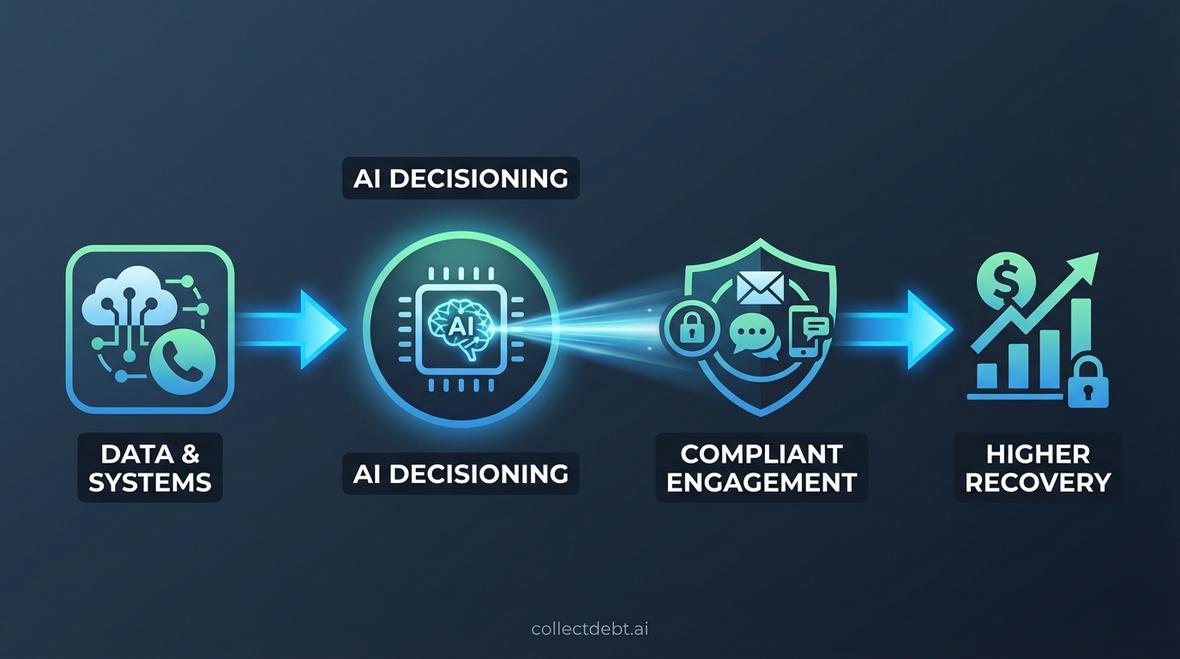
This four-stage process data aggregation, AI decisioning, compliant engagement, and recovery optimization represents the operational foundation of modern beam ai implementations. The system ingests information from multiple sources, applies intelligent algorithms to determine optimal engagement strategies, executes compliant multi-channel outreach, and ultimately drives superior recovery performance compared to traditional methodologies.
Omnichannel Engagement Capabilities
Modern debtors expect communication flexibility across multiple channels including voice calls, SMS, email, and digital self-service portals. Beam ai technology enables seamless orchestration across these touchpoints, maintaining conversation context and compliance requirements regardless of channel. The omnichannel support features provided by collectdebt.ai ensure that whether a debtor responds via text message, phone call, or web portal, the system maintains complete interaction history and adjusts strategy accordingly.
This channel flexibility proves particularly valuable given changing consumer communication preferences. Younger demographics typically prefer text-based interactions, while older debtors may respond better to voice calls. Beam ai systems automatically adapt to these preferences, increasing engagement rates and accelerating resolution timelines.
Compliance Automation and Regulatory Advantages
For Collections Directors and Compliance Officers, regulatory adherence represents the most critical operational imperative. FDCPA, TCPA, and Regulation F violations can result in substantial fines, litigation costs, and reputational damage that far exceed any short-term collection gains. Beam ai technology addresses these concerns through systematic compliance automation that removes human error from the equation.
FDCPA and TCPA Compliance Frameworks
Every interaction orchestrated by beam ai systems must adhere to strict regulatory guidelines governing contact frequency, permissible hours, disclosure requirements, and communication cessation protocols. The compliance solutions at collectdebt.ai embed these requirements directly into system logic, making it virtually impossible for the platform to generate non-compliant communications.
Key compliance capabilities include automatic time-zone detection to prevent calls outside permitted hours, mandatory mini-Miranda disclosures at interaction initiation, immediate implementation of cease-and-desist requests, and comprehensive audit trails documenting every communication attempt. According to CFPB FDCPA compliance benchmarks, automated systems have demonstrated measurable reductions in compliance violation incidents, directly addressing the litigation exposure concerns of risk-conscious decision-makers.
Documentation and Audit Trail Capabilities
Beyond preventing violations, beam ai platforms create comprehensive documentation of all collection activities. This documentation proves invaluable during audits, litigation defense, and performance analysis. Every call transcript, SMS message, email communication, and payment arrangement is automatically archived with timestamp, channel, and outcome data. This level of documentation granularity would be prohibitively expensive to achieve with human agents but occurs automatically with AI-driven systems.
ROI and Operational Efficiency Gains
While compliance benefits justify beam ai adoption from a risk perspective, the economic case centers on dramatic operational efficiency improvements and enhanced recovery performance. Collections agencies operate on thin margins where small improvements in recovery rates or cost-per-contact directly impact profitability.
Cost Reduction Versus Traditional Call Centers
Traditional call center operations incur substantial recurring costs including agent salaries, benefits, training, supervision, facilities, and infrastructure. Agent turnover rates in collections frequently exceed 50% annually, creating continuous recruitment and training expenses. Beam ai technology eliminates these variable costs, replacing them with predictable subscription pricing that scales efficiently with portfolio volume.
The generative AI versus traditional debt collection ROI analysis demonstrates that agencies implementing AI-powered solutions typically achieve 40-60% cost reductions compared to equivalent human agent capacity while simultaneously improving recovery rates by 15-25%. These combined improvements generate compelling return-on-investment metrics that typically achieve payback within 6-9 months of implementation.
Scalability for Portfolio Growth
Perhaps the most strategic advantage of beam ai implementation is near-infinite scalability. Traditional operations require proportional headcount increases to handle portfolio growth, creating linear cost scaling and recruitment challenges. AI-powered systems handle volume increases with minimal incremental cost, enabling agencies to pursue growth opportunities without corresponding operational complexity.
This scalability extends to handling seasonal fluctuations, portfolio acquisitions, and new client onboarding. A accounts receivable automation solution can increase contact volume by 500% during peak periods without hiring temporary staff, then scale back seamlessly when volumes normalize.
Implementation and Integration Considerations
Despite compelling benefits, Collections Directors appropriately scrutinize implementation complexity, integration requirements, and change management challenges before committing to beam ai adoption. Understanding these practical considerations helps organizations plan successful deployments.
Systems Integration Requirements
Effective beam ai implementation requires seamless integration with existing collections management systems, payment processors, CRM platforms, and data warehouses. The platform must access account information, update collection status, record payments, and synchronize data bidirectionally to maintain system-of-record accuracy. The integration capabilities at collectdebt.ai support connections with major collections platforms including DAKCS, LATITUDE, Collect!, and dozens of other industry-standard systems through pre-built connectors and flexible API architectures.
Implementation timelines vary based on integration complexity but typically require 4-8 weeks for standard deployments. This includes data mapping, system configuration, compliance rule implementation, agent training (for hybrid models), and phased portfolio migration to minimize disruption.
Hybrid Human-AI Deployment Models
While fully automated beam ai implementations offer maximum efficiency, many agencies benefit from hybrid models that leverage AI for initial contact attempts and routine interactions while escalating complex negotiations or disputes to human specialists. This approach optimizes resource allocation by directing expensive human labor toward high-value activities where emotional intelligence and creative problem-solving provide genuine advantages.
The inbound conversational AI features enable sophisticated call routing that seamlessly transfers debtors from AI agents to human specialists when situations warrant, maintaining conversation context and compliance documentation throughout the handoff.
Advanced Features and Competitive Differentiation
As beam ai technology matures, advanced capabilities increasingly differentiate leading platforms from basic implementations. Decision-makers should evaluate these sophisticated features when selecting solutions.
Right Party Contact Verification
Contacting wrong parties wastes resources and creates compliance risks. Advanced beam ai platforms employ voice biometrics, knowledge-based authentication, and behavioral analysis to verify debtor identity before substantive collection discussions. The right party verification capabilities at collectdebt.ai reduce wrong-party contact rates by over 85% compared to traditional verification methods, simultaneously improving efficiency and compliance.
Predictive Payment Modeling
Machine learning algorithms analyze historical payment behavior, economic indicators, and account characteristics to predict payment likelihood and optimal settlement amounts. This predictive capability enables dynamic offer generation that maximizes recovery while maintaining acceptable settlement rates. Rather than applying uniform collection strategies across portfolios, beam ai systems tailor approaches to individual debtor circumstances and payment capacity.
Self-Service Resolution Portals
Many debtors prefer resolving obligations without agent interaction. The self-service debt resolution features enable debtors to access account information, negotiate payment arrangements, and submit payments through secure digital portals available 24/7. This reduces inbound call volume while improving debtor satisfaction and resolution rates.
Industry-Specific Applications of Beam AI
While beam ai technology applies broadly across debt collection scenarios, certain industries present unique requirements that benefit from specialized implementations.
Healthcare Revenue Cycle Management
Medical debt collection presents distinctive challenges including complex billing structures, insurance coordination, and heightened sensitivity around patient relationships. The healthcare collections solutions address these requirements through specialized workflows that handle insurance verification, payment plan flexibility, and empathetic communication appropriate for medical contexts.
Auto Finance Collections
Automotive lenders face unique considerations including collateral recovery options, reinstatement negotiations, and repossession coordination. Beam ai implementations for auto finance incorporate these specialized workflows while maintaining compliance with state-specific regulations governing vehicle repossession. The auto finance collections capabilities at collectdebt.ai demonstrate recovery rate improvements of 20-30% compared to traditional approaches in this vertical.
Utility and Telecom Disconnection Management
Utility providers and telecommunications companies must balance collection activities with service continuity considerations and regulatory obligations around disconnection procedures. The utilities and telecom solutions embed industry-specific logic for disconnection notices, payment arrangement thresholds, and reconnection coordination.
Measuring Success: KPI Frameworks for Beam AI Implementations
Quantifying beam ai performance requires comprehensive metrics that extend beyond simple recovery rates to encompass efficiency, compliance, and debtor experience indicators.
Primary Performance Metrics
Essential KPIs include right-party contact rate, promise-to-pay conversion rate, promise-to-pay kept rate, liquidation rate, cost-per-dollar-collected, and average days-to-resolution. Leading implementations typically achieve right-party contact rates exceeding 60%, promise-to-pay conversion rates of 35-45%, and promise-kept rates above 75%—all representing substantial improvements over traditional benchmarks.
Compliance and Risk Indicators
Equally important are metrics tracking compliance performance including complaint rate per thousand accounts, cease-and-desist adherence, time-zone violation rate, and documentation completeness. Beam ai implementations should demonstrate near-zero compliance violations, providing measurable risk reduction that CFOs and General Counsels can quantify when evaluating platform ROI.
Future Trends in Beam AI and Collection Automation
The beam ai landscape continues rapid evolution with emerging capabilities that will further transform collection operations over the coming years. Generative AI models enable increasingly natural conversations that debtors cannot distinguish from human interactions. Emotional intelligence algorithms detect debtor stress levels and adjust communication approaches accordingly. Blockchain-based payment systems enable instant settlement with reduced processing costs.
Forward-thinking Collections Directors should evaluate not only current beam ai capabilities but also vendor roadmaps and commitment to continuous innovation. The pace of AI advancement means that platforms remaining static will quickly fall behind more innovative competitors.
Selecting the Right Beam AI Platform for Your Organization
Given the proliferation of beam ai solutions entering the market, decision-makers must systematically evaluate options against organizational requirements. Critical evaluation criteria include compliance certification and audit history, integration capabilities with existing systems, industry-specific functionality, scalability architecture, pricing transparency, implementation support, and ongoing account management.
Organizations should request detailed demonstrations using their actual account data, speak with existing customers in similar verticals, and conduct pilot programs on limited portfolios before full deployment. The platform comparison resources at collectdebt.ai provide structured frameworks for evaluating competing solutions against key decision criteria.
Frequently Asked Questions About Beam AI in Debt Collection
What does beam ai implementation typically cost?
Pricing models vary significantly across providers, ranging from per-account monthly fees to percentage-of-recovery arrangements. Most enterprise implementations require initial setup fees of fifteen to thirty-five thousand dollars plus monthly subscription costs based on active account volumes. The total cost typically represents 40-60% savings compared to equivalent traditional call center capacity.
Can beam ai systems guarantee FDCPA compliance?
While no system can provide absolute guarantees, properly configured beam ai platforms dramatically reduce compliance risk compared to human agents. Systematic rule enforcement, automatic time-zone detection, mandatory disclosures, and comprehensive audit trails create multiple layers of compliance protection that would be impossible to achieve consistently with human operations.
How long does beam ai implementation take?
Standard implementations typically require six to ten weeks from contract execution to production deployment. This timeline includes system integration, compliance rule configuration, workflow customization, user training, and phased portfolio migration. Organizations with complex integration requirements or highly customized workflows may require twelve to sixteen weeks.
Do debtors respond negatively to AI interactions?
Research indicates that debtor acceptance of AI interactions depends primarily on experience quality rather than the presence of automation itself. Well-designed beam ai systems that provide efficient resolution options, respect communication preferences, and demonstrate empathy achieve satisfaction scores comparable to or exceeding human agent interactions. Transparency about AI usage and easy escalation paths to human agents address concerns from debtors preferring human interaction.
Conclusion
Beam ai technology represents a fundamental transformation in debt collection operations, offering Collections Directors and CFOs a powerful tool to simultaneously improve recovery performance, reduce operational costs, and minimize compliance risk. The combination of intelligent automation, omnichannel engagement, predictive analytics, and systematic compliance enforcement addresses the core challenges facing modern collection organizations. As AI capabilities continue advancing and industry adoption accelerates, agencies that delay implementation risk competitive disadvantage against more technologically sophisticated competitors. Decision-makers should evaluate beam ai solutions not as experimental technology but as essential infrastructure for sustainable collection operations in 2026 and beyond.
Ready to Transform Your Collections Process?
See how CollectDebt.ai can help you automate debt collection, reduce costs, and improve compliance.