Amsher Collections: A Comprehensive Guide To Modern Debt Recovery Solutions And AI-Powered Alternatives

In the rapidly evolving landscape of debt collection, agencies like Amsher Collections have long represented the traditional approach to accounts receivable management. However, as the industry faces mounting pressure to improve efficiency, maintain compliance, and reduce operational costs, decision-makers are increasingly exploring innovative alternatives. This comprehensive guide examines Amsher Collections within the broader context of modern debt recovery, while highlighting how AI-powered solutions are transforming the industry for Directors of Operations, Collections Managers, and CFOs seeking scalable automation.
Understanding Amsher Collections and Traditional Collection Methods
Amsher Collections operates within the conventional debt collection framework, utilizing established methodologies that have defined the industry for decades. Traditional collection agencies like Amsher Collections typically employ human agents who make outbound calls, send physical letters, and manually manage case files across various debtor accounts. These agencies often work on contingency fee arrangements, taking a percentage of recovered amounts typically ranging from 25% to 50% depending on account age and complexity.
The traditional model presents several inherent challenges. Operational costs remain high due to staffing requirements, training expenses, and infrastructure investments. Scalability proves difficult, as expanding collection capacity necessitates proportional increases in headcount. Moreover, human-driven processes introduce variability in compliance adherence, communication quality, and overall recovery performance. According to the FTC Consumer Sentinel Network Data Book 2023, debt collection topped complaint categories with 1.2 million reports, with TCPA violations appearing in 15% of cases underscoring the critical need for automated compliance solutions.
Key Limitations of Traditional Collection Agencies
While agencies like Amsher Collections have established reputations within their markets, the traditional collection model faces significant constraints that impact recovery rates and operational efficiency. Understanding these limitations helps decision-makers evaluate whether conventional approaches align with their organizational objectives.
Scalability and Capacity Constraints
Traditional collection agencies face fundamental scalability barriers. Each additional account requires proportional human resources, creating a linear relationship between workload and staffing costs. During peak collection periods or when handling large portfolio acquisitions, agencies struggle to rapidly expand capacity without compromising quality or experiencing significant delays. This inflexibility can result in aged accounts receiving inadequate attention during critical early collection windows when recovery probability remains highest.
Compliance Risk and Regulatory Burden
Human-driven collection processes inherently carry higher compliance risk. Individual agents may inadvertently violate FDCPA, TCPA, or state-specific regulations through improper language, calling outside permitted hours, or failing to provide required disclosures. Training programs attempt to mitigate these risks, but human error remains unavoidable. The regulatory landscape continues tightening, with the Consumer Financial Protection Bureau implementing stricter oversight and enforcement actions that expose agencies to substantial penalties for violations.
Modern compliance solutions leverage AI to eliminate human error, ensuring every communication adheres to federal and state regulations automatically.
Cost Structure and Economic Inefficiency
The economics of traditional collection agencies create challenges for both the agency and their clients. High overhead costs including salaries, benefits, facility expenses, and technology infrastructure typically consume 60-70% of gross collections. Contingency fee structures, while risk-sharing in nature, often result in clients paying 30-50% of recovered amounts, significantly impacting net recovery rates. For organizations with high-volume, low-balance accounts, these economics become particularly unfavorable.
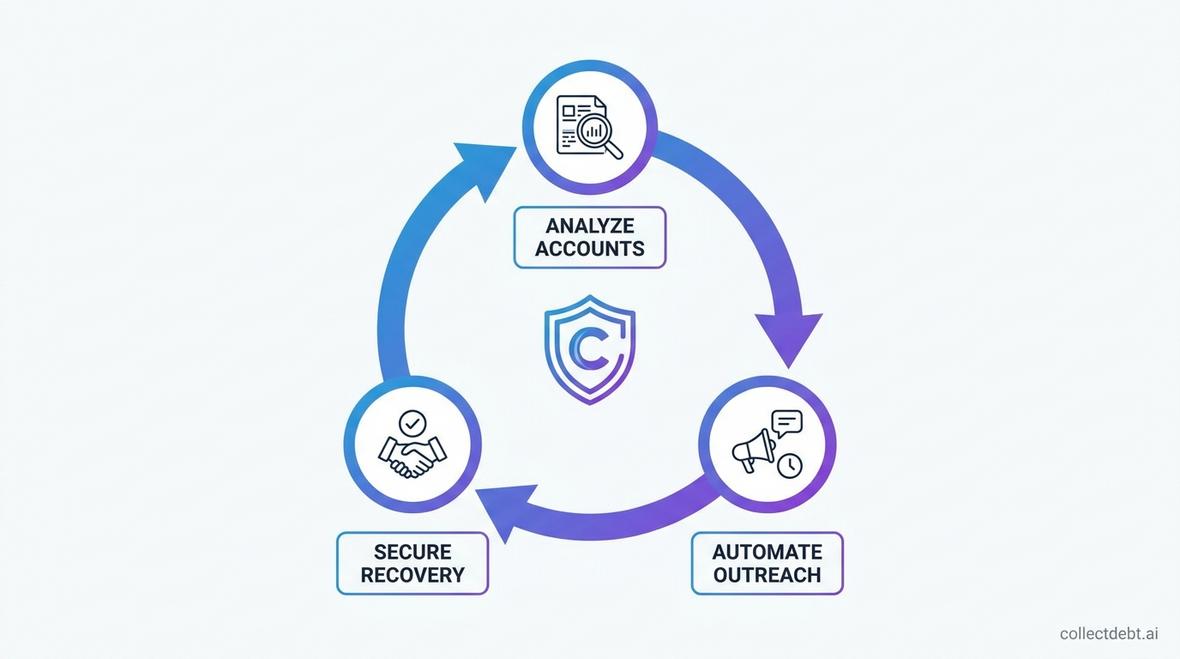
The AI-Powered Alternative: Transforming Debt Collection
The emergence of artificial intelligence in debt collection represents a paradigm shift from traditional methods employed by agencies like Amsher Collections. AI debt collection platforms leverage machine learning, natural language processing, and predictive analytics to automate and optimize recovery processes while dramatically reducing costs and improving compliance.
Automated Outreach and Engagement
AI-powered collection systems execute sophisticated outreach campaigns across multiple channels simultaneously. Unlike traditional agencies limited by agent availability, AI platforms can initiate thousands of personalized contacts concurrently through voice calls, SMS, email, and chat interfaces. These systems utilize behavioral data to determine optimal contact times, preferred communication channels, and messaging strategies for individual debtors.
Advanced omnichannel support ensures consistent debtor experiences across all touchpoints, with seamless transitions between communication methods based on debtor preferences and responsiveness patterns.
Compliance Automation and Risk Elimination
AI collection platforms embed regulatory compliance directly into their operational architecture. Every communication undergoes automatic validation against FDCPA, TCPA, and relevant state statutes before execution. Systems automatically track call frequency, honor do-not-call requests, observe time-of-day restrictions, and maintain comprehensive audit trails for regulatory examinations.
This architectural approach to compliance eliminates the human error factor that plagues traditional agencies. The technology ensures 100% adherence to FDCPA compliance standards, dramatically reducing legal exposure and regulatory risk for organizations managing accounts receivable.
Cost Efficiency and ROI Advantages
The economic advantages of AI-powered collection solutions prove compelling for cost-conscious decision-makers. By eliminating the need for large agent teams, expensive call center infrastructure, and ongoing training programs, AI platforms reduce operational costs by 60-80% compared to traditional agencies like Amsher Collections. These savings translate directly to improved net recovery rates and superior return on investment.
Organizations implementing AI collection solutions typically maintain recovery rates comparable to or exceeding traditional methods while retaining 80-90% of collected amounts rather than paying steep contingency fees. For detailed analysis, review this comprehensive guide on generative AI versus traditional debt collection ROI.
Key Capabilities of Modern AI Collection Platforms
Understanding the specific capabilities that differentiate AI-powered solutions from traditional agencies like Amsher Collections helps decision-makers evaluate technology options for their organizations.
Conversational AI and Natural Interactions
Modern AI collection platforms deploy sophisticated conversational agents capable of conducting natural, contextual dialogues with debtors. These systems understand intent, respond to questions, handle objections, and navigate complex conversation flows that previously required human judgment. Advanced natural language understanding enables the AI to detect debtor sentiment, adjust communication tone accordingly, and escalate to human oversight when appropriate.
Inbound conversational AI capabilities allow debtors to initiate contact on their terms, accessing account information, making payments, and negotiating arrangements through intuitive self-service interfaces available 24/7.
Intelligent Payment Arrangement and PTP Management
AI platforms excel at negotiating and managing payment arrangements. By analyzing debtor financial indicators, payment history, and behavioral signals, these systems propose realistic payment plans with high fulfillment probability. Automated promise-to-pay management tracks commitments, sends timely reminders, and automatically adjusts strategies when debtors fail to honor agreements.
Right Party Contact and Identity Verification
One of the most significant challenges in debt collection involves confirming debtor identity and ensuring communications reach the correct individual. AI platforms incorporate sophisticated right party verification protocols that authenticate caller identity through multi-factor approaches including voice biometrics, knowledge-based authentication, and behavioral analysis all while maintaining FDCPA compliance regarding third-party disclosures.
Post-Call Analysis and Continuous Optimization
Unlike traditional collection agencies where call quality monitoring involves sampling small percentages of interactions, AI platforms analyze 100% of debtor engagements. Advanced post-call analysis extracts insights regarding communication effectiveness, objection patterns, and optimal messaging strategies. Machine learning algorithms continuously refine approach strategies based on these insights, creating self-improving collection systems that become more effective over time.
Industry-Specific Applications Beyond Amsher Collections
While traditional agencies like Amsher Collections typically operate across various sectors, specialized AI collection platforms offer industry-tailored solutions that address unique challenges within specific verticals.
Healthcare Revenue Cycle Management
The healthcare sector faces distinctive collection challenges including complex insurance coordination, patient financial responsibility confusion, and sensitivity requirements. AI platforms designed for healthcare collections incorporate specialized workflows that explain medical billing, coordinate insurance payments, and offer patient-friendly payment plans while maintaining HIPAA compliance and preserving patient relationships.
Financial Services and Auto Finance
Financial institutions managing credit card portfolios, personal loans, and auto finance accounts benefit from AI solutions that integrate directly with core banking systems. These platforms provide real-time account status, automated payment processing, and sophisticated skip tracing capabilities. For auto finance specifically, specialized AI solutions incorporate repossession prevention strategies and vehicle location tracking integration.
Utilities and Telecommunications
Utility and telecom providers managing high-volume, relatively low-balance accounts find AI collection particularly advantageous. The economics of traditional collection become unfavorable for accounts under $500, but automated AI approaches make small-balance collection economically viable. Industry-specific platforms incorporate service restoration workflows, payment plan options that prevent disconnection, and integration with billing systems for seamless account management.
Implementation Considerations for Collection Decision-Makers
Organizations evaluating whether to continue with traditional agencies like Amsher Collections or transition to AI-powered solutions should consider several strategic factors.
Integration with Existing Technology Infrastructure
Successful AI collection implementation requires seamless integration with existing accounts receivable systems, customer relationship management platforms, and payment processing infrastructure. Modern platforms offer extensive integration capabilities through APIs, webhooks, and pre-built connectors for common enterprise systems. Decision-makers should prioritize solutions offering flexible integration options that minimize implementation complexity and accelerate time-to-value.
Hybrid Human-AI Approaches
Rather than viewing AI as a complete replacement for human collectors, many organizations implement hybrid models where AI handles high-volume, straightforward accounts while human agents focus on complex, high-value cases requiring nuanced judgment. This approach maximizes efficiency while maintaining human touch for sensitive situations. The optimal balance depends on portfolio composition, account values, and organizational priorities.
Change Management and Stakeholder Alignment
Transitioning from established agencies like Amsher Collections to AI-powered solutions requires careful change management. Internal stakeholders including legal, compliance, IT, and operations teams must understand the technology, trust its capabilities, and align around implementation objectives. Successful deployments typically include pilot programs demonstrating effectiveness before full-scale rollout, comprehensive training for oversight personnel, and clear communication regarding expected outcomes and success metrics.
Measuring Success: KPIs for AI Collection Performance
Organizations replacing traditional agencies with AI solutions should establish clear performance metrics to evaluate effectiveness and demonstrate ROI.
Recovery Rate and Roll Rate Improvement
The fundamental measure of collection effectiveness remains recovery rate the percentage of outstanding debt successfully collected. AI platforms typically maintain or improve recovery rates compared to traditional methods while significantly reducing cost-per-dollar-collected. Additionally, monitoring roll rates (the percentage of accounts progressing to later delinquency stages) provides insight into early-stage intervention effectiveness.
Operational Efficiency Indicators
Key efficiency metrics include contact rate (percentage of debtors successfully reached), right party contact rate (percentage of contacts reaching the actual debtor), and resolution rate (percentage of contacts resulting in payment or arrangement). AI platforms typically achieve contact rates 3-5 times higher than traditional agencies due to 24/7 operation and multi-channel approaches. For comprehensive guidance on performance measurement, explore essential chatbot KPIs for AI-powered debt collection.
Compliance and Risk Metrics
Monitoring compliance-related indicators proves critical for risk management. Track metrics including complaint rates, cease-and-desist requests, regulatory inquiries, and litigation incidents. AI platforms should demonstrate near-zero compliance violations compared to traditional agencies where human error creates inherent risk. Comprehensive audit trails and communication recordings provide documentation for regulatory examinations and dispute resolution.
The Future of Debt Collection Beyond Traditional Agencies
The debt collection industry stands at an inflection point. Traditional agencies like Amsher Collections face increasing pressure from technological innovation, regulatory complexity, and client demands for improved economics. AI-powered solutions continue advancing rapidly, incorporating generative AI capabilities, predictive analytics, and increasingly sophisticated natural language processing.
Forward-thinking decision-makers recognize that competitive advantage increasingly derives from technology adoption rather than traditional operational scale. Organizations that transition early to AI-powered collection platforms position themselves to capture efficiency gains, reduce compliance risk, and improve debtor experiences creating sustainable competitive advantages in accounts receivable management.
The question facing Collections Managers, Directors of Operations, and CFOs is no longer whether to adopt AI collection technology, but rather when and how to implement these transformative solutions. For organizations currently working with traditional agencies, the transition to platforms offering end-to-end collection automation represents a strategic imperative rather than a discretionary enhancement.
Frequently Asked Questions
How do AI collection platforms compare to agencies like Amsher Collections in terms of recovery rates?
AI collection platforms typically achieve recovery rates comparable to or exceeding traditional agencies while reducing operational costs by 60-80%. The key advantage lies not in dramatically higher recovery percentages, but in superior economics organizations retain 80-90% of collected amounts rather than paying 30-50% contingency fees to third-party agencies.
Can AI collection systems truly maintain FDCPA and TCPA compliance without human oversight?
Modern AI platforms embed compliance rules directly into their operational architecture, automatically validating every communication against federal and state regulations before execution. This approach eliminates human error the primary source of compliance violations. While human oversight remains important for strategy and exception handling, the technology itself ensures 100% adherence to regulatory requirements for routine collection activities.
What is the typical implementation timeline for transitioning from a traditional agency to an AI collection platform?
Implementation timelines vary based on portfolio complexity and integration requirements, but most organizations complete deployment within 4-8 weeks. This includes system integration, data migration, workflow configuration, compliance validation, and pilot testing. Organizations can typically begin processing accounts through AI platforms within 30 days of project initiation.
Do debtors respond negatively to AI-powered collection communications compared to human agents?
Research indicates debtors often prefer AI interactions for routine collection matters. AI platforms offer 24/7 availability, consistent professional tone, and self-service options that empower debtors to resolve obligations on their own terms. Many debtors appreciate the reduced pressure and judgment-free environment that AI communications provide. For sensitive or complex situations, hybrid approaches allowing escalation to human agents prove most effective.
Conclusion
While Amsher Collections and similar traditional agencies have served the debt collection industry for decades, the emergence of AI-powered solutions represents a fundamental transformation in accounts receivable management. Decision-makers seeking to maximize recovery rates, minimize operational costs, and ensure regulatory compliance increasingly recognize that technology-driven approaches offer superior economics and performance compared to conventional human-centered models. Organizations evaluating their collection strategies should carefully assess how AI platforms address their specific portfolio characteristics, compliance requirements, and business objectives. The transition from traditional agencies to automated solutions represents not merely a vendor change, but a strategic shift toward scalable, efficient, and compliant debt recovery that positions organizations for long-term competitive advantage in an increasingly technology-driven marketplace.
Ready to Transform Your Collections Process?
See how CollectDebt.ai can help you automate debt collection, reduce costs, and improve compliance.