AI Debt Collection: The Complete 2026 Guide To Automated Recovery Solutions

Introduction to AI Debt Collection
The debt collection industry is undergoing a fundamental transformation as artificial intelligence reshapes traditional recovery methods. AI debt collection solutions are no longer experimental they represent a proven strategy for agencies seeking to maximize recovery rates while maintaining strict regulatory compliance. As household debt levels continue rising and consumer expectations evolve, decision-makers in collections operations face mounting pressure to adopt scalable, cost-effective technologies that deliver measurable results.
Modern AI debt platforms combine conversational AI, predictive analytics, and omnichannel engagement to create recovery systems that operate 24/7 with minimal human intervention. These solutions address the core challenges plaguing traditional call centers: high operational costs, inconsistent compliance, limited scalability, and declining contact rates. For Directors of Operations, Collections Managers, and CFOs evaluating automation investments, understanding the capabilities and implementation considerations of AI debt technology has become essential to maintaining competitive advantage in 2026.
The Regulatory Imperative for AI Debt Solutions
Compliance challenges have intensified dramatically across the collections industry. CFPB debt collection complaints doubled from 109,900 in 2023 to 207,800 in 2024, highlighting the growing scrutiny agencies face under regulations like the FDCPA and TCPA. These escalating complaint volumes reflect both increased consumer awareness and the compliance gaps inherent in manual collection processes where human error remains unavoidable.
AI debt collection platforms directly address these regulatory risks through programmatic compliance enforcement. Unlike human agents who may inadvertently violate call time restrictions or use prohibited language, AI systems apply compliance rules consistently across every interaction. The technology automatically validates consent for communication channels, maintains required disclosures, and documents all debtor interactions with complete audit trails. For organizations operating across multiple jurisdictions with varying state-level regulations, AI debt solutions provide centralized compliance management that scales effortlessly.
The financial consequences of non-compliance extend beyond regulatory fines. Agencies face reputational damage, operational disruptions from consent orders, and increased legal costs. By implementing AI-powered compliance solutions, organizations transform regulatory adherence from a liability into a competitive differentiator that builds consumer trust while protecting operational continuity.
Efficiency and Cost Advantages of AI Debt Technology
The economic case for AI debt automation centers on dramatic improvements in operational efficiency and cost structure. Forrester: AI-powered virtual agents boost throughput 2x over traditional call centers, with documented portfolio resolution rates reaching 76% compared to manual methods. This performance advantage stems from AI's ability to simultaneously manage thousands of accounts, eliminate idle time, and maintain consistent engagement quality throughout every interaction.
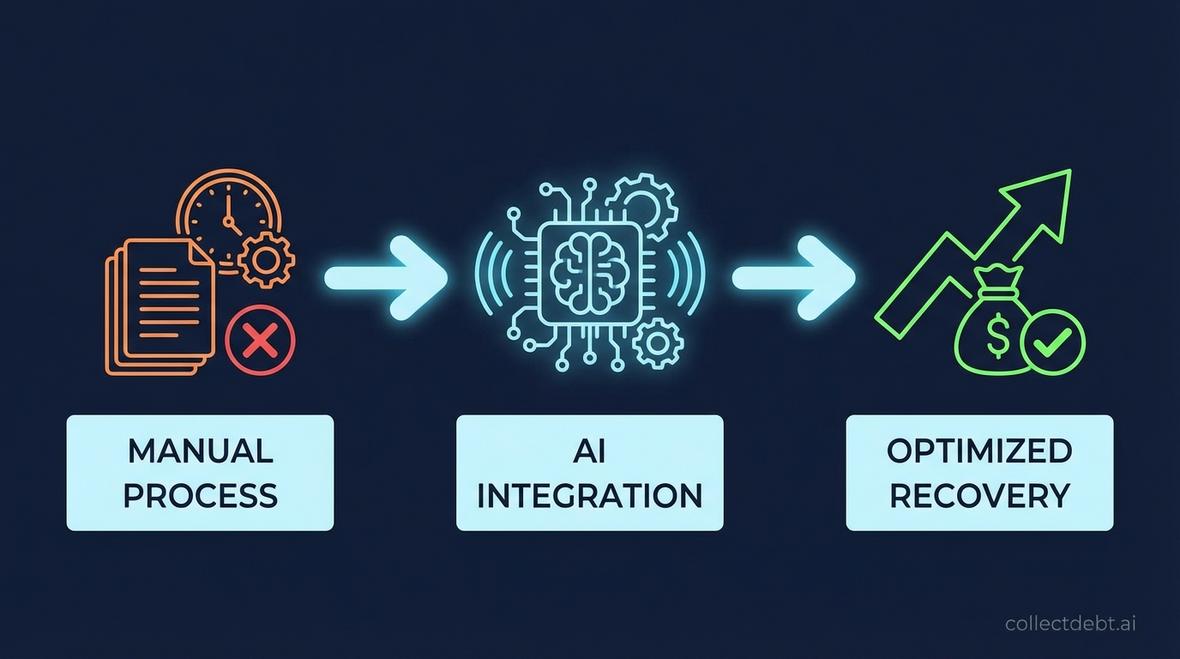
Traditional call centers incur substantial fixed costs including agent salaries, benefits, training programs, facility expenses, and supervisory overhead. AI debt platforms replace these variable costs with predictable subscription models that scale with collection volumes. The technology eliminates common inefficiencies like agent turnover, training cycles, and inconsistent performance that plague human-staffed operations. Organizations typically achieve cost reductions of 60-70% while simultaneously increasing contact attempts and expanding operational hours to 24/7 availability.
Beyond direct cost savings, AI debt solutions enhance capital efficiency through improved liquidation rates and faster time-to-resolution. The technology's ability to identify optimal contact timing, personalize communication strategies, and instantly process payments accelerates cash collection cycles. For CFOs evaluating technology investments, the combination of reduced operating expenses and improved recovery performance delivers compelling return-on-investment timelines typically ranging from 6-12 months.
Core Capabilities of Modern AI Debt Platforms
Conversational AI and Natural Language Processing
The foundation of effective AI debt collection lies in conversational AI that conducts natural, empathetic interactions with debtors. Modern platforms utilize advanced natural language processing to understand debtor intent, detect emotional states, and adapt conversation flow in real-time. This technology moves beyond rigid interactive voice response systems to deliver genuinely human-like conversations that build rapport and encourage payment commitments.
Conversational AI systems for debt collection handle complex scenarios including hardship negotiations, payment plan structuring, and dispute resolution without human intervention. The technology recognizes hundreds of conversation variations, maintains context across multi-turn dialogues, and seamlessly transitions between topics as debtor needs evolve. This sophistication ensures debtors receive consistent, professional service that maintains brand reputation while advancing collection objectives.
Omnichannel Engagement and Communication Orchestration
Contemporary AI debt platforms orchestrate engagement across voice, SMS, email, and digital channels through unified workflows. This omnichannel approach recognizes that consumers have channel preferences that vary by context and demographic factors. Younger debtors often prefer text-based communication, while older populations may respond better to voice outreach. AI systems dynamically select optimal channels based on historical response patterns and real-time engagement signals.
Channel orchestration extends beyond simple multi-channel deployment. Advanced AI debt solutions maintain conversation continuity as debtors move between channels, preserving context and eliminating frustrating information requests. A debtor might receive an initial SMS notification, respond via text to request payment options, then complete authentication and payment through a voice call all tracked and managed by the AI system as a single, coherent interaction journey.
Identity Verification and Right Party Contact
Regulatory compliance and operational efficiency both depend on accurate debtor identification before substantive collection conversations begin. AI-powered right party verification systems utilize voice biometrics, knowledge-based authentication, and behavioral analysis to confirm debtor identity with high confidence while maintaining positive user experiences.
These verification systems protect organizations from inadvertent third-party disclosures that violate FDCPA regulations while reducing time wasted on wrong-party contacts. The technology adapts authentication rigor based on risk factors applying heightened verification for high-value accounts or sensitive transactions while streamlining authentication for routine inquiries. This intelligent approach balances security requirements with debtor convenience to maximize completed interactions.
Implementation and Integration Considerations
Integration with Existing Collection Infrastructure
Successful AI debt deployment requires seamless integration with existing collection management systems, payment processors, and data warehouses. Modern platforms offer pre-built connectors for major collection software vendors and flexible APIs that accommodate custom integrations. The integration architecture should enable bidirectional data flow, ensuring AI systems access current account information while updating collection systems with interaction outcomes in real-time.
Organizations must evaluate integration complexity during vendor selection, considering factors like API documentation quality, available technical support, and implementation timelines. The most effective AI debt solutions provide sandbox environments for testing integrations before production deployment and offer dedicated implementation teams that understand collections-specific technical requirements. This support infrastructure significantly reduces deployment risk and accelerates time-to-value.
Data Quality and Training Requirements
AI debt collection effectiveness correlates directly with training data quality and volume. Organizations should prepare historical interaction data, payment outcomes, and debtor demographic information for AI model training. The technology learns optimal communication strategies, payment propensity indicators, and compliance patterns from this historical data. Insufficient or biased training data produces AI systems that perpetuate existing inefficiencies or create new compliance risks.
Data preparation extends beyond simple data extraction. Organizations must cleanse data for accuracy, standardize formats across disparate systems, and establish governance protocols for ongoing data quality management. Leading AI debt vendors provide data assessment services that identify gaps and recommend preparation strategies before implementation begins. This upfront investment in data quality delivers compounding returns as AI models continuously learn and improve from production interactions.
Industry-Specific AI Debt Collection Applications
Financial Services and Credit Card Collections
Financial institutions face unique collection challenges including high account volumes, diverse debtor populations, and stringent regulatory oversight. AI debt solutions for financial services address these complexities through automated segmentation, personalized communication strategies, and integrated payment processing. The technology handles everything from early-stage delinquency reminders to complex hardship negotiations for seriously delinquent accounts.
Credit card portfolios particularly benefit from AI's ability to identify optimal contact timing and predict payment propensity. The technology analyzes spending patterns, payment history, and external economic indicators to prioritize accounts most likely to respond positively to outreach. This intelligent workload prioritization maximizes collector productivity by focusing efforts where they generate highest returns.
Healthcare Revenue Cycle and Patient Collections
Healthcare providers confront growing patient responsibility balances as high-deductible health plans proliferate. AI-powered healthcare collections balance recovery objectives with patient relationship preservation through empathetic communication and flexible payment options. The technology recognizes healthcare collections' unique sensitivities, incorporating language and tone appropriate for medical contexts while maintaining HIPAA compliance.
Healthcare AI debt systems integrate with electronic health record systems and practice management platforms to access current balance information and insurance status. This integration enables real-time eligibility verification, coordination of benefits resolution, and accurate payment allocation across complex account structures involving multiple service dates and insurance adjustments.
Utilities and Telecommunications
Utility and telecom providers deal with recurring billing relationships where collection strategies must preserve ongoing service relationships. AI solutions for utilities collections emphasize early intervention, payment plan establishment, and service continuity while managing disconnection processes when necessary. The technology monitors payment patterns to identify financial distress early, enabling proactive outreach before accounts reach critical delinquency.
For telecommunications specifically, AI debt platforms handle complex scenarios involving disputed charges, service quality issues, and contract termination fees. The technology applies specialized logic for these situations, escalating to human specialists when disputes require technical investigation while autonomously resolving straightforward balance inquiries and payment arrangements.
Measuring AI Debt Collection Performance
Essential Performance Indicators
Organizations must establish comprehensive metrics frameworks to evaluate AI debt collection effectiveness. Key performance indicators include right party contact rates, promise-to-pay conversion rates, liquidation percentages, and cost-per-dollar-collected. Leading implementations achieve right party contact rates exceeding 60% compared to 20-30% for traditional dialers, while promise-to-pay rates often reach 40-50% of connected conversations.
Beyond volume metrics, organizations should track compliance indicators including call time violations, disclosure accuracy, and consent documentation completeness. AI systems enable 100% quality assurance through automated call monitoring and compliance scoring, eliminating the sampling limitations inherent in manual QA processes. This comprehensive compliance visibility provides audit-ready documentation and early warning systems for potential regulatory issues.
Continuous Optimization and Model Refinement
AI debt collection platforms improve continuously through machine learning algorithms that identify successful patterns and adapt strategies based on outcomes. Organizations should establish governance processes for reviewing model performance, approving strategy changes, and maintaining human oversight of AI decision-making. This governance ensures AI systems remain aligned with business objectives and regulatory requirements as they evolve.
Advanced platforms provide performance dashboards that visualize key metrics, identify optimization opportunities, and enable A/B testing of alternative strategies. Collection managers can experiment with different communication approaches, payment incentives, and contact cadences while the AI system measures comparative effectiveness. This data-driven optimization culture transforms collections from art to science, replacing intuition-based decisions with empirically validated strategies.
Selecting an AI Debt Collection Partner
Critical Vendor Evaluation Factors
Organizations evaluating AI debt vendors should assess several critical dimensions beyond basic functionality. Compliance capabilities deserve primary consideration vendors must demonstrate deep understanding of FDCPA, TCPA, and state-specific regulations with built-in guardrails that prevent violations. Request documentation of compliance frameworks, audit histories, and regulatory examination experiences.
Technical architecture represents another crucial evaluation area. Cloud-native platforms offer superior scalability and reliability compared to legacy on-premises solutions. Assess security certifications including SOC 2, PCI-DSS for payment processing, and industry-specific compliance standards. Evaluate disaster recovery capabilities, uptime guarantees, and incident response protocols to ensure operational continuity.
Implementation and Change Management Support
Successful AI debt deployment requires more than technology installation it demands organizational change management and staff training. Evaluate vendors' implementation methodologies, dedicated support resources, and training programs for both technical staff and collection team members. The transition from human-staffed operations to AI-augmented processes creates cultural challenges that vendors with change management expertise can help navigate.
Consider the vendor's product roadmap and commitment to continuous innovation. The AI debt collection landscape evolves rapidly as new language models, compliance regulations, and consumer preferences emerge. Partners with active development programs and regular feature releases ensure your investment remains current rather than becoming obsolete. Review customer references focusing on long-term partnership experiences rather than just initial implementation success.
Future Trends in AI Debt Collection
The AI debt collection industry continues advancing rapidly across multiple dimensions. Generative AI models enable increasingly sophisticated natural language capabilities that blur distinctions between human and AI conversations. These advanced models understand subtle contextual nuances, cultural references, and emotional undertones that earlier systems missed, creating genuinely empathetic debtor experiences.
Predictive analytics evolution enables earlier intervention and more accurate payment propensity modeling. U.S. Treasury: Rising household debt necessitates AI for early intervention compliance, emphasizing proactive approaches that prevent serious delinquency rather than reacting after accounts deteriorate. Future AI systems will incorporate broader economic indicators, social media signals, and alternative data sources to predict financial distress before traditional delinquency indicators appear.
Regulatory technology integration represents another frontier as agencies like the CFPB explore AI-powered supervision tools. Collection organizations must prepare for environments where regulators deploy AI systems to monitor compliance at scale, analyzing thousands of interactions automatically. This evolution reinforces the necessity of AI debt platforms with robust compliance architectures that withstand algorithmic regulatory scrutiny.
Frequently Asked Questions
How does AI debt collection maintain FDCPA compliance?
AI debt platforms enforce FDCPA compliance through programmatic rule implementation that applies restrictions consistently across all interactions. The systems automatically validate permissible contact times, require mandatory disclosures, prevent prohibited language, and maintain comprehensive documentation. Unlike human agents susceptible to errors under pressure, AI systems never deviate from programmed compliance parameters.
What recovery rate improvements can organizations expect?
Organizations typically experience 30-50% improvements in liquidation rates when implementing comprehensive AI debt solutions. These gains result from increased contact rates through 24/7 operations, optimized contact timing based on predictive models, personalized communication strategies, and friction-reduced self-service payment options. Actual results vary based on portfolio characteristics and implementation scope.
How long does AI debt collection implementation require?
Implementation timelines range from 6-12 weeks for standard deployments to 4-6 months for complex enterprise integrations. Factors affecting duration include system integration complexity, data preparation requirements, compliance review processes, and testing thoroughness. Organizations should allocate additional time for staff training and pilot programs before full production deployment.
Can AI systems handle complex hardship negotiations?
Modern AI debt platforms manage sophisticated hardship scenarios including income verification, expense analysis, and payment plan structuring. The technology applies programmatic decision trees that evaluate debtor circumstances against organizational policies to offer appropriate accommodations. For situations requiring subjective judgment or exceptional approvals, AI systems seamlessly escalate to human specialists while maintaining conversation context.
What security measures protect sensitive debtor information?
Enterprise AI debt platforms implement multiple security layers including end-to-end encryption for data transmission and storage, role-based access controls, comprehensive audit logging, and regular penetration testing. Leading vendors maintain SOC 2 Type II certifications, PCI-DSS compliance for payment processing, and implement data residency controls for jurisdictional requirements. Organizations should verify security certifications during vendor evaluation.
Conclusion
AI debt collection technology has matured from experimental innovation to essential infrastructure for modern collection operations. The combination of dramatic efficiency improvements, enhanced compliance management, and superior debtor experiences creates compelling value propositions for agencies seeking competitive advantage in increasingly challenging markets. As regulatory scrutiny intensifies and consumer expectations evolve, organizations that embrace AI-powered collection solutions position themselves for sustainable success while those clinging to manual processes face mounting operational and financial pressures. The transition to AI debt platforms represents not merely technological adoption but fundamental business transformation that redefines what effective, compliant, and consumer-friendly collections look like in 2026 and beyond.
Ready to Transform Your Collections Process?
See how CollectDebt.ai can help you automate debt collection, reduce costs, and improve compliance.