AI Debt Collection: The Complete 2026 Guide To Automated Recovery Solutions

Understanding AI Debt Collection in 2026
The debt collection industry is undergoing a transformative shift as ai debt collection technologies redefine how businesses recover outstanding payments. Traditional collection methods, once reliant on manual calling and paper-based processes, are now being replaced by intelligent automation systems that leverage artificial intelligence, machine learning, and natural language processing to deliver superior recovery rates while maintaining compliance and improving customer experience.
As we navigate through 2026, ai debt collection has become more than just a competitive advantage it's rapidly becoming a necessity for organizations looking to optimize their accounts receivable management. From financial services to healthcare, industries across the spectrum are adopting AI-powered solutions to streamline their collection workflows and maximize recovery outcomes.
This comprehensive guide explores everything you need to know about ai debt collection, from the underlying technologies and implementation strategies to measurable ROI and future trends that will shape the industry in the years ahead.
What Is AI Debt Collection?
AI debt collection refers to the application of artificial intelligence technologies to automate, optimize, and enhance the debt recovery process. Unlike traditional collection methods that rely heavily on human agents making repetitive calls, AI-powered systems can analyze vast amounts of debtor data, predict payment behavior, personalize communication strategies, and negotiate settlements all while maintaining strict regulatory compliance.
Modern AI debt collection solutions incorporate several advanced technologies:
- Machine Learning: Algorithms that learn from historical payment data to predict which debtors are most likely to pay and which communication strategies will be most effective.
- Natural Language Processing (NLP): Enables AI systems to understand and respond to debtor communications in a natural, conversational manner across multiple channels.
- Predictive Analytics: Identifies optimal contact times, preferred communication channels, and personalized payment plans based on individual debtor profiles.
- Voice AI: Powers intelligent voice agents that can conduct collection calls with human-like conversation capabilities while adhering to compliance requirements.
- Automation: Streamlines repetitive tasks such as sending reminders, scheduling follow-ups, and processing payments without manual intervention.
The integration of these technologies creates a comprehensive end-to-end collection system that operates 24/7, scales effortlessly, and continuously improves through machine learning.
How AI Debt Collection Works: The Intelligent Recovery Process
Understanding how ai debt collection operates is essential for organizations considering implementation. The process typically follows a sophisticated, multi-stage workflow that maximizes recovery while minimizing operational costs.
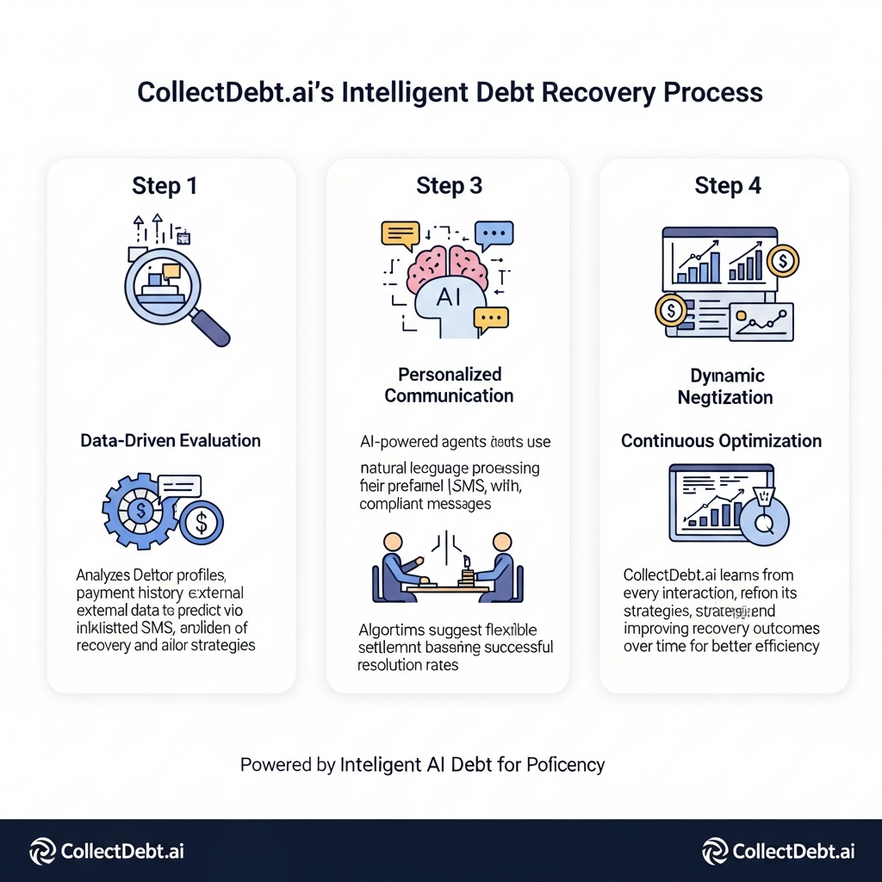
Step 1: Data-Driven Evaluation and Risk Assessment
The first stage of the ai debt collection process involves comprehensive data analysis. AI systems ingest debtor information from multiple sources, including payment history, credit scores, demographic data, communication preferences, and external economic indicators. Advanced algorithms then segment debtors into risk categories and assign prioritization scores based on the likelihood of recovery.
This data extraction process enables collection teams to focus their efforts on accounts with the highest recovery potential while automatically handling lower-priority cases through self-service channels.
Step 2: Personalized, Multi-Channel Communication
Once debtors are segmented, AI-powered systems initiate personalized outreach through the debtor's preferred communication channel. Whether through SMS, email, voice calls, or chatbots, the AI tailors messaging based on individual debtor profiles.
Omnichannel support ensures consistent messaging across all touchpoints, while conversational AI enables natural dialogue that addresses debtor concerns, answers questions, and negotiates payment arrangements without human intervention.
Step 3: Dynamic Negotiation and Settlement
Advanced ai debt collection platforms employ sophisticated negotiation algorithms that can offer flexible payment plans, settlement discounts, and alternative arrangements based on debtor circumstances. The system analyzes factors such as debt age, debtor income, and historical payment behavior to determine optimal settlement offers that balance recovery rates with customer satisfaction.
The promise-to-pay feature automates the commitment process, sending confirmations and scheduling reminders to ensure debtors follow through on their agreements.
Step 4: Continuous Learning and Optimization
Perhaps the most powerful aspect of ai debt collection is its ability to learn and improve over time. Every interaction generates data that feeds back into the machine learning models, refining strategies and improving future performance. Post-call analysis examines conversation patterns, identifies successful tactics, and adjusts approaches for maximum effectiveness.
This continuous optimization cycle means that AI collection systems become more effective with each interaction, constantly adapting to changing debtor behaviors and market conditions.
Key Benefits of AI Debt Collection
Organizations implementing ai debt collection solutions are experiencing transformative benefits across multiple dimensions of their operations. The advantages extend far beyond simple automation, delivering measurable improvements in recovery rates, compliance, cost efficiency, and customer experience.
Dramatically Improved Recovery Rates
Studies consistently show that ai debt collection systems achieve higher recovery rates compared to traditional methods. By leveraging predictive analytics to identify the right time, channel, and message for each debtor, AI systems optimize every touchpoint for maximum effectiveness. Many organizations report recovery rate improvements of 20-40% after implementing AI-powered solutions.
The data on AI debt collection recovery rates demonstrates clear advantages across various industries and debt types.
Enhanced Regulatory Compliance
Compliance with regulations such as the Fair Debt Collection Practices Act (FDCPA) and similar international standards is critical in debt collection. AI debt collection systems are programmed with comprehensive compliance rules, ensuring every communication adheres to regulatory requirements.
From proper mini-Miranda rights disclosures to call time restrictions and prohibited language, AI systems eliminate compliance risks that arise from human error or inconsistent training. The compliance features built into modern platforms provide audit trails and documentation for every interaction.
Massive Operational Efficiency Gains
Automation of repetitive tasks frees human agents to focus on complex cases requiring personal attention. Batch calling capabilities allow AI systems to contact thousands of debtors simultaneously, while self-service debt resolution portals enable debtors to manage their accounts independently.
Organizations typically see 60-80% reductions in operational costs as AI handles the majority of routine collection activities, allowing smaller teams to manage larger portfolios more effectively.
Superior Customer Experience
Contrary to concerns about impersonal automation, ai debt collection actually improves the debtor experience. AI systems offer 24/7 availability, instant responses, multiple communication channel options, and personalized payment solutions tailored to individual circumstances.
The ability to self-serve through digital channels reduces the stress and embarrassment many debtors feel when dealing with collection issues, leading to higher engagement and better outcomes for both parties.
Unlimited Scalability and Consistency
Unlike human-dependent operations that require hiring, training, and managing additional staff to handle volume increases, ai debt collection systems scale instantly. Whether handling 100 or 100,000 accounts, AI maintains consistent quality and approach across all interactions.
This scalability is particularly valuable for seasonal businesses or organizations experiencing rapid growth in their receivables portfolios.
AI Debt Collection Across Industries
The versatility of ai debt collection technology makes it applicable across virtually every industry that extends credit or manages receivables. Each sector benefits from tailored approaches that address industry-specific challenges and regulatory requirements.
Financial Services and Banking
Banks and financial institutions leverage AI in banking to manage credit card debt, personal loans, and mortgage arrears. The technology enables sophisticated segmentation, risk-based pricing for settlements, and automated early-stage interventions that prevent delinquencies from escalating.
Healthcare and Medical Billing
The healthcare sector faces unique collection challenges with complex billing structures and sensitive patient relationships. Early-out self-pay healthcare collections benefit significantly from AI's ability to explain charges, offer payment plans, and maintain empathetic communication while recovering outstanding balances.
Auto Finance and Transportation
Auto finance collections utilize AI to manage loan delinquencies, prevent repossessions through early intervention, and negotiate modification arrangements. The auto finance use case demonstrates particularly strong results with voice AI agents.
Retail and E-commerce
Retail organizations use ai debt collection to recover unpaid invoices, manage buy-now-pay-later (BNPL) delinquencies, and handle returned payment situations. The technology's ability to maintain positive customer relationships while recovering funds is particularly valuable in this sector.
Utilities and Telecommunications
Utilities and telecom providers benefit from AI's high-volume processing capabilities and ability to offer flexible payment arrangements that prevent service disconnections while ensuring revenue recovery.
Real Estate and Hospitality
From unpaid rent to outstanding hotel bills, real estate and hospitality organizations leverage AI to automate reminder sequences, negotiate payment plans, and escalate cases appropriately while maintaining professional relationships.
Implementing AI Debt Collection: Key Considerations
Successfully deploying ai debt collection technology requires thoughtful planning and strategic execution. Organizations should consider several critical factors when evaluating and implementing AI solutions.
Integration with Existing Systems
Effective ai debt collection platforms must seamlessly integrate with existing technology infrastructure, including customer relationship management (CRM) systems, accounting software, payment processors, and data warehouses. The integration capabilities of your chosen solution will determine implementation complexity and operational efficiency.
Modern platforms offer API-based connections, pre-built integrations with popular systems, and flexible data exchange protocols that minimize disruption during deployment.
Data Quality and Preparation
AI systems are only as effective as the data they're trained on. Organizations should audit their existing debtor data for accuracy, completeness, and consistency before implementation. Clean, structured data enables AI algorithms to generate more accurate predictions and more effective collection strategies.
Compliance Framework and Governance
Establishing clear compliance protocols and governance structures is essential when implementing ai debt collection technology. This includes defining approval workflows, establishing escalation procedures, documenting AI decision-making processes, and creating audit mechanisms to ensure ongoing regulatory adherence.
The FDCPA compliance guide for AI debt collection provides detailed frameworks for maintaining regulatory standards.
Human-AI Collaboration Model
The most successful implementations don't eliminate human agents entirely they create optimized collaboration between AI and human debt collectors. Define which cases AI will handle autonomously, when escalation to human agents is appropriate, and how agents will leverage AI insights and recommendations in their work.
Change Management and Training
Introducing ai debt collection represents a significant operational change that requires careful change management. Staff may have concerns about job security, new technology learning curves, or changes to established workflows. Successful organizations invest in comprehensive training programs and clear communication about how AI will enhance not replace human capabilities.
Measuring ROI and Performance Metrics
Quantifying the return on investment from ai debt collection implementation requires tracking multiple performance indicators across financial, operational, and customer experience dimensions.
Financial Performance Metrics
- Recovery Rate: Percentage of outstanding debt successfully collected
- Days Sales Outstanding (DSO): Average time to collect payment
- Collection Cost Ratio: Cost per dollar collected
- Net Recovery: Total collections minus operational costs
- Right Party Contact Rate: Percentage of attempts reaching the actual debtor
The comparison of generative AI versus traditional debt collection ROI demonstrates typical performance improvements organizations can expect.
Operational Efficiency Metrics
- Contact Attempts per Resolution: Number of touchpoints required to resolve an account
- Agent Productivity: Accounts handled per agent (for hybrid models)
- Automation Rate: Percentage of cases resolved without human intervention
- Response Time: Average time to respond to debtor inquiries
- Containment Rate: Percentage of interactions completed within self-service channels
Understanding containment rates in debt collections helps optimize the balance between automation and human intervention.
Compliance and Quality Metrics
- Compliance Violation Rate: Number of regulatory breaches per interaction
- Complaint Rate: Percentage of debtors filing complaints
- Audit Success Rate: Percentage of interactions passing compliance audits
- Script Adherence: Consistency in following approved communication protocols
The Future of AI Debt Collection: Trends for 2026 and Beyond
As we progress through 2026, several emerging trends are shaping the evolution of ai debt collection technology and practices.
Generative AI and Large Language Models
The integration of advanced large language models (LLMs) is enabling even more sophisticated conversational capabilities. These systems can understand context, emotion, and nuance in debtor communications, generating responses that feel genuinely empathetic and helpful rather than scripted.
The evolution from ChatGPT to specialized conversational AI for debt collection represents a significant leap in AI's ability to handle complex, emotionally sensitive collection conversations.
Voice AI and Natural Conversation
Voice AI technology continues advancing rapidly, with systems now capable of handling interruptions, detecting emotional states, and adjusting tone and approach in real-time. The distinction between AI and human agents is becoming increasingly difficult for debtors to identify.
Multilingual and Cultural Adaptation
Multi-language AI debt collection systems are expanding access to diverse debtor populations, breaking down language barriers that previously required specialized staff or limited collection effectiveness.
Predictive Early Intervention
Advanced analytics are enabling organizations to identify accounts at risk of delinquency before payments are missed, allowing proactive intervention that prevents debt from accumulating. This shift from reactive collection to preventive account management represents a fundamental transformation in receivables management.
Ethical AI and Transparency
As AI becomes more prevalent in collections, regulatory bodies and consumers are demanding greater transparency in how AI systems make decisions. Explainable AI that can articulate its reasoning and ethical AI frameworks that prevent bias are becoming essential requirements for ai debt collection platforms.
Selecting the Right AI Debt Collection Platform
With numerous ai debt collection solutions available, organizations must carefully evaluate options to find the platform that best meets their specific requirements.
Key Evaluation Criteria
When comparing platforms, consider:
- Technology Capabilities: NLP sophistication, machine learning algorithms, voice quality, and integration options
- Industry Specialization: Experience and optimization for your specific industry and debt types
- Compliance Features: Built-in regulatory compliance, audit capabilities, and documentation
- Scalability: Ability to handle your current volume and future growth
- Customization: Flexibility to adapt to your specific workflows and business rules
- Support and Training: Implementation assistance, ongoing support, and user training resources
- Pricing Model: Transparent pricing structure aligned with your budget and usage patterns
Platform Comparisons
Organizations should conduct thorough comparisons of available solutions. Resources such as Retell vs CollectDebt, Vodex vs CollectDebt, and similar comparison guides can help identify the strengths and weaknesses of different platforms.
Getting Started with AI Debt Collection
Organizations ready to implement ai debt collection should follow a structured approach to ensure successful deployment and rapid value realization.
Start with a Pilot Program
Rather than full-scale deployment, begin with a limited pilot program targeting a specific debt segment or account type. This allows you to test the technology, refine approaches, and demonstrate value before broader rollout.
Define Clear Success Metrics
Establish baseline measurements for current performance and define specific, measurable goals for the AI implementation. This creates accountability and provides clear benchmarks for evaluating success.
Invest in Comprehensive Training
Ensure all stakeholders from executives to front-line staff understand how the ai debt collection system works, what it can and cannot do, and how it will change current processes.
Plan for Iteration and Optimization
AI systems improve over time, but this requires ongoing monitoring, analysis, and refinement. Build continuous optimization into your implementation plan rather than treating deployment as a one-time project.
Conclusion: The AI Debt Collection Imperative
As we navigate through 2026, ai debt collection has transitioned from emerging technology to essential business capability. Organizations that embrace AI-powered collection solutions are experiencing dramatic improvements in recovery rates, operational efficiency, compliance adherence, and customer satisfaction simultaneously.
The competitive landscape is shifting rapidly. Businesses that continue relying exclusively on traditional collection methods face increasing disadvantages in cost structure, recovery performance, and scalability compared to AI-enabled competitors.
For organizations managing accounts receivable across any industry from financial services to healthcare, from retail to utilities the question is no longer whether to implement ai debt collection, but how quickly you can deploy it effectively.
The technology has matured, the ROI is proven, and the competitive imperative is clear. Organizations that act decisively to implement comprehensive AI-powered collection solutions will secure significant advantages in the increasingly competitive landscape of receivables management.
To explore how ai debt collection can transform your organization's recovery performance, visit CollectDebt.ai to learn more about industry-leading AI-powered debt collection solutions designed for the modern enterprise.
Frequently Asked Questions About AI Debt Collection
Will AI debt collection completely replace human collectors?
No, the most effective approach combines AI automation with human expertise. AI handles routine cases, high-volume outreach, and initial contact, while human agents focus on complex situations requiring empathy, negotiation skills, and judgment. This hybrid model delivers superior results compared to either approach alone.
How does AI debt collection ensure regulatory compliance?
AI debt collection systems are programmed with comprehensive compliance rules covering regulations like the FDCPA, TCPA, and industry-specific requirements. Every communication is automatically screened for prohibited language, proper disclosures, contact time restrictions, and other compliance factors. The systems maintain detailed audit trails documenting every interaction for regulatory review.
What is the typical cost of implementing AI debt collection?
Costs vary significantly based on organization size, debt volume, and platform selection. Most vendors offer flexible pricing models including per-account fees, subscription pricing, or performance-based arrangements. Many organizations achieve positive ROI within 3-6 months through improved recovery rates and reduced operational costs.
How long does it take to implement an AI debt collection system?
Implementation timelines range from a few weeks for basic deployments to several months for complex, highly customized solutions. Factors affecting timeline include integration complexity with existing systems, data migration requirements, customization needs, and staff training. Many platforms offer phased rollout options that deliver value incrementally.
Is debtor data secure with AI debt collection platforms?
Reputable ai debt collection platforms implement enterprise-grade security measures including data encryption, secure authentication, role-based access controls, and compliance with data protection regulations like GDPR and CCPA. Organizations should verify security certifications and data handling practices during vendor evaluation.
What recovery rate improvements can organizations expect from AI debt collection?
Results vary based on industry, debt type, and implementation quality, but organizations typically report recovery rate improvements of 20-40% compared to traditional methods. Some segments see even higher gains, particularly in early-stage collections where AI's ability to contact debtors quickly and consistently proves most effective.
Ready to Transform Your Collections Process?
See how CollectDebt.ai can help you automate debt collection, reduce costs, and improve compliance.