AI Collections Agent: The Complete 2026 Guide To Automated Debt Recovery Solutions

What is an AI Collections Agent?
An AI collections agent is an autonomous software system that uses artificial intelligence, machine learning, and natural language processing to automate debt collection activities. Unlike traditional automated dialers or IVR systems, these sophisticated agents can conduct dynamic, two-way conversations with debtors across multiple channels including voice, SMS, email, and chat while maintaining full compliance with regulations like the FDCPA and TCPA.
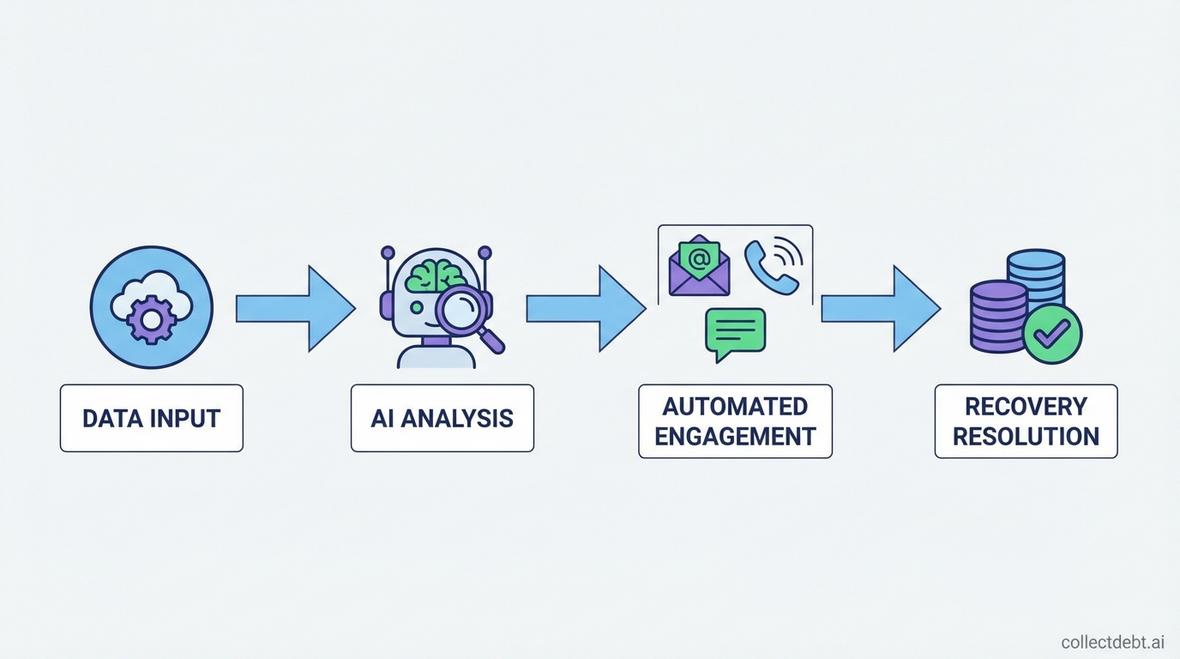
For decision-makers in collections operations, AI collections agents represent a paradigm shift from labor-intensive call centers to scalable, cost-effective recovery systems. These intelligent agents handle account identification, right party verification, payment negotiation, promise-to-pay arrangements, and dispute resolution autonomously, escalating only the most complex cases to human agents.
The core value proposition centers on three pillars: operational efficiency (reducing cost-per-contact by up to 70%), improved recovery rates (through personalized, data-driven engagement), and ironclad compliance (via programmatic adherence to regulatory frameworks). As collection agencies and AR departments face mounting pressure to do more with less, AI collections agents have emerged as mission-critical infrastructure for modern debt recovery operations.
How AI Collections Agents Work: The Technology Stack
Understanding the underlying architecture helps collections managers evaluate vendor capabilities and integration requirements. A robust AI collections agent platform typically comprises five integrated layers:
Natural Language Processing (NLP) Engine
The NLP layer enables the agent to understand debtor intent, sentiment, and context during conversations. Advanced models trained on collections-specific interactions can detect financial hardship indicators, identify dispute triggers, and adjust communication tone in real-time. This technology powers both inbound conversational AI and outbound engagement strategies.
Decision Intelligence Layer
This component determines optimal contact strategies based on account attributes, debtor behavior patterns, historical response data, and regulatory constraints. Machine learning algorithms continuously refine strategies, identifying which communication channels, times, and message frameworks yield the highest promise-to-pay conversion rates for specific debtor segments.
Compliance Automation Framework
Regulatory adherence is embedded at the system level, not as an afterthought. The AI collections agent automatically enforces contact frequency limits, respects communication preferences, validates right party verification before discussing debt details, and maintains detailed audit trails. According to CFPB Regulation F compliance benchmarks, AI-driven compliance automation reduces violation incidents by 85% compared to manual processes.
Omnichannel Orchestration
Modern debtors expect flexible communication options. AI agents coordinate seamlessly across voice, SMS, email, web chat, and self-service portals, maintaining conversation context regardless of channel switches. This omnichannel support capability increases contact rates by 40-60% compared to voice-only strategies.
Integration & API Layer
Enterprise-grade AI collections agents integrate with existing collections management systems, payment gateways, CRMs, and dialer platforms. RESTful APIs and webhooks enable bi-directional data flow, ensuring account status updates, payment confirmations, and debtor interactions are synchronized in real-time across all systems.
Key Capabilities of AI Collections Agents
The functional scope of AI collections agents extends far beyond simple scripted interactions. Here are the core capabilities that distinguish advanced platforms:
Autonomous Outbound Campaigns
AI agents execute high-volume outbound campaigns without human intervention. They automatically select optimal contact times based on debtor timezone and behavioral patterns, personalize opening messages using account history, and adapt conversation flow based on real-time responses. Advanced systems can manage thousands of concurrent conversations, dramatically reducing time-to-contact for new placements.
Intelligent Payment Negotiation
Rather than rigid payment demands, AI collections agents employ dynamic negotiation frameworks. They assess debtor financial capacity through conversational cues, propose payment arrangements within pre-approved parameters, and secure commitments through behavioral psychology techniques. The result: 35-50% higher promise-to-pay conversion rates compared to human-only operations.
Self-Service Debt Resolution
Many debtors prefer resolving obligations without speaking to an agent. AI-powered self-service debt resolution portals allow debtors to verify accounts, view balance details, arrange payment plans, and process payments 24/7. This reduces operational costs while improving debtor satisfaction scores.
Multilingual Communication
Language barriers significantly impact recovery rates in diverse markets. Leading AI collections agents support 20+ languages with native-level fluency, automatically detecting debtor language preference and switching seamlessly. This capability expands addressable debtor populations without proportional staffing increases.
Dispute Detection & Routing
When debtors contest debt validity, AI agents immediately recognize dispute language patterns, halt collection activity per FDCPA requirements, capture detailed dispute information, and route cases to appropriate validation workflows. This automated compliance response eliminates costly violations from missed dispute flags.
Benefits of Implementing AI Collections Agents
The business case for AI collections agents rests on measurable improvements across operational, financial, and strategic dimensions:
Dramatic Cost Reduction
Labor represents 60-70% of traditional collections operating expenses. AI collections agents reduce per-account contact costs by 65-80%, with some organizations reporting per-contact costs dropping from $8-12 (human agent) to $1-2 (AI agent). For agencies handling hundreds of thousands of accounts, this translates to millions in annual savings.
Scalability Without Headcount
Traditional growth requires proportional hiring, training, and infrastructure investment. AI agents scale elastically handling 10,000 or 100,000 accounts with identical per-unit economics. This enables agencies to pursue high-volume, lower-balance accounts previously deemed uneconomical for human contact.
Improved Recovery Rates
By optimizing contact timing, personalizing messaging, and maintaining consistent follow-up cadences, AI collections agents typically increase overall recovery rates by 15-25%. The impact is particularly pronounced in early-stage collections, where rapid, persistent contact drives higher cure rates.
Compliance & Risk Mitigation
Human error drives the majority of FDCPA and TCPA violations missed opt-outs, improper disclosures, excessive contact frequency, or third-party communications. AI agents eliminate these risks through programmatic compliance enforcement, reducing violation risk by over 85% and associated legal costs accordingly. Research from Forrester: Multi-agent systems breakthrough in 2026 for compliance workflows shows that multi-agent AI architectures deliver measurable improvements in complex compliance validation processes.
Data-Driven Insights
Every AI agent interaction generates structured data debtor responses, objection types, payment commitment factors, optimal contact times, and channel preferences. Advanced analytics platforms transform this data into actionable intelligence, enabling continuous strategy refinement and portfolio segmentation optimization.
AI Collections Agents Across Industries
While the core technology remains consistent, implementation strategies vary significantly across vertical markets:
Healthcare Collections
Medical debt presents unique challenges patient sensitivity, insurance complexity, and regulatory constraints like HIPAA. AI collections agents for healthcare incorporate specialized workflows for insurance verification, payment plan options aligned with financial assistance programs, and empathetic communication frameworks that preserve patient relationships while maximizing recovery.
Auto Finance Collections
In auto finance, the repossession threat provides unique leverage but also regulatory exposure. AI agents manage early-stage delinquency with automated payment reminders and arrangement options, escalating to human specialists only when repo becomes likely. This approach reduces costly repossessions while maintaining portfolio performance.
Utilities & Telecom
Subscription-based businesses face high-volume, low-balance delinquencies where traditional collections economics don't work. AI agents make micro-balance recovery profitable through complete automation, maintaining service relationships while recovering past-due amounts. Learn more about utilities and telecom applications.
Financial Services
Banks and credit unions leverage AI collections agents across multiple product lines credit cards, personal loans, overdrafts, and mortgages. Integration with core banking systems enables real-time account status updates and payment processing, while regulatory compliance frameworks address stringent financial services requirements. Discover specialized financial services solutions.
Implementing an AI Collections Agent: Best Practices
Successful deployment requires strategic planning beyond technology selection. Collections leaders should address these critical implementation dimensions:
Define Clear Use Cases
Not all accounts benefit equally from AI automation. High-performing implementations segment portfolios by balance, age, debtor profile, and complexity, deploying AI agents where they deliver maximum impact typically early-stage, high-volume segments while reserving human agents for high-value, complex negotiations.
Ensure System Integration
AI collections agents must integrate seamlessly with collections management systems, payment processors, CRMs, and dialers. Evaluate vendor integration capabilities early, ensuring APIs support required data flows and that implementation timelines account for integration testing and validation.
Establish Compliance Guardrails
While AI agents automate compliance, human oversight remains essential. Implement quality assurance processes that sample AI interactions, monitor for drift or anomalies, and validate that conversation flows reflect current regulatory interpretations. Establish clear escalation protocols for edge cases and disputed accounts.
Design Hybrid Workflows
The most effective implementations combine AI and human agents strategically. AI handles high-volume, low-complexity interactions payment reminders, balance inquiries, simple arrangements while routing complex negotiations, disputes, and high-value accounts to experienced human collectors. This hybrid model optimizes both efficiency and effectiveness.
Invest in Training & Change Management
AI implementation fundamentally changes collector roles from outbound calling to exception handling and complex case resolution. Successful transitions require comprehensive training, clear communication about role evolution, and engagement strategies that position AI as augmentation rather than replacement.
The Future of AI Collections Agents
The AI collections agent market continues rapid evolution, with several transformative trends emerging:
Predictive Payment Modeling
Next-generation platforms incorporate predictive analytics that forecast payment probability, optimal contact strategies, and arrangement structures most likely to result in successful resolution. These models enable preemptive strategy adjustments before delinquency occurs, shifting collections from reactive to predictive.
Emotional Intelligence Enhancement
Advanced NLP models increasingly detect emotional states stress, anger, confusion, willingness during conversations, adjusting tone, pacing, and approach accordingly. This emotional intelligence capability bridges the traditional gap between AI efficiency and human empathy.
Regulatory AI Evolution
As regulators incorporate AI-specific guidance into collections frameworks, compliance solutions will evolve to address algorithmic bias, transparency requirements, and explainability standards. Forward-thinking platforms are already building audit trails that demonstrate decision logic and fairness across debtor populations.
Voice Biometrics & Authentication
Emerging voice biometric technologies enable frictionless identity verification during AI agent conversations, replacing security questions with voiceprint analysis. This enhances security while improving debtor experience and reducing authentication time.
Choosing the Right AI Collections Platform
Evaluating AI collections agent vendors requires assessment across multiple dimensions:
Core Technology: Does the platform use proprietary AI models or generic conversational frameworks? Specialized collections-trained models deliver superior performance.
Compliance Infrastructure: How does the platform enforce FDCPA, TCPA, and state-specific regulations? Look for built-in compliance automation, not manual configuration requirements.
Integration Capabilities: What APIs, webhooks, and pre-built connectors are available? Seamless integration with existing systems is critical for operational efficiency.
Omnichannel Support: Does the platform support voice, SMS, email, and chat with unified conversation context? Channel flexibility drives higher contact and conversion rates.
Analytics & Reporting: What insights does the platform provide beyond basic call metrics? Advanced analytics on debtor behavior, strategy effectiveness, and compliance monitoring create competitive advantages.
Vendor Stability & Support: Evaluate vendor financial stability, implementation support quality, and ongoing customer success resources. AI collections represent critical infrastructure vendor partnership quality matters.
ROI of AI Collections Agents
Financial justification for AI collections agent investment typically focuses on three value drivers:
Direct Cost Savings: Labor cost reduction from automation, typically 65-80% per-contact cost improvement, with payback periods of 6-12 months for most implementations.
Revenue Enhancement: Incremental recovery from improved contact rates, optimized strategies, and expanded account coverage, often adding 15-25% to baseline recovery rates.
Risk Mitigation: Reduced compliance violations and associated legal costs, plus reputational protection from consistent, professional debtor interactions.
For a mid-sized agency handling 100,000 accounts annually, AI collections agent deployment typically generates $1.5-3 million in annual value through combined cost savings and revenue enhancement, against implementation costs of $150,000-400,000.
Frequently Asked Questions About AI Collections Agents
Will AI collections agents replace human collectors entirely?
No. The optimal model combines AI handling of high-volume, routine interactions with human agents focusing on complex negotiations, high-value accounts, and situations requiring nuanced judgment. AI augments rather than replaces human expertise.
Do debtors prefer AI or human agents?
Research shows debtor preference varies by context. For simple inquiries, balance checks, and payment processing, many debtors prefer fast, convenient AI self-service. For complex financial discussions or hardship situations, human interaction remains preferred. Offering choice optimizes satisfaction.
How can AI guarantee compliance?
While no system is infallible, AI collections agents dramatically reduce compliance risk through programmatic rule enforcement, eliminating common human errors around contact frequency, disclosure requirements, and opt-out management. Regular auditing and human oversight validate ongoing compliance.
What is typical implementation timeline?
Implementation timelines vary by organizational complexity and integration requirements. Basic deployments may go live in 4-6 weeks, while enterprise implementations with extensive system integration and custom workflow development typically require 3-6 months.
What integration is required?
At minimum, AI collections agents need bi-directional integration with collections management systems for account data and status updates, plus payment gateway integration for transaction processing. Advanced implementations may integrate with dialers, CRMs, and business intelligence platforms.
Conclusion
The AI collections agent represents a fundamental transformation in debt recovery operations delivering unprecedented efficiency, scalability, and compliance while maintaining or improving recovery performance. For collections leaders facing pressure to reduce costs, expand capacity, and eliminate regulatory risk, AI automation has evolved from optional innovation to competitive necessity. The platforms available in 2026 offer sophisticated capabilities that were experimental just years ago, with proven ROI across diverse industry applications. Organizations that strategically implement AI collections agents position themselves to thrive in an increasingly automated, data-driven collections landscape, while those delaying adoption risk competitive disadvantage in both operational efficiency and recovery effectiveness. To explore how AI debt collection can transform your operations, evaluate leading platforms against your specific requirements and begin pilots that demonstrate value before full-scale deployment.
Ready to Transform Your Collections Process?
See how CollectDebt.ai can help you automate debt collection, reduce costs, and improve compliance.