How Does Scarcity Affect Decision-Making: Psychology, Impact & Solutions For 2026
Introduction
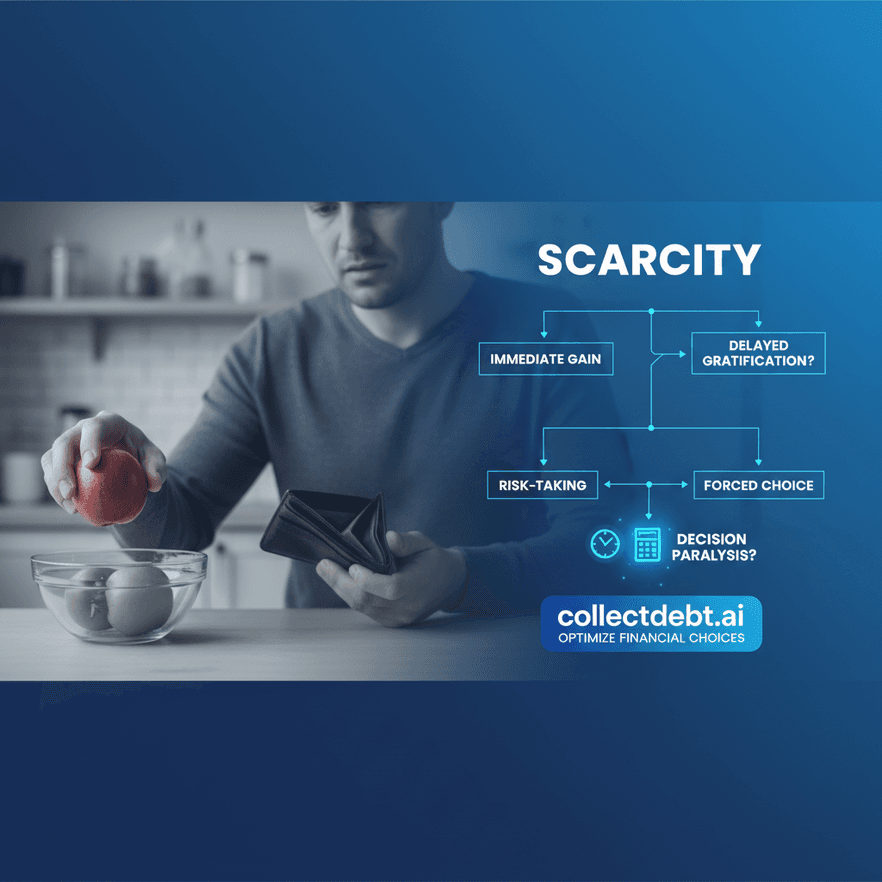
In today's fast-paced business environment, understanding how does scarcity affect decision-making is critical for organizations managing financial operations, debt collection, and customer engagement. Scarcity whether of time, money, or resources fundamentally alters the way individuals and businesses make choices. This cognitive phenomenon doesn't just influence personal finance decisions; it shapes entire industries, from financial services to healthcare and beyond.
Research consistently demonstrates that scarcity creates a psychological tunnel vision, forcing decision-makers to focus intensely on immediate needs while neglecting long-term consequences. For debt collection agencies, accounts receivable management teams, and financial institutions, recognizing how scarcity influences debtor behavior is essential for designing empathetic, effective collection strategies. In this comprehensive guide, we'll explore the psychology behind scarcity-driven decisions, examine real-world impacts across industries, and provide actionable solutions for 2026 and beyond.
The Psychology of Scarcity: How Limited Resources Reshape Thinking
Scarcity is more than just having less it's a mental state that fundamentally changes cognitive processing. When resources become scarce, the human brain shifts into a focused, narrowed mode of thinking that prioritizes immediate survival over strategic planning.
Cognitive Bandwidth and Tunneling Effect
Psychologists Sendhil Mullainathan and Eldar Shafir introduced the concept of 'bandwidth tax' in their groundbreaking research on scarcity. When people experience scarcity particularly financial scarcity their cognitive bandwidth becomes consumed by the pressing problem at hand. This creates a 'tunneling' effect where individuals hyper-focus on immediate needs while becoming blind to peripheral information, even when that information is critically important.
According to research from Princeton University, experiencing financial scarcity can reduce cognitive capacity by approximately 13-14 IQ points equivalent to losing a full night's sleep. This cognitive load directly impacts decision-making quality, leading to choices that might seem irrational to outside observers but make perfect sense within the scarcity mindset.
Present Bias Amplification
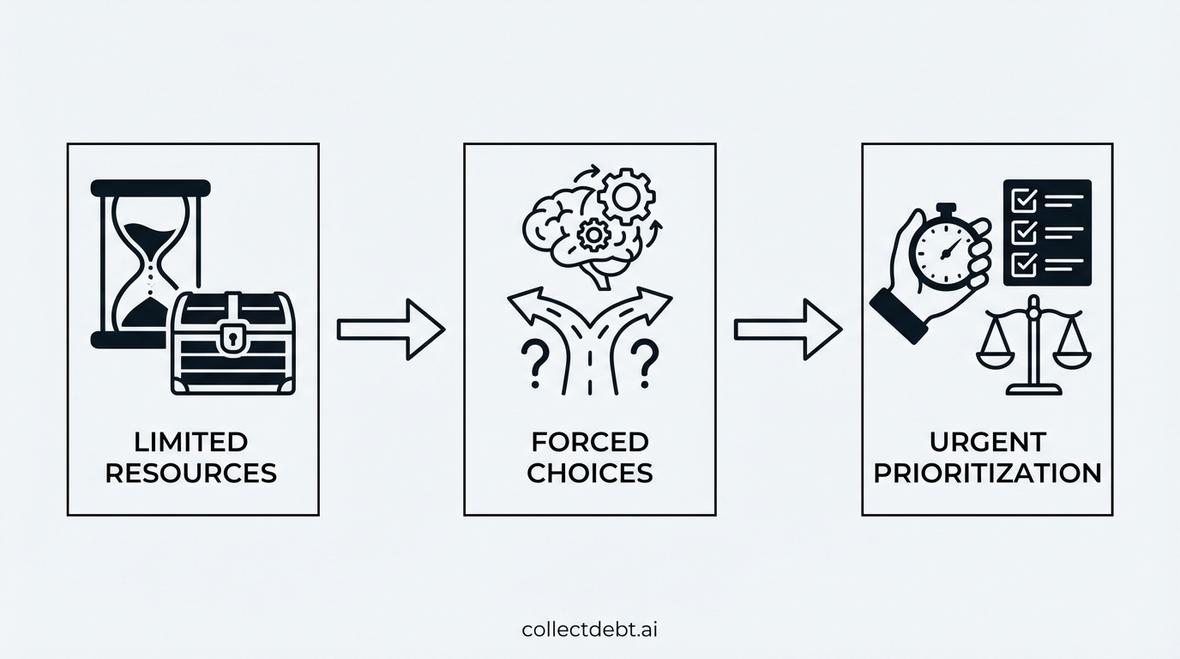
Scarcity intensifies present bias the tendency to prioritize immediate rewards over future benefits. When facing limited resources, people become significantly more likely to choose smaller immediate gains over larger delayed rewards. This phenomenon explains why individuals experiencing financial hardship might skip necessary preventive healthcare, delay vehicle maintenance, or make minimum payments that ultimately cost more in interest decisions that seem counterproductive but are driven by immediate survival needs.
For organizations implementing AI debt collection strategies, understanding this present bias is crucial. Debtors aren't necessarily avoiding payment out of malice; they're often making impossible choices between competing urgent needs.
Stress and Decision Fatigue
Scarcity generates chronic stress, which depletes decision-making resources throughout the day. Each financial decision no matter how small draws from a limited pool of mental energy. By the time individuals facing scarcity encounter important decisions, they're often cognitively exhausted, leading to either decision paralysis or impulsive choices.
Research published in the Journal of Consumer Psychology demonstrates that financial scarcity increases cortisol levels, impairs executive function, and reduces the ability to resist temptation. This biochemical reality must inform how collection agencies approach debtors, particularly through conversational AI that can reduce cognitive burden during payment negotiations.
How Does Scarcity Affect Decision-Making: Core Mechanisms
Understanding the specific mechanisms through which scarcity influences choices provides actionable insights for businesses dealing with financially constrained customers.
Temporal Discounting and Future Planning
Scarcity dramatically increases temporal discounting the rate at which people devalue future rewards compared to immediate ones. When resources are scarce, the future becomes psychologically distant and abstract, while present needs feel overwhelmingly concrete and urgent.
A study by the American Psychological Association found that individuals experiencing financial scarcity discount future rewards at rates 40-60% higher than those with financial security. This explains why long-term payment plans, while objectively beneficial, may feel less attractive to debtors than resolving immediate creditor pressure, even through disadvantageous terms.
Risk Perception and Loss Aversion Shifts
Scarcity fundamentally alters risk perception. Paradoxically, people facing scarcity may become simultaneously more risk-averse in some domains and more risk-seeking in others. They become highly loss-averse regarding their scarce resource (protecting every dollar fiercely) while potentially taking desperate gambles to escape scarcity (lottery tickets, high-risk investments).
For healthcare providers and utilities managing patient or customer accounts, this dual risk orientation means payment solutions must minimize perceived loss while offering realistic paths out of financial difficulty.
Mental Accounting and Budget Rigidity
Under scarcity, mental accounting how people categorize and treat money differently based on its source or intended use becomes more rigid and compartmentalized. Money designated for one purpose cannot easily be reallocated, even when rational analysis would suggest flexibility.
This rigidity affects debt collection outcomes significantly. A debtor might have funds in a 'rent envelope' but genuinely cannot access that money mentally for a medical bill, despite both being equally urgent objectively. Account receivable strategies that recognize these mental boundaries and work within them achieve higher success rates.
Industry-Specific Impacts: How Scarcity-Driven Decisions Affect Different Sectors
The effects of scarcity on decision-making manifest differently across industries, requiring tailored approaches.
Financial Services and Banking
In financial services, scarcity creates a paradoxical situation where those who most need careful financial planning are least able to engage in it effectively. Banks and credit unions witness this through increased overdraft fees, payday loan utilization, and default rates among customers experiencing financial scarcity.
Progressive institutions are responding by implementing self-service debt resolution platforms that reduce the cognitive burden on customers, allowing them to manage obligations without the stress of direct confrontation. According to industry analyses, self-service options can improve resolution rates by 25-35% among financially stressed customers.
Healthcare and Medical Collections
Healthcare presents a unique scarcity scenario where medical necessity collides with financial limitations. Patients facing medical debt often experience dual scarcity health resources and financial resources creating particularly complex decision-making environments.
Research from the Healthcare Financial Management Association indicates that approximately 60% of patients with outstanding medical bills delay or avoid future care, demonstrating how scarcity-driven decisions compound over time. Healthcare providers implementing promise to pay systems with flexible terms see significantly better engagement when these systems account for the psychological realities of financial scarcity.
Retail and E-Commerce
In the retail sector, scarcity influences both purchasing decisions and payment behaviors. Buy-now-pay-later (BNPL) services have exploded precisely because they address the present-bias intensified by scarcity, allowing immediate acquisition while deferring payment.
However, this same mechanism can lead to overextension. Retailers managing customer credit accounts benefit from understanding that missed payments often reflect scarcity-driven tunneling rather than intentional avoidance. Collection approaches that acknowledge this psychology offering flexible payment dates aligned with income schedules, for instance demonstrate measurably better outcomes.
Utilities and Telecommunications
Essential services providers face the particular challenge that their services represent non-negotiable needs for customers already experiencing scarcity. The decision to pay a utility bill versus buying food represents an impossible choice created by resource limitations.
Utility companies achieving the best collection outcomes use omnichannel support that meets customers in their preferred communication channels while offering payment arrangements that recognize income volatility. Automated systems that can quickly assess individual circumstances and offer appropriate solutions reduce the cognitive burden on customers making these impossible choices.
Business Implications: Adapting Collection Strategies to Scarcity Psychology
Understanding how scarcity affects decision-making transforms collection strategy from punitive to empathetic while improving outcomes.
Strategic Timing and Communication
Traditional collection strategies often increase contact frequency as accounts age, inadvertently adding to the cognitive burden of debtors experiencing scarcity. More effective approaches consider optimal timing based on income cycles and reduce unnecessary communications that consume debtor bandwidth.
Advanced end-to-end collection platforms now incorporate behavioral economics principles, timing outreach to coincide with income deposits and using language that reduces cognitive load rather than increasing stress. Organizations implementing these timing strategies report 15-30% improvements in contact rates and resolution success.
Simplifying Choice Architecture
When cognitive bandwidth is limited by scarcity, complex choices become overwhelming. Collection strategies that simplify decision-making offering a single clear path forward rather than multiple complicated options achieve better results.
This is where AI-powered systems excel. By analyzing individual circumstances and presenting the single most appropriate solution rather than overwhelming debtors with options, these systems reduce decision fatigue. The complete guide to AI-powered debt collection demonstrates how machine learning can identify the optimal offer for each unique situation, removing the cognitive burden from both debtor and collector.
Default Options and Automation
Scarcity increases reliance on default options because making active decisions depletes scarce cognitive resources. Well-designed payment systems leverage this by making the beneficial choice the default option automatic payment plans, pre-scheduled payment dates aligned with income, and opt-out rather than opt-in arrangements.
Research in behavioral economics shows that changing from opt-in to opt-out systems can increase participation rates by 30-50%. In debt collection, this translates to setting up payment arrangements that continue automatically unless stopped, rather than requiring monthly re-engagement from debtors experiencing bandwidth constraints.
AI Solutions for Scarcity-Informed Collections in 2026
Artificial intelligence offers unprecedented capabilities to implement scarcity-informed collection strategies at scale.
Predictive Scarcity Analytics
Modern AI systems can identify indicators of financial scarcity before they manifest in payment behavior. By analyzing patterns in payment timing, amount variability, and engagement patterns, these systems can proactively offer assistance before accounts become severely delinquent.
This predictive capability allows organizations to intervene with supportive resources payment plan options, financial counseling connections, or temporary accommodation at the moment when they're most effective. Early intervention reduces the depth of scarcity-driven decision-making tunnels before they form.
Personalized, Empathetic Communication
AI-powered conversational interfaces can now deliver highly personalized communication that adapts to individual circumstances while maintaining the empathetic tone essential when engaging with people experiencing scarcity. Natural language processing enables these systems to detect stress indicators in debtor responses and adjust approach accordingly.
Unlike scripted human agents who may lack training in scarcity psychology or become desensitized over time, AI systems consistently apply evidence-based communication principles. They can recognize when a debtor is experiencing decision paralysis and simplify choices, or detect when present-bias is driving unrealistic promises and guide toward sustainable agreements.
Cognitive Load Reduction Through Automation
Perhaps the most valuable contribution of AI to scarcity-informed collections is the dramatic reduction in cognitive burden placed on debtors. Automated systems handle routine tasks scheduling, reminders, payment processing that would otherwise consume mental bandwidth.
Self-service portals powered by AI allow debtors to manage obligations on their own schedule, when their cognitive resources are available, rather than during inbound calls that may catch them at high-stress moments. This autonomy and flexibility directly addresses the decision fatigue created by scarcity.
Maintaining Compliance Within Psychological Context
Scarcity-informed strategies must still maintain strict compliance with regulatory requirements. Modern AI systems achieve this by embedding compliance rules within algorithms that also account for psychological factors.
The system ensures all communications meet FDCPA requirements while simultaneously applying behavioral economics principles to maximize debtor engagement and success. This dual optimization regulatory compliance and psychological effectiveness represents the frontier of collection technology in 2026.
Implementing Scarcity-Informed Strategies: Practical Steps for 2026
Organizations ready to adapt their collection approaches based on scarcity psychology can follow these implementation steps.
Assessment and Training
Begin by assessing current collection strategies through a scarcity-psychology lens. Identify practices that inadvertently increase cognitive burden, add unnecessary complexity, or fail to account for present-bias and temporal discounting. Train collection teams on the psychology of scarcity so they understand debtor behavior as rational within constraints rather than irrational or willfully uncooperative.
Technology Platform Evaluation
Evaluate collection technology for features that support scarcity-informed strategies: flexible payment scheduling, simplified choice architecture, automated workflows that reduce debtor cognitive burden, and AI-driven personalization. Legacy systems built on confrontational collection paradigms will require significant adaptation or replacement.
Pilot Program Development
Implement scarcity-informed approaches through controlled pilot programs that allow measurement against traditional methods. Focus pilots on segments where scarcity indicators are strongest lower-balance accounts, customers with erratic payment histories, or portfolios from industries serving lower-income populations.
Track not only resolution rates but also secondary metrics like debtor stress indicators, complaint rates, and long-term customer relationship impacts. The most effective strategies improve both collection outcomes and customer experience simultaneously.
Continuous Optimization Through Data
Scarcity-informed collection is not a one-time implementation but an ongoing optimization process. Continuously analyze which approaches work best for which debtor segments, how timing affects outcomes, and which simplifications produce the greatest cognitive load reduction.
Advanced analytics platforms can identify subtle patterns perhaps certain communication phrasings work better during particular times of month, or specific payment arrangements succeed with specific demographic segments. This continuous learning and adaptation represents the full potential of combining behavioral economics with modern technology.
Future Trends: Scarcity Psychology and Collections Beyond 2026
As we look beyond 2026, several emerging trends will further transform how organizations address scarcity-driven decision-making in collections.
Integrated Financial Wellness Programs
Progressive organizations are moving beyond pure collection toward integrated financial wellness programs that address the root causes of scarcity. By partnering with financial education providers, budgeting tool developers, and social services, these organizations help customers escape scarcity mindsets entirely.
This approach recognizes that the most sustainable collection strategy is helping customers achieve financial stability where scarcity no longer dominates decision-making. While this represents a longer-term investment, it produces better lifetime customer value and significantly reduced default rates over time.
Predictive Intervention Ecosystems
Future systems will identify scarcity indicators across multiple data sources not just payment history but also broader economic signals, employment data (with appropriate permissions), and even social determinants of health in healthcare contexts. This comprehensive view enables truly proactive intervention before financial crisis occurs.
These predictive ecosystems could automatically trigger supportive resources payment plan offers, connection to assistance programs, or temporary account accommodations the moment scarcity indicators appear, preventing the deep cognitive impairment that comes with advanced financial crisis.
Regulatory Evolution Toward Psychology-Informed Standards
Regulatory frameworks are beginning to incorporate behavioral economics and scarcity psychology principles. Future regulations may mandate certain scarcity-informed practices simplicity requirements for payment communications, cooling-off periods for stressed debtors, or mandatory assessment of cognitive burden in collection contacts.
Organizations implementing scarcity-informed strategies now position themselves ahead of these regulatory curves, building practices that will become compliance requirements rather than scrambling to adapt when regulations change.
Real-World Applications: Case Studies in Scarcity-Informed Collections
Auto Finance Collections Transformation
A major auto finance company serving subprime borrowers recognized that traditional collection approaches were failing precisely because their customer base experienced the most severe financial scarcity. By implementing scarcity-informed strategies simplified payment options, income-aligned payment dates, and empathetic AI-driven communication they achieved a 40% reduction in repossessions while maintaining portfolio performance.
The key insight was recognizing that customers wanted to keep their vehicles (essential for employment and therefore escaping scarcity) but were making impossible choices between competing urgent needs. By simplifying those choices and reducing cognitive burden, the company enabled better decisions from customers operating under severe constraints.
Healthcare System Payment Program Redesign
A large healthcare system redesigned its patient payment program based entirely on scarcity psychology principles. They eliminated complex multi-option payment plans in favor of a single recommended plan calculated by AI based on individual circumstances. They shifted from monthly invoices requiring active payment to automatic arrangements with opt-out options.
Results included a 35% increase in payment plan enrollment, 28% improvement in plan completion rates, and significant decreases in complaints and patient satisfaction issues related to billing. By removing cognitive burden from patients already stressed by health concerns and financial constraints, the system achieved better outcomes for all stakeholders.
Frequently Asked Questions About Scarcity and Decision-Making
What is the scarcity mindset and how does it develop?
The scarcity mindset is a psychological state that develops when individuals experience persistent resource limitations most commonly financial constraints but also time scarcity, health limitations, or social isolation. This mindset is characterized by tunnel vision on immediate needs, present bias, decision fatigue, and reduced cognitive bandwidth. It develops through repeated experiences of resource insufficiency and becomes a self-reinforcing pattern as scarcity-driven decisions often create conditions that perpetuate scarcity.
How does scarcity affect decision-making differently than stress alone?
While stress and scarcity both impair decision-making, scarcity creates unique cognitive changes beyond general stress responses. Scarcity specifically narrows attentional focus to the scarce resource while creating blindness to peripheral information. It also amplifies present bias and temporal discounting in ways that general stress does not. Scarcity essentially reorganizes cognitive priorities around the immediate scarcity problem, whereas stress creates more diffuse impairment across cognitive functions.
Can businesses ethically use scarcity psychology in collections?
Yes, when applied appropriately, understanding scarcity psychology allows businesses to design more ethical and effective collection strategies. The goal is not to exploit scarcity but to reduce its cognitive burden and enable better decision-making. Ethical application involves simplifying choices, reducing stress, offering flexibility, and ultimately helping customers escape scarcity rather than deepening it. This contrasts sharply with manufactured scarcity tactics (artificial urgency, false deadlines) which would be manipulative.
What role does AI play in addressing scarcity-driven decision-making?
AI enables scarcity-informed collection strategies at scale by personalizing approaches to individual circumstances, reducing cognitive burden through automation, timing interventions optimally, and consistently applying behavioral economics principles. AI systems can detect scarcity indicators in payment patterns and adjust strategies accordingly, offer simplified decision architectures tailored to individual situations, and maintain empathetic communication tone that human agents might lose through burnout or insufficient training.
How can individuals overcome scarcity-driven decision-making patterns?
Overcoming scarcity mindsets requires both immediate cognitive strategies and longer-term resource building. Immediate strategies include creating simple decision rules in advance (automating decisions to reduce burden), building slack or buffers when possible (even small emergency funds reduce scarcity psychology), and using external cognitive supports (written budgets, automatic payments). Long-term approaches involve building actual resources to escape material scarcity, developing financial literacy, and potentially working with financial counselors who understand scarcity psychology.
Conclusion
Understanding how does scarcity affect decision-making is no longer optional for organizations managing customer financial relationships in 2026. Scarcity fundamentally reshapes cognitive processes, creating tunnel vision, present bias, and decision fatigue that directly impact payment behaviors. Rather than viewing these scarcity-driven decisions as irrational or uncooperative, forward-thinking organizations recognize them as predictable responses to cognitive constraints and design collection strategies accordingly.
The future of effective collections lies in combining behavioral economics insights with advanced AI technologies that reduce cognitive burden, simplify choices, and maintain empathetic engagement at scale. Organizations implementing these scarcity-informed strategies achieve better collection outcomes while simultaneously improving customer relationships and satisfaction. As regulatory environments evolve to incorporate these psychological realities, businesses that have already adapted their approaches will find themselves well-positioned for sustainable success in an increasingly empathetic, data-driven collection landscape.
Ready to Transform Your Collections Process?
See how CollectDebt.ai can help you automate debt collection, reduce costs, and improve compliance.