How Does Scarcity Affect Decision-Making: Psychology, Impact & Solutions For 2026
Understanding How Scarcity Affects Decision-Making
In today's fast-paced financial landscape, understanding how scarcity affects decision-making is crucial for businesses, collection agencies, and individuals managing resources. Scarcity whether of time, money, or cognitive bandwidth fundamentally alters the way we process information, evaluate options, and execute decisions. Research in behavioral economics and psychology has consistently shown that when resources feel limited, our decision-making processes shift dramatically, often leading to suboptimal outcomes.
This comprehensive guide explores the psychological mechanisms behind scarcity-driven decisions, examines their real-world impacts across industries like debt collection and financial services, and provides actionable strategies to counteract these cognitive biases. Whether you're managing accounts receivable or navigating personal financial challenges, understanding these principles can transform your approach to critical decisions.
What Is the Scarcity Mindset?
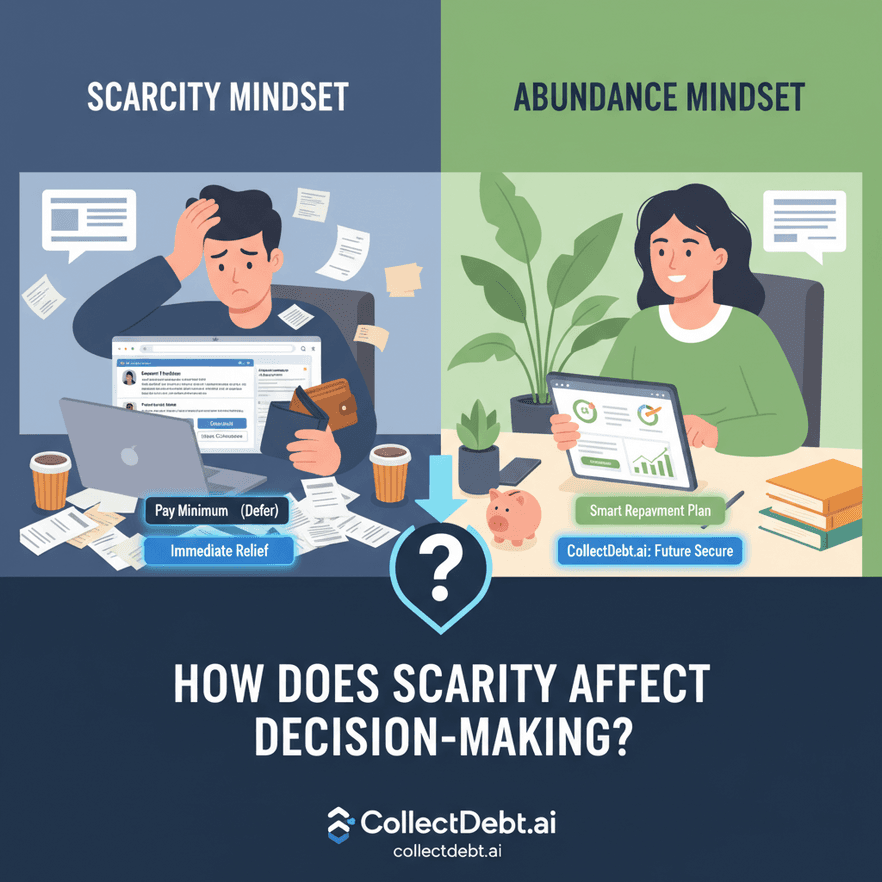
The scarcity mindset refers to a psychological state where individuals perceive resources as limited, triggering a cascade of cognitive and behavioral changes. This perception doesn't always reflect actual scarcity; even the feeling of scarcity can produce measurable effects on decision-making quality.
When operating under scarcity, the brain enters a state of heightened focus on immediate needs while simultaneously reducing capacity for long-term planning. This phenomenon, extensively documented in research by behavioral scientists like Sendhil Mullainathan and Eldar Shafir, creates what they term 'tunneling' — an intense focus on pressing concerns that excludes peripheral considerations.
The Cognitive Mechanisms Behind Scarcity
Understanding how scarcity affects decision-making requires examining the underlying cognitive mechanisms:
- Reduced Cognitive Bandwidth: Scarcity consumes mental resources, leaving less capacity for complex reasoning and self-control
- Attentional Narrowing: Focus intensifies on the scarce resource, creating blind spots for other important considerations
- Temporal Discounting: Future consequences become heavily discounted in favor of immediate relief
- Risk Perception Shifts: Tolerance for risk often increases as desperation mounts
These mechanisms explain why financial stress leads to poor money management, why time pressure produces rushed decisions, and why collection agencies using traditional methods often struggle with effectiveness. Modern solutions like AI-powered debt collection are designed specifically to counteract these cognitive limitations.
How Scarcity Affects Decision-Making in Financial Contexts
The impact of scarcity on financial decision-making is particularly pronounced and well-documented. When individuals face financial constraints, their decision-making patterns shift in predictable yet problematic ways.
Tunnel Vision and Short-Term Focus
One of the most significant ways scarcity affects decision-making is through tunnel vision. When resources feel limited, individuals become hyper-focused on immediate needs while neglecting long-term planning. In debt collection scenarios, this manifests as:
- Prioritizing accounts with the loudest complaints rather than highest revenue potential
- Focusing exclusively on closing immediate gaps in cash flow
- Ignoring strategic portfolio management in favor of quick wins
- Neglecting compliance requirements under pressure to meet quotas
This short-term orientation creates a vicious cycle where immediate actions undermine long-term financial health. Organizations implementing end-to-end collection solutions can break this cycle through structured, data-driven approaches that maintain strategic focus even under resource constraints.
Increased Risk-Taking and Impulsive Decisions
Scarcity fundamentally alters risk perception. When facing resource limitations, decision-makers often exhibit increased risk tolerance, making choices they would normally avoid. This manifests as:
- Hasty Collections Tactics: Aggressive approaches that risk regulatory violations or customer relationships
- Poorly Vetted Strategies: Implementing solutions without adequate testing or consideration
- Impulsive Technology Adoption: Investing in unproven tools without proper evaluation
- Compliance Shortcuts: Risking legal exposure to achieve short-term results
The impulsivity driven by scarcity leads to decisions made without structured evaluation processes. This is where conversational AI solutions provide significant advantages, offering consistent, compliant interactions regardless of organizational stress levels.
Difficulty with Planning and Resource Allocation
Perhaps the most insidious effect of scarcity on decision-making is the degradation of planning capacity. When cognitive resources are consumed by immediate concerns, strategic planning suffers dramatically:
| Planning Challenge | Scarcity Impact | Business Consequence |
|---|---|---|
| Portfolio Strategy | Reactive rather than proactive account management | Lower overall recovery rates |
| Resource Allocation | Misalignment between effort and return potential | Inefficient use of collector time |
| Technology Investment | Short-term fixes over strategic solutions | Accumulated technical debt |
| Staff Development | Training and development deferred indefinitely | Declining performance over time |
Organizations can overcome these planning difficulties by implementing structured systems that maintain strategic focus. Tools offering automated data extraction and analysis remove the cognitive burden of manual processing, freeing mental resources for higher-level strategic thinking.
How Scarcity Affects Decision-Making Across Different Industries
The impacts of scarcity-driven decision-making extend across multiple sectors, each facing unique manifestations of these cognitive challenges.
Financial Services and Banking
In the financial services industry, scarcity affects both institutions and their customers. Banks facing liquidity constraints may tighten lending standards excessively, while customers experiencing financial scarcity make suboptimal borrowing and repayment decisions. The implementation of AI in banking applications helps institutions maintain consistent decision quality even during periods of market stress.
Healthcare Revenue Cycle Management
The healthcare industry faces unique scarcity challenges in revenue cycle management. Patients experiencing medical debt often exhibit classic scarcity behaviors avoiding communication, making minimum payments without strategic planning, or ignoring bills entirely. Healthcare providers, meanwhile, struggle with resource allocation between patient care and collections. Modern healthcare revenue cycle automation addresses these challenges through empathetic, structured engagement that respects patient circumstances while maintaining collection effectiveness.
Retail and Hospitality
Both retail and hospitality sectors experience seasonal scarcity that affects decision-making. During low-revenue periods, businesses may cut essential services or make pricing decisions that damage long-term brand value. The scarcity mindset can lead to short-term promotional strategies that erode profit margins without building sustainable customer relationships.
Utilities and Telecommunications
The utilities and telecom sectors deal with high volumes of small-balance accounts where scarcity of collection resources creates difficult prioritization decisions. Without structured approaches, collectors may focus disproportionately on vocal customers rather than accounts with highest recovery potential. Implementing batch calling capabilities ensures systematic coverage regardless of resource constraints.
Strategies to Counteract Scarcity-Driven Decision-Making
Understanding how scarcity affects decision-making is only valuable when paired with effective mitigation strategies. Organizations can implement several approaches to maintain decision quality under resource constraints.
Implement Data-Backed Decision Frameworks
The antidote to scarcity-driven impulsivity is structured, data-driven decision-making. By establishing frameworks that guide choices based on empirical evidence rather than urgency, organizations can maintain strategic alignment even under pressure. Key elements include:
- Predictive Scoring Models: Prioritizing accounts based on likelihood to pay rather than squeakiest wheel
- ROI Calculations: Evaluating all initiatives through consistent return-on-investment lenses
- A/B Testing Protocols: Requiring evidence before scaling new approaches
- Regular Strategy Reviews: Scheduled planning sessions that aren't deferred under pressure
Modern platforms provide these frameworks as built-in features, ensuring consistent application regardless of organizational stress levels. Learn more about implementing AI debt collection software for improved recovery.
Simplify Workflows Through Automation
Complexity exacerbates scarcity's cognitive impacts. When decision-makers face convoluted processes, they're more likely to take shortcuts or make errors. Workflow simplification achieves multiple objectives:
- Reduces cognitive load, preserving mental resources for strategic decisions
- Minimizes opportunities for scarcity-driven deviations from best practices
- Ensures consistency across team members regardless of individual stress levels
- Enables faster onboarding and reduced dependence on institutional knowledge
Platforms offering omnichannel support exemplify this principle, consolidating multiple communication channels into unified workflows that reduce complexity while improving effectiveness.
Deploy Proactive Reminders and Structured Task Management
Scarcity consumes working memory, making it difficult to maintain awareness of all necessary tasks. Proactive reminder systems compensate for this limitation by:
- Surfacing time-sensitive actions before they become urgent
- Maintaining visibility on long-term objectives amid daily pressures
- Ensuring compliance requirements aren't overlooked under deadline pressure
- Distributing cognitive load across time rather than concentrating it in crisis moments
Advanced systems incorporate promise-to-pay tracking with automated follow-up sequences, ensuring consistent execution without requiring constant human oversight.
Facilitate Better Planning Through Specialized Tools
Perhaps the most powerful approach to counteracting how scarcity affects decision-making is providing tools specifically designed to maintain planning capacity under resource constraints. These include:
- Portfolio Analytics Dashboards: Visualizing strategic metrics to maintain big-picture awareness
- Scenario Planning Tools: Evaluating potential strategies without resource-intensive manual analysis
- Automated Reporting: Eliminating time-consuming data compilation to preserve planning capacity
- Collaborative Planning Platforms: Distributing planning workload across teams
Organizations implementing comprehensive solutions report significant improvements in strategic consistency. Explore how conversational AI transforms debt collection through structured, strategic engagement.
The Role of AI in Counteracting Scarcity Effects
Artificial intelligence represents a paradigm shift in addressing how scarcity affects decision-making. Unlike human decision-makers, AI systems don't experience cognitive depletion, emotional stress, or attentional narrowing under resource constraints.
Maintaining Consistent Decision Quality
AI-powered collection systems maintain decision quality regardless of organizational stress levels. Whether processing the first account of the day or the thousandth, AI applies consistent criteria, follows established protocols, and maintains strategic alignment. This consistency is particularly valuable during peak periods when human collectors experience the greatest scarcity pressure.
The implementation of right party verification through AI ensures compliance and accuracy even during high-volume periods when human agents might cut corners under time pressure.
Eliminating Emotional and Impulsive Decision-Making
Scarcity often triggers emotional responses that compromise decision quality. AI systems operate without emotional influence, maintaining objective evaluation criteria across all interactions. This emotional neutrality prevents:
- Aggressive tactics driven by frustration or quota pressure
- Inconsistent treatment based on collector mood or stress levels
- Escalation patterns that damage customer relationships
- Compliance violations resulting from emotional reactions
Organizations implementing voice AI for debt collection report improved customer satisfaction alongside higher recovery rates, demonstrating the value of emotionally consistent engagement.
Scaling Strategic Capacity Without Cognitive Limits
Perhaps AI's greatest contribution to counteracting scarcity effects is its ability to scale strategic capacity indefinitely. While human teams face cognitive bandwidth limitations, AI systems can:
- Analyze entire portfolios simultaneously rather than sequentially
- Maintain awareness of hundreds of variables across thousands of accounts
- Execute complex, multi-step strategies without simplification
- Learn and adapt from every interaction across the entire organization
This scaling capacity is particularly evident in comprehensive AI debt collection automation, where systems manage complexity that would overwhelm traditional approaches.
Real-World Applications and Case Studies
Understanding how scarcity affects decision-making becomes most valuable when examining practical applications across different contexts.
Auto Finance Collections Transformation
The auto finance sector faces unique scarcity challenges with high-value accounts requiring sophisticated strategies. Traditional approaches often defaulted to aggressive tactics under portfolio pressure, damaging recovery rates and customer relationships.
Organizations implementing AI-powered approaches reported significant improvements by eliminating scarcity-driven decision compromises. Structured engagement strategies maintained consistent quality across all accounts, while automated systems prevented the tunnel vision that previously led to neglecting mid-priority accounts. Read more about auto finance collections optimization.
Healthcare Self-Pay Collections
Medical debt presents perhaps the most challenging scarcity scenario patients facing both financial and health-related stress make particularly poor decisions about repayment. Traditional collection approaches exacerbated these problems through aggressive tactics that increased patient stress.
Modern approaches using early-out strategies for healthcare self-pay counteract these scarcity effects through empathetic, structured engagement that helps patients make sustainable repayment plans rather than impulsive promises they can't keep.
Utilities Payment Arrangement Success
Utility companies face seasonal scarcity in customer payment capacity while simultaneously experiencing resource constraints in their collection operations. This dual scarcity creates challenging dynamics where both parties make suboptimal decisions.
Implementation of self-service debt resolution tools empowers customers to evaluate options without time pressure while reducing organizational resource demands, effectively counteracting scarcity effects on both sides of the interaction.
Implementing Scarcity-Aware Systems in Your Organization
Recognizing how scarcity affects decision-making should inform organizational system design and implementation strategies.
Assess Current Scarcity Vulnerabilities
Begin by identifying where scarcity most significantly impacts your decision-making:
- Which decisions are most frequently made under time pressure?
- Where do resource constraints force suboptimal compromises?
- What long-term strategies consistently get deferred?
- Which compliance areas show the most violations during peak periods?
This assessment reveals priority areas for intervention and helps justify investment in systems that counteract scarcity effects.
Design Scarcity-Resistant Processes
With vulnerabilities identified, redesign processes to maintain quality under resource constraints:
- Build in Automation: Automate routine decisions to preserve cognitive resources for complex judgments
- Establish Decision Frameworks: Create clear criteria that guide choices without requiring extensive analysis
- Implement Forcing Functions: Design systems that prevent common scarcity-driven shortcuts
- Create Capacity Buffers: Build slack into systems to prevent constant crisis mode
Organizations can leverage comprehensive integration capabilities to embed these principles into existing technology stacks without requiring complete system replacements.
Train Teams on Scarcity Awareness
Technology alone cannot fully counteract scarcity effects; teams need awareness of these cognitive biases and strategies to mitigate them:
- Educate staff on how scarcity affects their decision-making
- Provide tools and frameworks to maintain quality under pressure
- Establish team norms that prevent scarcity-driven shortcuts
- Create psychological safety for acknowledging cognitive limitations
This human element complements technological solutions, creating comprehensive resilience against scarcity effects.
Measuring Success and Continuous Improvement
Implementing scarcity-aware systems requires ongoing measurement and refinement to ensure effectiveness.
Key Performance Indicators
Track metrics that reveal whether scarcity effects are being successfully counteracted:
- Decision Consistency: Variation in decision quality across high and low-pressure periods
- Strategic Alignment: Degree to which daily actions support long-term objectives
- Compliance Rates: Violations during peak stress periods versus normal operations
- Recovery Performance: Collection effectiveness across different resource constraint scenarios
Modern analytics platforms provide visibility into these metrics, enabling data-driven refinement of approaches.
Continuous Optimization
Understanding how scarcity affects decision-making is an ongoing process requiring regular refinement:
- Regularly review decision quality during high-stress periods
- Gather team feedback on where scarcity pressures remain problematic
- Test new approaches to counteracting identified vulnerabilities
- Update systems based on evolving organizational needs and constraints
Organizations committed to this continuous improvement approach consistently outperform those treating scarcity effects as static challenges.
Future Trends in Addressing Scarcity and Decision-Making
As we progress through 2026 and beyond, several emerging trends will shape how organizations address scarcity's impact on decision-making.
Advanced Predictive Analytics
Next-generation systems will predict not just account behavior but also organizational decision-making vulnerabilities, proactively adjusting workflows before scarcity effects manifest. These systems will recognize patterns indicating increased scarcity pressure and automatically implement protective measures.
Personalized Cognitive Support
Future platforms will provide individualized decision support tailored to each team member's specific scarcity vulnerabilities. By recognizing personal patterns in how scarcity affects different individuals, systems will provide targeted interventions that maintain decision quality at the individual level.
Holistic Organizational Resilience
The most sophisticated organizations will integrate scarcity awareness across all operational dimensions from hiring and training to technology selection and process design. This holistic approach creates organizational cultures inherently resistant to scarcity-driven decision compromises.
Frequently Asked Questions About Scarcity and Decision-Making
What is the scarcity mindset and how does it develop?
The scarcity mindset is a psychological state where perceived resource limitations fundamentally alter cognitive processing. It develops when individuals or organizations experience constraints in critical resources like time, money, or capacity. This perception triggers neurological changes that narrow attention, reduce cognitive bandwidth, and shift time preferences toward immediate concerns. The mindset can develop from actual resource limitations or simply from the perception of scarcity, making it a psychological phenomenon as much as an economic one.
How long do the effects of scarcity on decision-making last?
Scarcity's cognitive effects can persist even after resource constraints are resolved. Research shows that individuals who experience prolonged scarcity develop persistent patterns of scarcity-driven thinking that continue affecting decisions long after circumstances improve. However, with conscious intervention including structured decision frameworks, cognitive awareness, and supportive systems these effects can be mitigated relatively quickly, often within weeks of implementing comprehensive countermeasures.
Can technology completely eliminate the effects of scarcity on decision-making?
While technology cannot eliminate the psychological experience of scarcity, it can effectively counteract most of its negative decision-making impacts. AI and automation systems maintain consistent decision quality regardless of resource constraints, compensate for reduced cognitive bandwidth, and prevent common scarcity-driven shortcuts. The combination of technological support and human awareness creates resilience that, while not eliminating scarcity's psychological experience, largely neutralizes its negative effects on organizational outcomes.
How does scarcity specifically affect compliance in debt collection?
Scarcity pressure creates significant compliance vulnerabilities in debt collection. Under resource constraints and quota pressure, collectors may take shortcuts that violate regulations from inadequate disclosures to inappropriate contact frequency. The cognitive load imposed by scarcity reduces attention to compliance protocols, while time pressure encourages prioritizing results over proper procedures. Automated systems with built-in compliance guardrails prevent these violations by maintaining consistent protocol adherence regardless of organizational stress levels.
What industries are most affected by scarcity-driven decision-making problems?
While scarcity affects decision-making across all sectors, industries with high transaction volumes, tight margins, and regulatory complexity face the greatest challenges. Financial services, healthcare, utilities, and collections operations experience particularly significant impacts because they combine resource constraints with high-stakes decisions requiring careful judgment. These industries benefit most from implementing scarcity-aware systems that maintain decision quality under pressure.
How can organizations measure the impact of scarcity on their decision-making?
Organizations can measure scarcity's impact by comparing decision quality and outcomes across different resource constraint scenarios. Key metrics include decision consistency (variance in choices under high versus low pressure), strategic alignment (degree to which actions support long-term goals), compliance rates during peak versus normal periods, and performance outcomes across different stress levels. Tracking these metrics over time reveals whether interventions are successfully counteracting scarcity effects.
Conclusion: Moving Beyond Scarcity-Driven Decisions
Understanding how scarcity affects decision-making represents a critical competitive advantage in 2026's complex business environment. Organizations that recognize these cognitive vulnerabilities and implement systematic countermeasures consistently outperform those operating under scarcity's unconscious influence.
The path forward combines technological innovation with human awareness. AI-powered systems like those offered by CollectDebt.ai provide the structural foundation for maintaining decision quality under resource constraints, while educated teams leverage these tools effectively through conscious awareness of scarcity's psychological impacts.
By implementing the strategies outlined in this guide from data-driven decision frameworks to workflow simplification and AI-powered automation organizations can break free from scarcity's cognitive traps, making consistently strategic decisions regardless of resource pressures. The result is improved financial performance, enhanced compliance, better customer relationships, and organizational cultures resilient to the inevitable constraints of business operations.
The question is no longer whether scarcity affects your decision-making research conclusively demonstrates that it does. The question is whether you'll implement systems and processes to counteract these effects, positioning your organization for sustainable success in an increasingly complex and resource-constrained world.
Ready to Transform Your Collections Process?
See how CollectDebt.ai can help you automate debt collection, reduce costs, and improve compliance.