Artificial Intelligence In Accounts Receivable: Complete Guide To AI-Powered AR Automation

Introduction
The accounts receivable landscape is undergoing a profound transformation driven by artificial intelligence. As businesses grapple with mounting DSO (Days Sales Outstanding), compliance pressures, and the need for operational efficiency, artificial intelligence in accounts receivable has emerged as a game-changing solution. Directors of Operations, Collections Managers, and CFOs are increasingly recognizing that traditional manual AR processes cannot scale to meet modern demands while maintaining the personalization and compliance that today's regulatory environment requires.
This comprehensive guide explores how artificial intelligence is revolutionizing accounts receivable management, from predictive analytics and automated outreach to intelligent cash application and compliance monitoring. Whether you're managing a debt collection agency or overseeing AR operations for a large enterprise, understanding the capabilities and ROI potential of artificial intelligence in accounts receivable is critical to staying competitive in 2026 and beyond.
Understanding Artificial Intelligence in Accounts Receivable
Artificial intelligence in accounts receivable refers to the application of machine learning, natural language processing, deep learning, and automation technologies to streamline and optimize the entire AR workflow. Unlike traditional rule-based systems, AI-powered solutions can learn from historical data, adapt to changing patterns, and make intelligent decisions with minimal human intervention.
Core AI Technologies Transforming AR
The implementation of artificial intelligence in accounts receivable leverages multiple technological components working in concert. Machine learning algorithms analyze vast datasets of payment histories, customer behaviors, and account characteristics to identify patterns and make predictions. Natural language processing enables AI systems to understand and generate human-like communications across channels, from emails to chat interactions. Deep learning models process complex, unstructured data to extract insights that would be impossible for humans to discern manually.
According to research from Wise, AR AI systems use machine learning and natural language processing to handle routine tasks and predict when customers will pay, fundamentally changing how organizations approach collections and cash flow management.
Optical character recognition (OCR) technology allows AI systems to automatically extract data from invoices, remittance documents, and payment confirmations. Robotic process automation (RPA) executes repetitive tasks like data entry, payment posting, and report generation. When combined, these technologies create an intelligent ecosystem that can handle the entire AR lifecycle with unprecedented efficiency.
Key Applications in the AR Workflow
Artificial intelligence in accounts receivable touches every stage of the collection process. Predictive analytics engines assess customer payment propensity and default risk, enabling teams to prioritize high-value accounts. Intelligent routing systems automatically assign accounts to the most appropriate collection strategy whether automated outreach, human intervention, or legal escalation based on account characteristics and historical success rates.
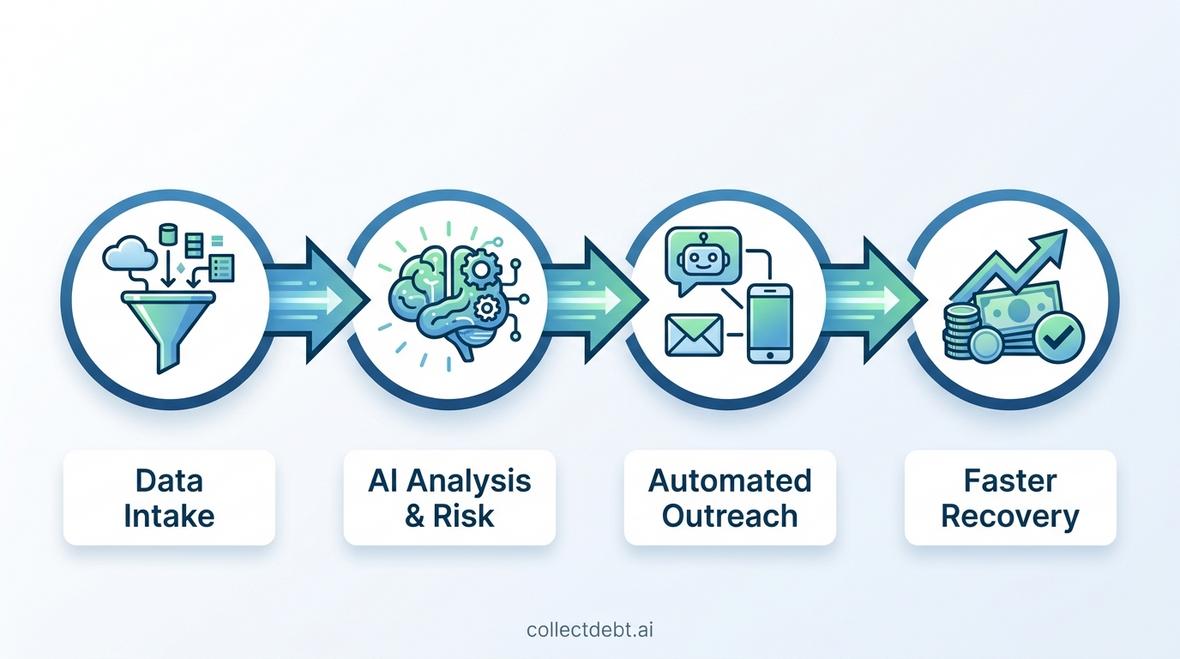
The image above illustrates a typical AI-driven debt collection workflow, demonstrating how data intake, AI analysis, automated outreach, and recovery optimization work together seamlessly. This end-to-end automation is transforming how organizations approach accounts receivable management.
Conversational AI platforms engage debtors through natural, context-aware dialogues across multiple channels voice, SMS, email, and chat while maintaining strict compliance with regulations like FDCPA and TCPA. These systems can handle common inquiries, negotiate payment arrangements, and escalate complex situations to human agents when necessary, all while documenting every interaction for audit purposes.
The Quantified Business Impact of AI in AR
The business case for implementing artificial intelligence in accounts receivable is supported by substantial empirical evidence demonstrating dramatic improvements in efficiency, cost reduction, and recovery rates.
Efficiency and Productivity Improvements
According to research from Billtrust, a typical mid-sized business can save $440,000 and 4,500 hours per year by automating invoice processes. The report further notes that manual cash application productivity averages about 40 payments per hour, while AI-powered systems can process hundreds of transactions simultaneously with higher accuracy.
EY case study research reports that an AI-driven collection assistant reduced the accounts receivable period by 22% through sophisticated customer profiling and payment analytics. This reduction in DSO directly translates to improved cash flow and working capital optimization.
The efficiency gains extend beyond simple automation. Artificial intelligence in accounts receivable enables collection teams to focus their expertise on high-value, complex accounts while AI handles routine follow-ups and low-risk accounts autonomously. This strategic resource allocation maximizes the return on your human capital investment.
Predictive Accuracy and Decision Support
Perhaps the most transformative aspect of artificial intelligence in accounts receivable is its predictive capability. Microsoft Research reports achieving up to 81% prediction accuracy for invoice payment timing, with simulations showing potential savings of approximately $1.75 million per month by optimizing collector work prioritization based on these predictions.
This level of predictive accuracy enables AR teams to implement proactive strategies rather than reactive collection efforts. By identifying accounts likely to become delinquent before they actually miss payments, organizations can engage in early intervention communications that preserve customer relationships while protecting revenue.
Cost Reduction and ROI
Traditional call center operations incur substantial costs agent salaries, training, turnover, infrastructure, and overhead. Artificial intelligence in accounts receivable provides a scalable alternative that operates 24/7 without fatigue, sick days, or turnover. Organizations implementing AI-powered debt collection solutions typically see ROI within 6-12 months through reduced operational costs and improved recovery rates.
The cost advantages compound over time as AI systems continuously learn and improve from every interaction. Unlike human agents who may plateau in performance, AI models become more effective with increased data exposure, creating a virtuous cycle of improvement.
Strategic AI Use Cases in Accounts Receivable
Understanding specific applications helps decision-makers identify where artificial intelligence in accounts receivable can deliver the most immediate value within their organizations.
Intelligent Collection Management
Collection prioritization represents one of the highest-impact applications of AI in AR. By analyzing factors including account age, balance size, payment history, customer segment, communication history, and economic indicators, AI engines generate dynamic priority scores that direct collector attention to accounts with the optimal combination of recovery probability and value.
According to research from Forrester, AI use cases in collection management demonstrate significant improvements in prioritization efficiency, with examples of organizations reducing collection cycle times by 30-40% through intelligent account routing.
Advanced systems incorporate omnichannel support, determining the optimal contact method and timing for each debtor based on their historical response patterns. Some debtors respond better to morning calls, others to evening SMS messages, and still others to email communications AI identifies these preferences automatically and adjusts outreach accordingly.
Automated Cash Application
Cash application matching incoming payments to outstanding invoices is traditionally one of the most time-consuming and error-prone AR processes. Artificial intelligence in accounts receivable revolutionizes this function through intelligent matching algorithms that can handle partial payments, multiple invoice payments, and ambiguous remittance information.
Machine learning models trained on historical payment patterns can accurately match payments even when remittance details are incomplete or contain errors. Natural language processing extracts relevant information from email payment notifications and scanned remittance documents, while OCR technology digitizes paper-based payment information.
Organizations implementing AI-powered cash application typically see straight-through processing rates exceed 80%, compared to 30-50% with traditional systems. The remaining exceptions are flagged for human review with AI-generated suggestions, significantly reducing resolution time.
Intelligent Deduction Management
Customer deductions unauthorized discounts, pricing disputes, shortage claims, and other payment reductions represent a significant challenge in AR management. Artificial intelligence in accounts receivable brings structure and efficiency to deduction resolution through automated categorization, root cause analysis, and validity assessment.
AI systems analyze deduction patterns to identify systemic issues requiring process improvements. For example, if a particular product consistently generates shortage claims, this may indicate a warehouse or shipping problem requiring operational attention. By surfacing these insights automatically, AI helps organizations address root causes rather than merely processing individual deductions reactively.
Continuous Compliance Monitoring
Regulatory compliance represents a critical concern in debt collection and AR management. Violations of FDCPA, TCPA, CFPB regulations, and state-specific collection laws can result in substantial fines, legal liability, and reputational damage. Artificial intelligence in accounts receivable provides continuous, automated compliance monitoring that human oversight cannot match in consistency or scale.
AI systems monitor every communication for prohibited language, frequency violations, time-of-day restrictions, and other regulatory requirements. Natural language processing analyzes agent and AI-generated communications in real-time, flagging potential violations before messages are sent. This proactive approach dramatically reduces compliance risk compared to traditional quality assurance sampling methods.
Organizations can implement comprehensive compliance solutions that integrate regulatory rules directly into communication workflows, ensuring that every interaction adheres to applicable regulations regardless of volume or channel.
Implementation Considerations for AI in AR
Successfully deploying artificial intelligence in accounts receivable requires careful planning and strategic decision-making across multiple dimensions.
Data Quality and Integration
AI systems are only as effective as the data they process. Organizations must ensure their AR data is accurate, complete, and properly structured before implementation. This typically involves data cleansing efforts to standardize customer information, correct errors, and fill gaps in historical records.
Integration with existing systems ERP platforms, CRM systems, payment processors, and communication tools is essential for seamless operation. Modern AI solutions offer robust integration capabilities with common enterprise systems, but organizations should verify compatibility with their specific technology stack during vendor evaluation.
Change Management and Team Training
Introducing artificial intelligence in accounts receivable represents a significant organizational change that impacts workflows, roles, and responsibilities. Successful implementations include comprehensive change management strategies that address employee concerns, communicate benefits clearly, and provide adequate training.
Rather than viewing AI as a replacement for human collectors, leading organizations position it as an augmentation tool that handles routine tasks while enabling staff to focus on relationship-building and complex problem-solving. This framing reduces resistance and helps teams embrace the technology as a productivity enhancer rather than a threat.
Vendor Selection and Evaluation
The AI solutions market for accounts receivable includes numerous vendors with varying capabilities, specializations, and pricing models. Decision-makers should evaluate potential partners across multiple criteria including AI sophistication, industry experience, compliance capabilities, integration flexibility, scalability, and support quality.
Organizations should request detailed demonstrations with realistic scenarios from their business, review customer case studies in similar industries, and conduct reference calls with existing clients. Understanding the vendor's AI development roadmap is also important—artificial intelligence in accounts receivable is rapidly evolving, and partners committed to continuous innovation will deliver greater long-term value.
Industry-Specific Applications of AI in AR
While artificial intelligence in accounts receivable delivers value across all sectors, certain industries face unique challenges where AI provides particularly compelling benefits.
Healthcare Revenue Cycle Management
Healthcare organizations face extraordinary AR complexity with multiple payers, complex billing codes, insurance verification requirements, and patient payment responsibilities. AI streamlines these workflows through automated insurance verification, intelligent claim scrubbing, denial prediction, and patient payment plan optimization. Organizations in healthcare collections leverage AI to navigate this complexity while maintaining patient satisfaction.
Financial Services Collections
Banks, credit unions, and lenders managing auto finance, personal loans, and credit card portfolios benefit from AI's ability to segment accounts by risk, personalize communication strategies, and predict default probability. Regulatory compliance is particularly critical in financial services, making AI's continuous monitoring capabilities especially valuable.
Utilities and Telecommunications
High-volume, relatively low-balance accounts characterize utilities and telecom AR. Artificial intelligence in accounts receivable enables these organizations to maintain customer relationships while efficiently managing millions of accounts through automated payment reminders, self-service payment portals, and intelligent escalation protocols.
Retail and E-Commerce
The retail sector, particularly B2B retail operations, faces seasonal fluctuations, diverse customer segments, and rapid payment pattern changes. AI adapts collection strategies dynamically based on seasonality, customer purchase patterns, and payment history, optimizing recovery while preserving relationships with valuable repeat customers.
Future Trends in AI-Powered Accounts Receivable
The trajectory of artificial intelligence in accounts receivable points toward increasingly sophisticated, autonomous, and effective systems.
Generative AI and Hyper-Personalization
Generative AI technologies are enabling unprecedented personalization in AR communications. Rather than selecting from pre-written templates, AI systems can now generate unique, contextually appropriate messages tailored to individual debtor circumstances, communication history, and preferences. This personalization improves response rates while maintaining regulatory compliance and brand consistency.
Organizations exploring generative AI versus traditional approaches are discovering substantial ROI improvements through enhanced engagement and reduced escalation requirements.
Autonomous AI Agents
The evolution toward truly autonomous AI agents represents the next frontier in artificial intelligence in accounts receivable. These systems will not only recommend actions but execute entire collection strategies independently from initial contact through negotiation, payment arrangement, and confirmation intervening with human collectors only when facing situations outside their training parameters.
Emotional Intelligence and Sentiment Analysis
Advanced AI systems are incorporating emotional intelligence capabilities that detect debtor sentiment, stress levels, and receptivity during interactions. By analyzing voice tone, word choice, and conversation patterns, these systems adjust communication approaches in real-time to optimize outcomes while demonstrating empathy and understanding.
Getting Started with AI in Your AR Operations
Organizations ready to implement artificial intelligence in accounts receivable should follow a structured approach to maximize success probability and ROI.
Assess Current State and Define Objectives
Begin by documenting current AR processes, pain points, performance metrics, and resource allocation. Identify specific objectives for AI implementation whether reducing DSO, lowering operational costs, improving compliance, or enhancing customer experience. Clear, measurable goals enable effective vendor evaluation and post-implementation success measurement.
Start with Focused Pilot Programs
Rather than attempting organization-wide transformation immediately, successful implementations typically begin with focused pilot programs addressing specific use cases or account segments. This approach allows teams to gain experience with the technology, refine processes, and demonstrate value before broader rollout.
Consider starting with inbound conversational AI for handling routine inquiries, or automated batch calling for low-balance accounts. These contained implementations deliver quick wins while building organizational confidence in the technology.
Measure, Learn, and Iterate
Artificial intelligence in accounts receivable improves continuously through machine learning, but organizations must also implement continuous improvement processes. Establish KPIs aligned with your objectives, monitor performance rigorously, solicit feedback from both collectors and customers, and work with your AI vendor to refine models and strategies based on results.
Leading organizations treat AI implementation as an ongoing journey rather than a one-time project, continuously identifying new applications and optimization opportunities as they gain experience and confidence with the technology.
Frequently Asked Questions
How does artificial intelligence in accounts receivable handle compliance requirements?
AI systems incorporate regulatory rules directly into communication workflows, monitoring every interaction for FDCPA, TCPA, and state-specific compliance requirements. Natural language processing analyzes messages in real-time, flagging potential violations before communications are sent. This proactive approach provides more comprehensive compliance coverage than traditional quality assurance sampling methods.
What ROI can organizations expect from implementing AI in AR?
ROI varies by organization size, current efficiency levels, and implementation scope, but research shows substantial benefits. Mid-sized businesses can save $440,000 and 4,500 hours annually through invoice automation, while collection period reductions of 22% have been documented. Most organizations achieve positive ROI within 6-12 months through combined cost reduction and improved recovery rates.
Will AI replace human collection agents?
Rather than replacing human collectors, artificial intelligence in accounts receivable augments their capabilities by handling routine, high-volume tasks while enabling staff to focus on complex accounts requiring empathy, negotiation skills, and relationship management. Organizations typically redeploy rather than reduce staff, shifting human resources toward higher-value activities that AI cannot effectively perform.
How does AI personalize communications with debtors?
AI analyzes historical interaction data, payment patterns, communication preferences, and response behaviors to tailor outreach strategies for individual debtors. Systems determine optimal contact timing, channel selection, message tone, and content based on what has proven effective for similar accounts. Advanced generative AI can create unique, contextually appropriate messages rather than selecting from templates.
What data is required to implement AI in accounts receivable?
Effective AI implementation requires historical account data including payment histories, contact information, communication records, account balances, and customer demographics. Data quality is critical organizations typically invest in data cleansing and standardization before implementation. Integration with existing systems (ERP, CRM, payment processors) is also essential for seamless operation.
Conclusion
Artificial intelligence in accounts receivable represents a fundamental transformation in how organizations approach collections, cash application, and customer engagement. The technology delivers quantifiable benefits including dramatic efficiency improvements, cost reductions, enhanced compliance, and superior customer experiences. As AI capabilities continue advancing particularly in generative AI, autonomous agents, and emotional intelligence early adopters will establish competitive advantages that become increasingly difficult for laggards to overcome. For Directors of Operations, Collections Managers, and CFOs seeking to optimize AR performance while controlling costs and maintaining compliance, exploring end-to-end AI collection solutions is no longer optional but essential for remaining competitive in the evolving financial landscape of 2026 and beyond.
Ready to Transform Your Collections Process?
See how CollectDebt.ai can help you automate debt collection, reduce costs, and improve compliance.