A/R Report: Complete Guide To Accounts Receivable Reporting For Debt Collection Success

Managing accounts receivable effectively is the cornerstone of maintaining healthy cash flow and minimizing bad debt. An a/r report (accounts receivable report) serves as a critical financial tool that provides visibility into outstanding invoices, customer payment patterns, and collection priorities. For debt collection agencies, accounts receivable departments, and financial operations teams, mastering a/r reporting is essential for maximizing recovery rates while reducing operational costs.
In this comprehensive guide, we'll explore everything you need to know about accounts receivable reports from fundamental components and best practices to advanced automation strategies powered by AI technology. Whether you're a Collections Manager, CFO, or Director of Operations, this resource will help you leverage a/r reports to transform your debt recovery processes.
What Is an A/R Report?
An a/r report is a financial document that summarizes all outstanding receivables owed to your organization. It provides a snapshot of money customers owe, organized by invoice date, due date, customer name, and aging categories. This report serves as the foundation for collection strategies, cash flow forecasting, and financial decision-making.
The primary purpose of an accounts receivable report is to identify which accounts require immediate attention, assess the overall health of your receivables portfolio, and prioritize collection efforts based on risk and value. For organizations handling debt collection, the a/r report becomes the operational roadmap that guides daily collection activities.
Key Components of an Effective A/R Report
A comprehensive a/r report typically includes the following elements:
- Customer Information: Name, account number, and contact details
- Invoice Details: Invoice number, date issued, and original amount
- Outstanding Balance: Current amount owed after payments and adjustments
- Due Date: Original payment deadline
- Days Past Due: Number of days the invoice is overdue
- Aging Categories: Groupings such as Current, 1-30 days, 31-60 days, 61-90 days, and 90+ days
- Payment History: Record of previous payments and payment patterns
- Credit Terms: Agreed-upon payment conditions
These components enable collection teams to quickly assess risk, identify delinquent accounts, and prioritize outreach efforts based on aging and dollar value.
Types of A/R Reports for Debt Collection
Different operational needs require different reporting formats. Understanding the various types of a/r reports helps you select the right tool for specific collection scenarios.
Accounts Receivable Aging Report
The aging report is the most widely used a/r report format in debt collection. It categorizes outstanding invoices by how long they've been unpaid, typically in 30-day increments. This report allows collection teams to identify accounts that are becoming increasingly delinquent and require escalated attention.
The aging structure provides immediate visibility into collection urgency. Accounts in the 90+ days category represent higher risk and often require more aggressive recovery strategies or consideration for charge-off versus continued collection efforts.
Customer Account Statement
This a/r report focuses on a single customer and shows all transactions, payments, and outstanding balances for that account. It's particularly useful for personalized collection communications and dispute resolution.
Collection Effectiveness Report
This performance-oriented report tracks key metrics such as Days Sales Outstanding (DSO), collection efficiency index, and recovery rates. It helps management assess the effectiveness of collection strategies and team performance.
Best Practices for Generating and Using A/R Reports
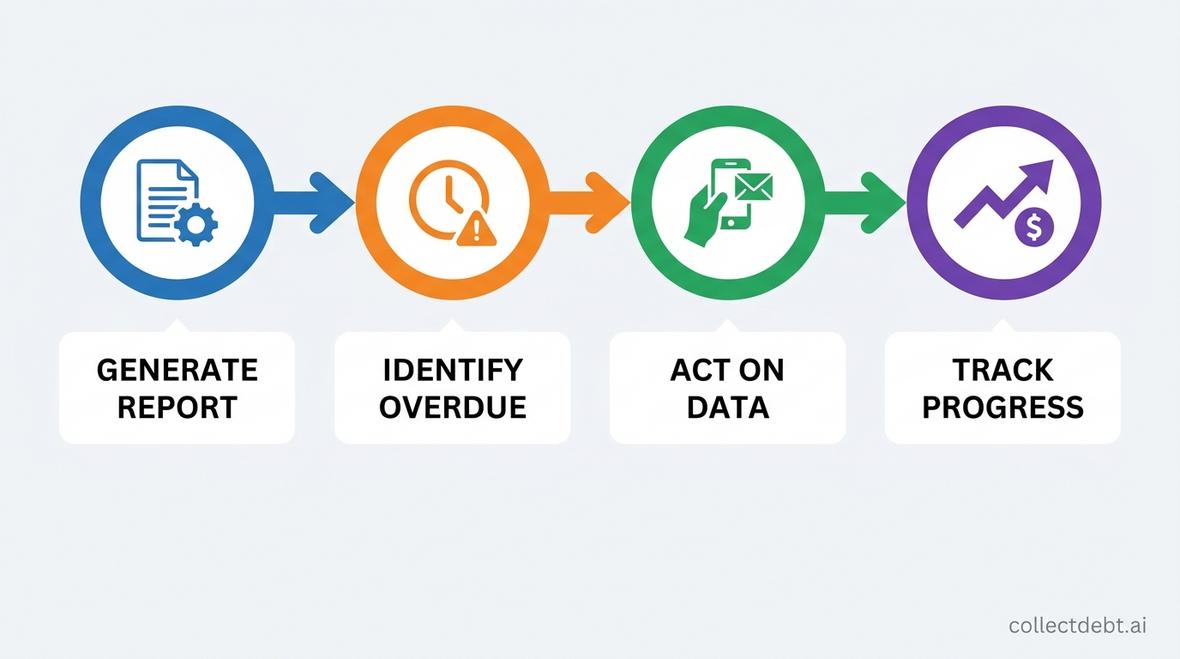
Creating an effective a/r report is only the first step knowing how to interpret and act on the data is what drives results. Here are proven best practices for maximizing the value of your accounts receivable reporting.
Establish Regular Reporting Schedules
Consistency is critical in debt collection. Generate your a/r reports on a regular schedule weekly for high-volume operations or at minimum monthly for smaller portfolios. Regular reporting enables you to identify trends, spot deteriorating accounts early, and maintain proactive collection postures.
Prioritize by Value and Risk
Not all outstanding receivables deserve equal attention. Use your a/r report to segment accounts by both dollar value and aging status. High-value accounts in early delinquency stages often yield better returns with minimal effort compared to low-value accounts in advanced stages of delinquency.
Consider implementing a tiered approach where accounts are categorized as high, medium, or low priority based on combined risk and value scores. This strategic segmentation allows collection teams to allocate resources efficiently and maximize recovery rates.
Integrate with Collection Workflows
Your a/r report should directly inform collection activities. When you identify overdue accounts, implement systematic workflows that trigger appropriate actions whether that's automated reminder emails, phone calls, or escalation to specialized collection agents.
Modern AI-powered debt collection solutions can automatically act on a/r report data, initiating personalized outreach across multiple channels based on account characteristics and payment history.
Monitor Key A/R Metrics
Beyond the basic a/r report, track these critical metrics to assess the health of your receivables portfolio:
- Days Sales Outstanding (DSO): Average number of days to collect payment
- Collection Effectiveness Index (CEI): Percentage of receivables collected in a given period
- Average Days Delinquent (ADD): Average age of outstanding receivables
- Best Possible DSO: Theoretical minimum DSO based on credit terms
- Accounts Receivable Turnover Ratio: How many times receivables are collected and replaced
For a deeper dive into these metrics, explore our guide on accounts receivable metrics that drive cash flow recovery.
A/R Report Example and Template
Understanding the structure of a practical a/r report helps you implement effective reporting in your organization. Below is an example of a typical aging report format:
| Customer Name | Invoice # | Total Due | Current | 1-30 Days | 31-60 Days | 61-90 Days | 90+ Days |
|---|---|---|---|---|---|---|---|
| Acme Corporation | INV-1001 | $15,000 | $5,000 | $10,000 | $0 | $0 | $0 |
| Beta Industries | INV-1002 | $8,500 | $0 | $0 | $3,500 | $5,000 | $0 |
| Gamma LLC | INV-1003 | $12,000 | $0 | $0 | $0 | $0 | $12,000 |
| Total | $35,500 | $5,000 | $10,000 | $3,500 | $5,000 | $12,000 | |
This example demonstrates how an a/r report organizes receivables data to provide immediate visibility into collection priorities. Gamma LLC's $12,000 in the 90+ days category represents the highest risk and would typically receive priority collection attention.
Automating A/R Reporting with AI Technology
Manual generation of a/r reports is time-consuming and prone to errors. Modern debt collection operations are increasingly leveraging automation and artificial intelligence to streamline reporting processes and act on data more efficiently.
Benefits of Automated A/R Reporting
Automated a/r report generation delivers several strategic advantages:
- Real-Time Visibility: Access up-to-date receivables information without waiting for monthly report cycles
- Reduced Manual Effort: Eliminate hours of data compilation and spreadsheet management
- Improved Accuracy: Minimize human error in data entry and calculation
- Actionable Insights: Advanced analytics identify patterns and predict collection outcomes
- Seamless Integration: Automatic synchronization with accounting systems and CRM platforms
AI-Powered A/R Management Solutions
Next-generation platforms like collectdebt.ai's accounts receivable solutions go beyond simple report generation to create complete automation workflows. These systems can:
- Automatically generate a/r reports on customized schedules
- Identify overdue accounts based on configurable aging criteria
- Trigger multi-channel outreach campaigns via phone, SMS, email, and chat
- Personalize communication based on debtor payment history and preferences
- Track collection progress and update reports in real-time
- Maintain compliance with FDCPA, TCPA, and other regulatory requirements
This end-to-end collection automation transforms the a/r report from a static document into a dynamic operational tool that drives continuous collection activity.
Industry-Specific A/R Report Considerations
Different industries face unique challenges in accounts receivable management, requiring tailored approaches to a/r reporting and collection strategies.
Healthcare A/R Reporting
Healthcare organizations deal with complex billing involving insurance claims, patient responsibility portions, and coordination of benefits. A/r reports in healthcare must account for claim denials, appeals processes, and patient payment plans. For healthcare-specific solutions, explore AI debt collection for healthcare providers.
Financial Services A/R Reporting
Banks, credit unions, and lending institutions require a/r reports that track loan payments, credit card balances, and various financial products. Regulatory compliance is paramount in this sector. Learn more about financial services debt collection solutions.
Utilities and Telecom A/R Reporting
Utilities and telecommunications companies manage recurring billing cycles with high transaction volumes. Their a/r reports must efficiently handle massive customer bases while identifying payment patterns and disconnection risks. Discover specialized utilities and telecom collection strategies.
Compliance Considerations for A/R Reporting and Collections
When using a/r reports to guide collection activities, organizations must maintain strict compliance with consumer protection regulations. The Fair Debt Collection Practices Act (FDCPA) and Telephone Consumer Protection Act (TCPA) impose specific requirements on how, when, and how frequently collectors can contact debtors.
Key compliance considerations include:
- Communication Timing: Restrictions on calling times (generally 8 AM to 9 PM local time)
- Frequency Limits: Avoiding harassment through excessive contact attempts
- Dispute Handling: Proper procedures when consumers dispute debt validity
- Validation Requirements: Providing debt verification when requested
- Cease Communication Requests: Honoring consumer requests to stop contact
Modern AI collection platforms incorporate built-in compliance safeguards that automatically ensure all collection activities initiated from a/r reports adhere to regulatory requirements.
Advanced Analytics and A/R Report Intelligence
Beyond basic aging reports, sophisticated analytics transform raw a/r report data into strategic intelligence that drives better decision-making.
Predictive Collection Analytics
Machine learning algorithms can analyze historical a/r report data to predict which accounts are most likely to pay, optimal contact times, and effective communication channels. This predictive capability allows collection teams to focus efforts where they'll generate the highest return on investment.
Customer Segmentation Strategies
Advanced segmentation goes beyond simple aging categories to consider factors such as:
- Customer lifetime value and relationship history
- Previous payment patterns and consistency
- Industry and economic factors affecting payment ability
- Communication preferences and responsiveness
- Dispute history and resolution outcomes
These nuanced segmentation strategies, informed by comprehensive a/r reports, enable more personalized and effective collection approaches.
Integrating A/R Reports with Collection Systems
The true power of a/r reporting is realized when reports seamlessly integrate with your broader collection technology ecosystem. Modern platforms offer integrations with major accounting, CRM, and ERP systems, ensuring that a/r data flows automatically between systems without manual data entry.
Key integration points include:
- Accounting Software: QuickBooks, Xero, NetSuite, Sage
- CRM Platforms: Salesforce, HubSpot, Microsoft Dynamics
- Payment Processors: Stripe, PayPal, Square
- Communication Platforms: Twilio, RingCentral, dialers
These integrations eliminate data silos and create a unified view of customer accounts, payment status, and collection activities all driven by the insights from your a/r reports.
Measuring Collection Success with A/R Reports
Your a/r report serves as the baseline for measuring collection performance. Establish clear benchmarks and track improvement over time using these key performance indicators:
- Roll Rate: Percentage of receivables moving from one aging bucket to the next
- Liquidation Rate: Speed at which receivables are converted to cash
- Bad Debt Write-Off Rate: Percentage of receivables ultimately deemed uncollectible
- Right Party Contact Rate: Percentage of collection attempts reaching the actual debtor
- Promise-to-Pay Conversion: Percentage of contacts resulting in payment commitments
Regularly comparing these metrics against your a/r reports provides clear visibility into whether your collection strategies are working or require adjustment. For more insights on optimizing collection performance, review our guide on AI debt collection recovery rates.
Frequently Asked Questions About A/R Reports
How often should I generate an a/r report?
The frequency depends on your organization's size and collection volume. High-volume operations typically generate a/r reports weekly or even daily, while smaller businesses may find monthly reporting sufficient. The key is consistency establish a regular schedule that allows you to identify trends and take timely action on delinquent accounts.
What is the difference between an a/r report and an aging report?
An aging report is a specific type of a/r report that organizes receivables by how long they've been outstanding. While all aging reports are a/r reports, not all a/r reports are aging reports. Other formats include customer account statements, collection effectiveness reports, and cash application reports.
Can a/r reports be automated?
Yes, modern accounting and collection software can automatically generate a/r reports on scheduled intervals. Advanced AI-powered platforms can not only automate report generation but also automatically act on the data by triggering collection workflows, personalized outreach, and payment reminders.
What percentage of receivables should be in the 90+ days category?
While benchmarks vary by industry, a healthy receivables portfolio typically has less than 10-15% of total outstanding balances in the 90+ days aging category. Higher percentages indicate collection challenges that require strategic intervention, potentially including more aggressive collection tactics or consideration of third-party collection services.
How do I use an a/r report to improve cash flow?
Use your a/r report to prioritize collection efforts on high-value accounts in early delinquency stages, identify customers who consistently pay late and may need adjusted credit terms, forecast incoming cash based on aging patterns, and measure the effectiveness of collection strategies by tracking changes in aging distribution over time.
Conclusion
Mastering the a/r report is fundamental to effective debt collection and accounts receivable management. These reports provide the visibility, prioritization, and actionable insights needed to maximize recovery rates while minimizing operational costs. By implementing best practices in a/r reporting including regular generation schedules, strategic segmentation, and integration with automated collection workflows organizations can dramatically improve their cash flow and reduce bad debt exposure. As artificial intelligence continues to transform the collections industry, platforms like collectdebt.ai are making it possible to not only generate sophisticated a/r reports but also automatically act on the insights they provide through compliant, personalized, multi-channel collection campaigns that drive results.
Ready to Transform Your Collections Process?
See how CollectDebt.ai can help you automate debt collection, reduce costs, and improve compliance.