P&M Autos Debt Collection: Complete Guide To AI-Powered Auto Finance Recovery In 2026

Introduction to P&M Autos Debt Collection Challenges
The automotive service industry faces unique challenges when it comes to debt collection and accounts receivable management. For businesses like P&M Autos, managing outstanding payments from auto service repairs, parts sales, and maintenance work requires a delicate balance between maintaining customer relationships and ensuring timely payment recovery. Traditional debt collection methods often fall short in the automotive sector, leading to cash flow problems and increased operational costs.
In 2026, the automotive service industry is experiencing a transformation in how they approach debt recovery. With rising repair costs and economic uncertainties, more customers are delaying payments or defaulting on invoices altogether. P&M Autos and similar automotive service providers are turning to innovative AI-powered solutions to streamline their collection processes while maintaining compliance with federal regulations like the Fair Debt Collection Practices Act (FDCPA).
This comprehensive guide explores how automotive businesses can leverage modern debt collection strategies, automation technologies, and AI-powered systems to improve recovery rates, reduce operational costs, and enhance customer experience throughout the payment recovery journey.
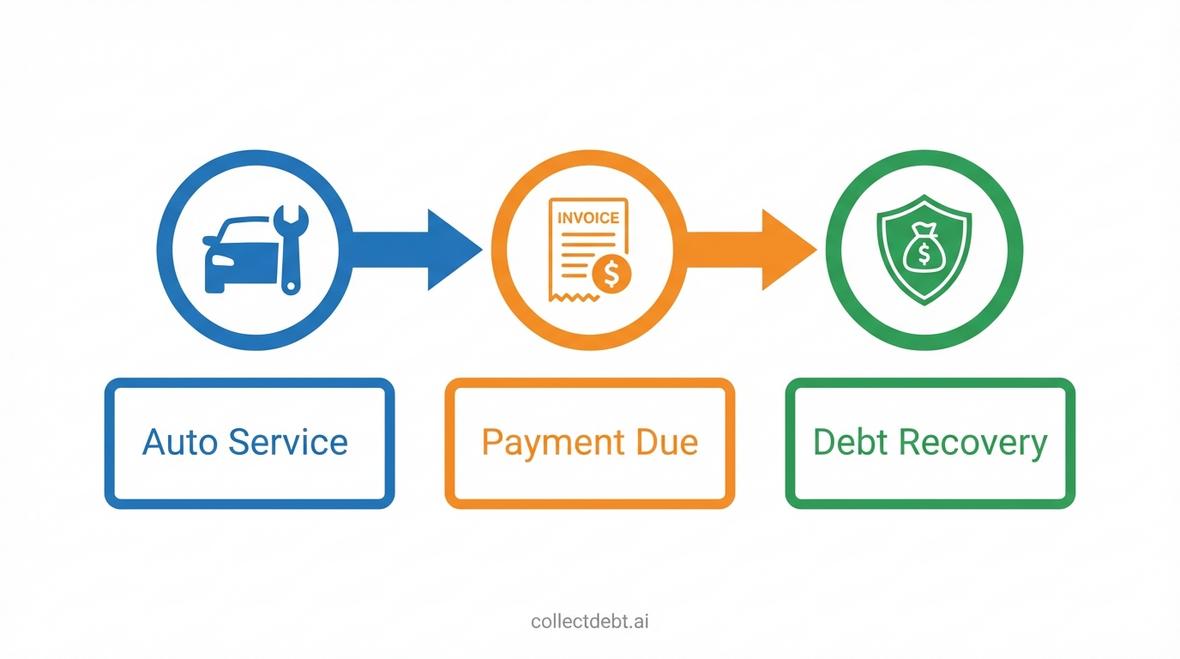
Understanding the Automotive Service Debt Collection Landscape
The automotive service sector operates in a unique financial environment. Unlike retail transactions where payment is typically collected at the point of sale, P&M Autos and similar businesses often extend credit to customers for repairs, maintenance services, and parts purchases. This creates a complex accounts receivable situation that requires specialized collection approaches.
Common Payment Challenges in Auto Service Businesses
Automotive service providers face several distinct challenges when collecting outstanding debts. Emergency repairs often result in unexpectedly high bills that customers may struggle to pay immediately. Many customers experience 'sticker shock' when presented with repair estimates, leading to payment delays or disputes. Additionally, customers may question the necessity of certain repairs, creating friction in the collection process.
Another significant challenge for P&M Autos operations involves seasonal fluctuations in cash flow. During economic downturns or specific times of the year, customers prioritize other expenses over automotive service debts. This pattern creates predictable spikes in delinquent accounts that require proactive management strategies.
Industry Statistics and Recovery Benchmarks
Understanding industry benchmarks is crucial for P&M Autos businesses evaluating their collection performance. According to research from the Commercial Collection Agency Section, first-party collection efforts in the automotive service sector typically achieve recovery rates between 30-40% when accounts are less than 90 days past due. However, recovery rates drop dramatically to 15-20% once accounts age beyond 180 days.
The automotive service industry also experiences higher dispute rates compared to other sectors. Studies indicate that approximately 25-30% of delinquent automotive service accounts involve some form of customer dispute regarding service quality, pricing, or necessity of repairs. This makes communication and documentation critically important in the collection process.
Traditional Debt Collection Methods vs. AI-Powered Solutions
Historically, P&M Autos businesses relied on manual collection processes involving phone calls, mailed statements, and eventually third-party collection agencies. While these methods can be effective, they come with significant limitations in terms of scalability, cost, and customer experience.
Limitations of Traditional Collection Approaches
Traditional collection methods for automotive service debts present several operational challenges. Manual phone calling is time-intensive and expensive, requiring dedicated staff to make hundreds of calls daily. Staff turnover in collection roles averages 30-40% annually, creating training costs and inconsistency in collection approaches. Additionally, human collectors can only work during business hours, limiting contact opportunities with customers who work traditional schedules.
Another critical limitation involves compliance risks. Manual collection processes increase the likelihood of FDCPA violations, which can result in costly lawsuits and regulatory penalties. Without automated systems to ensure proper disclosures, documentation, and calling restrictions, P&M Autos businesses expose themselves to significant legal liability.
The AI-Powered Collection Transformation
Modern AI debt collection platforms are revolutionizing how automotive service businesses recover outstanding payments. These systems leverage conversational AI, natural language processing, and machine learning to automate collection communications while maintaining personalization and compliance.
For P&M Autos operations, AI-powered collection systems offer several transformative advantages. These platforms can operate 24/7, contacting customers at times most convenient for them rather than being restricted to business hours. They automatically maintain compliance with federal and state regulations, eliminating human error in disclosure requirements and calling restrictions. Additionally, AI systems can handle thousands of accounts simultaneously, providing scalability impossible with human-only approaches.
The financial impact is substantial. Businesses implementing AI debt collection automation typically experience 40-60% reductions in collection costs while improving recovery rates by 15-25%. These systems also provide detailed analytics on payment patterns, customer responses, and optimal contact strategies, enabling continuous improvement in collection effectiveness.
Auto Finance and Service-Specific Collection Strategies
The automotive service sector requires specialized collection approaches that differ from general accounts receivable management. P&M Autos businesses must balance aggressive collection efforts with customer retention goals, as customers with outstanding balances may still need future automotive services.
Early Intervention and Preventive Strategies
The most effective collection strategy begins before an account becomes delinquent. P&M Autos operations should implement payment expectation communications at the time of service authorization. Clear written estimates, payment terms, and due date reminders reduce confusion and dispute rates significantly.
Implementing early out collection strategies is critical for automotive service debts. Automated reminder systems should contact customers 7 days before payment due dates, then again at 15, 30, and 60 days past due. Research shows that early intervention increases payment likelihood by 35-45% compared to waiting until accounts are 90+ days delinquent.
Payment Arrangement Options
Many customers of P&M Autos businesses genuinely intend to pay but face temporary cash flow constraints. Offering flexible payment arrangements through promise to pay features significantly improves resolution rates while maintaining customer relationships.
AI-powered collection systems can automatically offer payment plan options based on account balance, customer payment history, and industry best practices. For example, accounts under $500 might receive automatic offers for two monthly payments, while larger balances receive three to six-month payment plan options. These automated arrangements reduce the burden on staff while increasing customer engagement and payment completion rates.
Implementing AI Collection Technology for P&M Autos Operations
Transitioning from traditional to AI-powered collection methods requires strategic planning and proper technology selection. P&M Autos businesses must evaluate their specific needs, integration requirements, and operational workflows before implementing new systems.
Selecting the Right AI Collection Platform
Not all AI collection platforms are created equal, and automotive service businesses have unique requirements. When evaluating solutions, P&M Autos operations should prioritize platforms with proven experience in the auto finance collections sector.
Key features to evaluate include omnichannel communication capabilities (voice, SMS, email), integration with existing accounting and shop management software, compliance automation for FDCPA and state regulations, customizable communication scripts that reflect your brand voice, and detailed reporting and analytics dashboards. The platform should also offer right party verification to ensure communications reach the intended debtor.
Integration with Existing Systems
For P&M Autos businesses, seamless integration between collection systems and existing shop management software is essential. The collection platform should automatically import new invoices, update payment information in real-time, and synchronize customer communication history across all systems.
Modern AI collection platforms offer extensive integrations with popular automotive service management systems, accounting software, and payment processors. This connectivity eliminates manual data entry, reduces errors, and ensures that collection efforts are based on current account information.
Staff Training and Change Management
Implementing AI collection technology doesn't eliminate the need for human staff it transforms their role. P&M Autos employees transition from making routine collection calls to handling escalated situations, complex disputes, and relationship management.
Successful implementations include comprehensive staff training on the new system's capabilities, clear protocols for when human intervention is required, ongoing performance monitoring and optimization, and regular review of AI-generated communications to ensure quality. This human-AI collaboration approach typically delivers superior results compared to either method alone.
Compliance and Regulatory Considerations for Automotive Debt Collection
Debt collection in any industry is heavily regulated, and automotive service businesses must navigate complex federal and state requirements. For P&M Autos operations, maintaining compliance isn't just about avoiding penalties it's about building trust and protecting reputation.
FDCPA and Consumer Protection Requirements
The Fair Debt Collection Practices Act establishes strict guidelines for debt collection communications, timing, and practices. While the FDCPA technically applies to third-party collection agencies rather than original creditors, many states have adopted similar regulations that apply to first-party collectors like P&M Autos businesses.
Key compliance requirements include proper identification in all communications, prohibition of harassment or abusive practices, restrictions on calling times (generally 8 AM to 9 PM in the consumer's time zone), requirements for mini-Miranda rights disclosures, and validation notice requirements within five days of initial contact. Understanding these requirements is critical for any P&M Autos collection operation.
State-Specific Regulations
Beyond federal requirements, P&M Autos businesses must comply with state-specific debt collection laws, which vary significantly across jurisdictions. Some states impose additional restrictions on contact frequency, require specific licensing for collection activities, or provide enhanced consumer protections beyond federal requirements.
AI-powered collection platforms with built-in compliance features automatically adjust communications based on the debtor's location, ensuring adherence to all applicable state regulations. This geographic compliance automation is particularly valuable for P&M Autos businesses with multiple locations or customers across state lines.
Measuring Collection Success and Optimizing Performance
Implementing new collection strategies requires ongoing measurement and optimization. P&M Autos businesses should establish key performance indicators (KPIs) to track collection effectiveness and identify improvement opportunities.
Essential Collection Metrics
The most important metrics for P&M Autos debt collection include the collection effectiveness index (CEI), which measures the percentage of available debt collected during a specific period. A healthy CEI for automotive service businesses typically ranges from 75-85%. Days sales outstanding (DSO) measures the average time to collect payment, with industry benchmarks around 45-60 days for automotive services.
Other critical metrics include recovery rate by aging bucket (tracking success rates for accounts 0-30, 31-60, 61-90, and 90+ days past due), contact rate (percentage of collection attempts that successfully reach the customer), promise-to-pay fulfillment rate (percentage of payment commitments that customers honor), and cost per dollar collected (total collection costs divided by dollars recovered). Monitoring these metrics enables P&M Autos operations to identify trends, optimize strategies, and demonstrate ROI from collection investments.
Continuous Improvement Strategies
The most successful P&M Autos collection operations view performance optimization as an ongoing process rather than a one-time implementation. Regular data analysis reveals patterns in customer payment behavior, optimal contact timing, and most effective communication channels.
AI-powered collection systems excel at continuous improvement through machine learning. These platforms analyze thousands of customer interactions to identify successful approaches, then automatically adjust communication strategies based on what works best. For P&M Autos businesses, this means collection effectiveness improves over time without additional manual effort.
Maintaining Customer Relationships During Collection
One of the most challenging aspects of debt collection for P&M Autos businesses is balancing effective recovery with customer relationship preservation. Unlike pure lending institutions, automotive service providers often have ongoing relationships with customers who may need future services.
Empathetic Communication Approaches
Modern AI collection platforms enable P&M Autos businesses to maintain empathetic, professional communications throughout the collection process. Rather than aggressive demands, these systems use conversational approaches that acknowledge customer circumstances while clearly communicating payment expectations.
The tone and language used in collection communications significantly impact both payment likelihood and customer retention. Studies show that empathetic, solution-focused messaging increases payment rates by 20-30% compared to aggressive collection tactics. For P&M Autos operations, this approach protects long-term customer value while improving short-term collection results.
Omnichannel Customer Engagement
Today's customers expect to communicate through their preferred channels, whether voice, text, email, or chat. P&M Autos businesses implementing omnichannel support for debt collection achieve higher contact rates and better customer satisfaction scores.
AI-powered platforms can automatically determine the most effective channel for each customer based on response history, preferences, and demographic factors. This personalized approach increases engagement while respecting customer communication preferences, leading to better outcomes for both P&M Autos businesses and their customers.
Real-World Results: AI Collection in Automotive Services
Understanding theoretical benefits is valuable, but P&M Autos businesses need concrete evidence of AI collection effectiveness. Real-world implementations in the automotive service sector demonstrate substantial improvements across all key metrics.
Implementation Outcomes and ROI
Automotive service businesses implementing AI-powered collection systems typically experience dramatic improvements. Average recovery rates increase by 15-25% within the first six months of implementation. Collection costs decrease by 40-60% as automation replaces manual calling efforts. Days sales outstanding (DSO) improves by 10-15 days, accelerating cash flow significantly.
Perhaps most importantly, customer satisfaction scores remain stable or improve despite increased collection activity. This demonstrates that P&M Autos businesses can collect more effectively without damaging customer relationships when using empathetic, AI-powered approaches.
The return on investment for AI collection technology is typically realized within 3-6 months. For a P&M Autos operation with $500,000 in annual accounts receivable, implementing AI collection might cost $15,000-25,000 annually but generate $75,000-125,000 in additional recoveries and cost savings, representing a 300-500% ROI.
Future Trends in Automotive Debt Collection
The debt collection landscape continues to evolve rapidly, and P&M Autos businesses should prepare for emerging trends that will shape collection strategies in the coming years.
Predictive Analytics and Prevention
Advanced AI systems are moving beyond reactive collection to predictive risk assessment. These platforms analyze customer behavior patterns to identify accounts likely to become delinquent before they miss payments. For P&M Autos businesses, this enables proactive outreach with payment arrangement offers or service reminders that prevent delinquency altogether.
Predictive models can also optimize collection strategies by identifying the specific approaches most likely to succeed with individual customers. This level of personalization maximizes efficiency while minimizing customer friction.
Voice AI and Natural Conversation
The latest generation of voice AI debt collection systems deliver remarkably natural conversations that customers often cannot distinguish from human agents. For P&M Autos businesses, this technology enables scalable voice outreach without the limitations of human-only approaches.
These advanced systems understand context, handle complex conversations including disputes and payment negotiations, and adapt communication style based on customer responses. As voice AI technology continues improving, it will become the primary collection channel for many automotive service businesses.
Getting Started: Implementation Roadmap for P&M Autos
For P&M Autos businesses ready to modernize their collection operations, a structured implementation approach ensures successful technology adoption and maximum ROI.
Phase 1: Assessment and Planning
Begin by analyzing current collection performance, identifying specific pain points, and establishing baseline metrics. Document existing processes, technology systems, and staffing resources. This assessment provides the foundation for evaluating potential solutions and measuring future improvements.
Engage stakeholders from accounting, customer service, and management to ensure alignment on goals and success criteria. Define specific objectives such as target recovery rate improvements, cost reduction goals, and customer satisfaction requirements.
Phase 2: Solution Selection and Implementation
Research AI collection platforms with proven experience in automotive service debt recovery. Request demonstrations from multiple vendors, focusing on integration capabilities, compliance features, and reporting functionality. Select a partner that offers comprehensive support during implementation and ongoing optimization.
The implementation process typically requires 2-4 weeks for system configuration, data migration, and staff training. Start with a pilot program covering a subset of accounts to validate effectiveness before full-scale deployment.
Phase 3: Optimization and Scaling
Monitor performance metrics closely during the first 90 days, making adjustments to communication strategies, contact timing, and escalation protocols based on results. Gradually expand the system to cover all collection accounts as confidence and expertise grow.
Establish regular review cycles (monthly or quarterly) to analyze performance trends, identify improvement opportunities, and ensure ongoing compliance with evolving regulations. The most successful P&M Autos operations view collection technology as a continuously evolving system rather than a one-time implementation.
Frequently Asked Questions
How quickly can P&M Autos expect to see results from AI collection systems?
Most automotive service businesses observe measurable improvements within 30-60 days of implementation. Contact rates typically increase immediately as 24/7 automated outreach begins. Recovery rate improvements become evident within 60-90 days as accounts progress through the collection cycle. Full ROI is generally realized within 3-6 months.
Will AI collection systems damage customer relationships?
When properly configured with empathetic messaging and appropriate contact frequency, AI collection systems actually improve customer experience compared to aggressive manual collection tactics. Customers appreciate convenient communication channels, flexible payment options, and respectful treatment. Many P&M Autos businesses report stable or improved customer satisfaction scores after implementing AI collection technology.
What happens to existing collection staff when automation is implemented?
AI collection systems don't eliminate collection staff they transform their roles. Employees transition from making routine calls to handling complex situations requiring human judgment, such as detailed dispute resolution, major payment negotiations, and relationship management with high-value customers. Many businesses find they can handle significantly higher account volumes with the same staff count after implementing automation.
How do AI systems ensure compliance with debt collection regulations?
Quality AI collection platforms include built-in compliance features that automatically enforce FDCPA requirements, state-specific regulations, and internal policies. These systems maintain detailed documentation of all communications, ensure proper disclosures are included, respect calling time restrictions, and honor opt-out requests. This automated compliance typically reduces regulatory risk compared to manual processes prone to human error.
Can AI collection systems integrate with existing automotive shop management software?
Modern AI collection platforms offer extensive integration capabilities with popular shop management systems, accounting software, and payment processors. These integrations enable automatic invoice import, real-time payment updates, and synchronized customer communication history. This connectivity eliminates manual data entry and ensures collection efforts are based on current account information.
Conclusion
For P&M Autos and similar automotive service businesses, effective debt collection is essential for maintaining healthy cash flow and business sustainability. The transition from traditional manual collection methods to AI-powered automation represents a significant opportunity to improve recovery rates, reduce operational costs, and enhance customer experience simultaneously.
The evidence is compelling: businesses implementing modern collection technology typically achieve 15-25% improvements in recovery rates while reducing collection costs by 40-60%. These gains are realized without damaging customer relationships when empathetic, compliant communication strategies are employed. As AI technology continues advancing, the performance gap between automated and manual collection approaches will only widen.
The question for P&M Autos operations isn't whether to adopt AI collection technology, but when and how. Businesses that embrace these innovations today position themselves for competitive advantage, improved financial performance, and sustainable growth in an increasingly challenging economic environment. By following the implementation roadmap outlined in this guide, automotive service businesses can successfully modernize their collection operations and realize substantial returns on their technology investments.
Ready to Transform Your Collections Process?
See how CollectDebt.ai can help you automate debt collection, reduce costs, and improve compliance.