Controlling Collection Costs: An AI Expense Reporting Guide
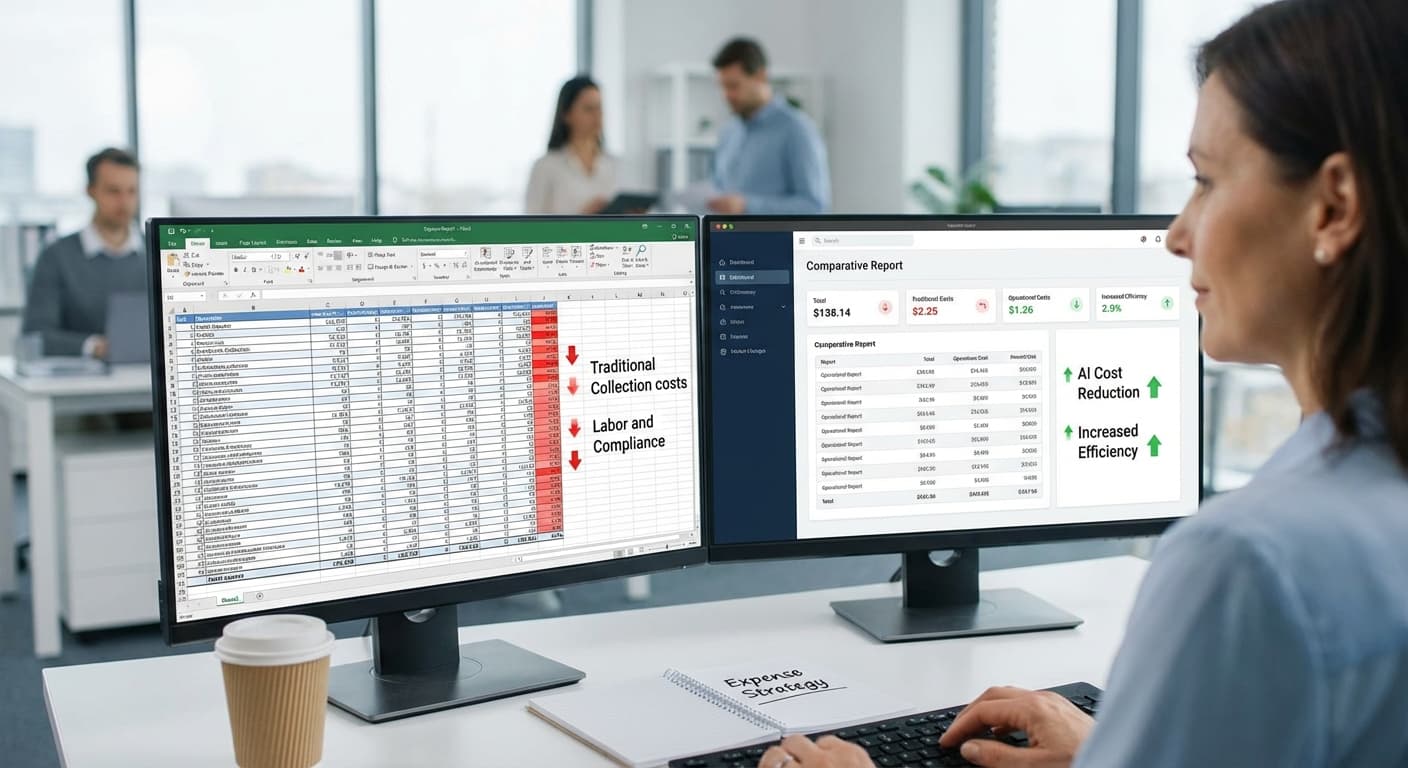
Essential expense types every debt collector tracks include labor costs, compliance monitoring, technology infrastructure, and legal fees. Debt collectors monitor these expenses through detailed expense reporting to maintain profitability amid declining recovery rates. Traditional debt collection agencies spend $8 to $15 per collection call, with labor accounting for 60% of budgets. AI Debt Collection platforms reduce these operational expenses by up to 70%, as financial institutions adopt automated systems for scalable debt recovery.
Understanding Traditional Debt Collection Automation Expenses
The average traditional debt collection automation expenses are $12.50 per outbound call, including labor, overhead, compliance, and technology.
Breaking Down Operational Costs
- Labor and training expenses consume 55% to 65% of total operational budgets
- Compliance monitoring overhead adds another 15% to 20% in costs
- Technology infrastructure costs account for 10% to 15% of expenses
- Legal and regulatory expenses typically require 5% to 10% of budgets
These percentages reveal why many agencies struggle to maintain profitability. Each new hire requires weeks of training, ongoing quality monitoring, and continuous compliance education. The investment never stops growing as regulations evolve and turnover rates remain high.
Hidden Costs of Manual Collection Processes
Quality control and error correction often go unnoticed in expense reporting but significantly impact profitability. Manual processes create inconsistencies that lead to compliance violations and costly mistakes. The Consumer Financial Protection Bureau issued over $200 million in penalties last year alone. Agent turnover rates in debt collection average 75% annually. Each departing employee costs agencies approximately $4,500 in recruitment, onboarding, and lost productivity. These hidden expenses compound quickly in larger operations.
Compliance violation penalties represent perhaps the most dangerous hidden cost. A single FDCPA compliance violation can result in fines up to $1,000 per incident. Class action lawsuits stemming from unfair debt collection practices can reach millions in settlements.
How Voice AI Agents Reduce Collection Rates and Operational Overhead
Voice AI agents reduce collection rates and operational overhead by replacing variable labor costs with fixed technology investments in AI Debt Collection.
Eliminating Variable Labor Costs
- 24/7 operation without overtime eliminates premium pay requirements entirely
- Consistent performance metrics remove the need for extensive quality monitoring
- Scalability without proportional expense increases allows unlimited growth potential
AI Debt Collection systems like CollectDebt AI maintain the same per-call cost whether handling 100 or 10,000 conversations simultaneously. This scalability breaks the traditional correlation between volume and expenses. Agencies can pursue more accounts without worrying about mounting operational costs.
Technology Investment vs. Long-term Savings
Technology investment in AI Debt Collection ranges from $15,000 to $50,000 initially, with positive ROI in 4 to 6 months through reduced expenses.
- Initial implementation costs include software licensing, integration, and basic customization
- ROI timeline shows breakeven at month 4 and 3x return by month 12
- Maintenance expenses average 80% less than traditional staffing costs
Smart agencies view this technology shift as replacing unpredictable monthly expenses with fixed costs. Expense reporting becomes clearer when labor variability disappears. Monthly operational costs drop by 68% once AI Debt Collection systems reach full deployment. The comparison becomes striking when examining ongoing expenses. Traditional agencies spend $180,000 annually per 10 collection agents. AI Debt Collection systems handling equivalent volume cost approximately $40,000 yearly including all maintenance and updates.
FDCPA Compliance: From Expense Burden to Automated Advantage
Traditional Compliance Monitoring Costs
Traditional compliance monitoring costs drain resources from productive collection activities, with agencies dedicating 20% of management time to quality assurance reviews. Training new collectors on FDCPA requirements takes 40 hours minimum. Ongoing education adds another 20 hours annually per employee. Factor in certification costs and legal consultations, and compliance becomes a major expense category.
Legal consultation fees alone average $15,000 yearly for mid-sized agencies. These costs spike dramatically when violations occur. One compliance mistake can trigger lawsuits costing hundreds of thousands in settlements and legal fees.
Automated Compliance Through AI Systems
Automated compliance through AI Debt Collection systems builds compliance into operations, with every interaction following pre-approved scripts.
- Real-time script adherence prevents agents from making prohibited statements
- Automatic documentation and recording creates complete audit trails instantly
- Built-in regulatory updates implement new rules without manual intervention
CollectDebt AI maintains 99.9% FDCPA compliance through intelligent conversation management. The system recognizes prohibited topics and automatically redirects discussions. This proactive approach prevents violations before they occur. Updates happen seamlessly when regulations change. Instead of retraining dozens of agents, the system updates instantly across all conversations. This adaptability saves thousands in ongoing training expenses while maintaining perfect compliance.
Maximizing ROI: When Debt Collection Lawsuits and Consumer Debt Trends Impact Your Bottom Line
Risk Mitigation Through Technology
Risk mitigation through technology in AI Debt Collection eliminates lawsuit triggers, with each claim averaging $50,000 in legal defense. AI Debt Collection systems eliminate common triggers for legal action. They never threaten, harass, or use inappropriate language. Every conversation maintains professional standards while following approved collection strategies. This consistency protects agencies from costly litigation.
Brand reputation suffers tremendously from negative collection experiences. Social media amplifies consumer complaints instantly. AI Debt Collection agents like those in CollectDebt AI maintain respectful, solution-focused conversations that preserve customer relationships. This approach reduces complaints by 75% compared to traditional methods.
Adapting to Credit Card Debt Market Changes
Adapting to credit card debt market changes involves scaling AI Debt Collection instantly, as credit card debt reached $1.08 trillion last quarter. Voice AI agents scale instantly to meet demand. Whether handling 100 or 10,000 accounts, the system maintains consistent performance. This flexibility allows agencies to pursue new portfolios without worrying about staffing constraints.
Collection strategies adapt automatically based on performance data. The AI Debt Collection system identifies successful approaches and implements them across all conversations. This optimization increases collection rates by 40% while reducing operational overhead. Agencies capture more revenue from existing portfolios without adding expenses. Market demands fluctuate seasonally and economically. AI Debt Collection systems adjust capacity instantly without hiring freezes or layoffs. This agility provides competitive advantages while maintaining stable expense structures throughout market cycles.
Frequently Asked Questions
Q1: How does expense reporting work with AI debt collection systems?
Expense reporting with AI Debt Collection systems uses detailed analytics dashboards that track every call, conversation outcome, and associated cost in real time. You'll see exactly how much each interaction costs compared to traditional methods, making expense reporting straightforward and transparent. Most systems export data directly to accounting software for simplified monthly reconciliation.
Q2: What are the typical prepaid expenses when implementing voice AI for debt collection?
Typical prepaid expenses when implementing voice AI for debt collection include software licensing fees, system integration costs, and basic customization, ranging from $15,000 to $50,000. These upfront costs cover the first year of service, training modules, and compliance configuration. Most agencies recover these prepaid expenses within 4 to 6 months through operational savings.
Q3: How do AI systems handle complex debt collection lawsuits scenarios?
AI Debt Collection systems handle complex debt collection lawsuits scenarios by automatically flagging accounts with active litigation and routing them to human agents or legal teams. The platform maintains complete conversation records and ensures no prohibited collection activities occur on disputed accounts. Built-in FDCPA compliance features prevent the system from violating cease and desist orders or court restrictions.
Q4: Can AI adapt to changing consumer debt trends and regulations?
AI Debt Collection adapts to changing consumer debt trends and regulations through automatic updates deployed instantly across conversations. The system learns from millions of interactions to optimize collection strategies based on current market conditions. Updates deploy instantly across all conversations without requiring manual intervention or retraining.
Q5: What's the average payback period for AI debt collection technology investments?
The average payback period for AI Debt Collection technology investments reaches positive ROI within 4 to 6 months. By month 12, typical returns reach 3x the initial investment through reduced operational expenses and increased collection rates. CollectDebt AI customers report average cost reductions of 68% in their first year.
Ready to Transform Your Collections Process?
See how CollectDebt.ai can help you automate debt collection, reduce costs, and improve compliance.